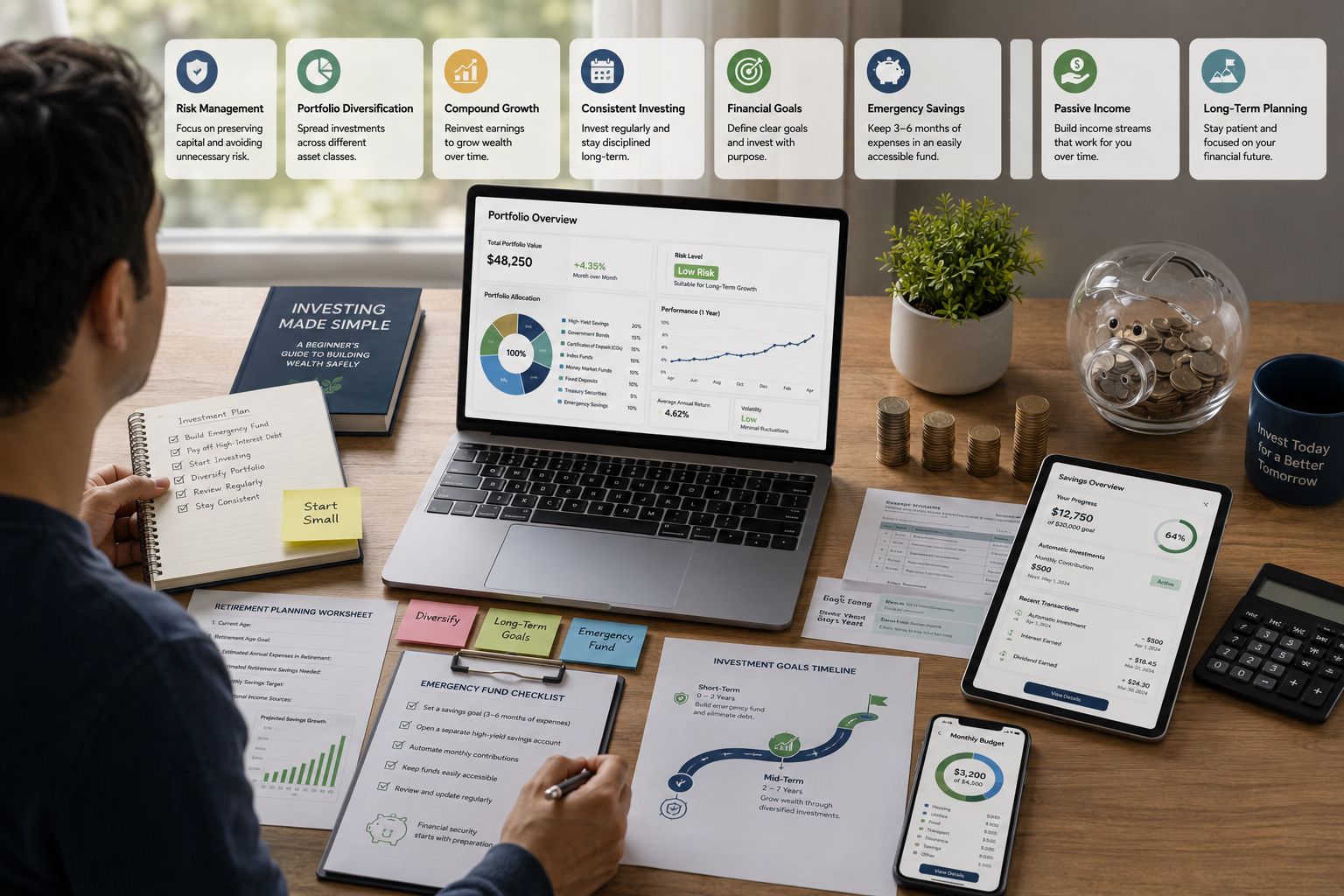
Protecting your principal matters more than chasing big gains, especially when you are starting out. This short guide explains simple strategies that help preserve capital while producing steady returns. It is written for U.S. readers who want clear, practical advice without complex jargon.
New savers often prefer safe options because volatility can be stressful and costly. By choosing conservative vehicles and diversifying across accounts, you can reduce shocks and build confidence.

This guide covers reliable approaches used by professionals. You will learn which holdings aim to protect funds, how to balance growth and safety, and why patience matters. Start with small steps and focus on steady progress.
Key Takeaways
- Prioritise preservation of principal before seeking higher yields.
- Diversify across safe vehicles to reduce volatility.
- Use simple, proven strategies rather than complex trading.
- Keep timelines realistic and avoid emotional reactions to markets.
- Build a stable plan that supports long-term financial goals.
Understanding the Basics of Risk and Return
Begin by learning the basic relationship between potential returns and possible losses. This framework helps set realistic expectations for your portfolio and financial goals.
Defining Risk Tolerance
Assessing personal risk tolerance means weighing how much volatility you can accept without selling during a market swing. Time horizon and specific goals shape that answer.
The Trade-off Between Safety and Growth
Higher-growth assets may offer larger returns but often come with more volatility. Inflation is another concern; very safe options can sometimes trail rising living costs over time.
Diversification helps manage these forces. Spreading assets across different types reduces the chance that one market shock wipes out progress.
Every investment involves a trade-off between risk and potential returns.
— Richard Carter, Fidelity Investments
- Match choices to your time horizon and goals.
- Balance safety and growth to fit your comfort level.
- Consider inflation when planning long-term return expectations.
How to Invest Money with Low Risk Effectively
The best path blends capital protection, modest returns, and easy access to cash.
Start by matching specific low-risk investments to clear financial goals and your comfort with market swings. Define if funds are for an emergency fund, near-term purchases, or long-term preservation.

Many investors build an emergency buffer using highly liquid options. That gives quick access during downturns and prevents forced sales of other holdings.
- Diversify across conservative options to limit one-event losses.
- Monitor your portfolio periodically so allocations still match goals and time horizons.
- Balance preservation and modest growth to offset inflation over time.
“Protecting principal is the clearest way to stay on track during volatile market periods.”
No investment is entirely without risk, but spreading capital across steady options reduces volatility. Focus on liquidity and consistent returns rather than chasing high-return stock moves that can derail long-term plans.
Utilizing High-Yield Savings and Money Market Accounts
High-yield savings and money market accounts offer a practical bridge between cash needs and modest growth. They keep funds accessible while earning interest that often beats standard savings accounts.

Distinguishing Between Accounts and Funds
Bank deposit accounts, such as high-yield savings and money market accounts, are typically FDIC insured up to $250,000 per depositor. That protection reduces credit risk for U.S. depositors.
Money market funds are different. They buy high-quality, short-term securities and aim to keep a stable share value, but they are not FDIC insured.
- Compare interest rates across banks so your cash earns the most competitive return in the current market.
- Money market accounts often allow limited check-writing, adding liquidity for occasional needs.
- For short-term goals, these accounts balance safety, portability, and modest returns better than many options.
“FDIC coverage and liquidity make deposit accounts a strong choice for an emergency buffer.”
The Role of Certificates of Deposit in Your Portfolio
A CD can be a dependable building block for capital preservation and steady income.
Certificates of deposit (CDs) pay a fixed interest rate for a set period, from a few months up to five years or more. If you keep funds until maturity, the return is guaranteed and predictable.

Opening a CD at an FDIC-insured bank or an NCUA-insured credit union protects your deposit up to $250,000 per depositor. That deposit security reduces credit concerns for U.S. savers.
Withdrawing before maturity usually triggers a penalty fee. That trade-off explains why many savers accept higher rates in exchange for limited access during the term.
- Locking rates: Savers often use CDs to lock in competitive interest rates when market signals point to falling yields.
- Product variety: Banks and credit unions offer staggered maturities and term options for different goals.
- Laddering: Staggering multiple CDs creates periodic income and preserves some liquidity as accounts mature at different times.
“CDs provide stability and predictable returns, ideal for conservative portions of a portfolio.”
Government-Backed Securities and Treasury Options
U.S. government debt offers a range of reliable securities that suit conservative savers.
Treasury bills and notes cover short and intermediate periods. Bills mature in one year or less. Notes run up to 10 years. Both pay interest and return principal at maturity, backed by the full faith and credit of the U.S. government.
Treasury Inflation-Protected Securities (TIPS)
TIPS adjust principal based on the Consumer Price Index. That feature helps protect purchasing value during periods of rising inflation. Investors often choose TIPS when inflation is a major concern.
Series I Savings Bonds
Series I bonds combine a fixed rate and an inflation-adjusted component. They are purchased directly from the government and offer tax advantages for many savers.
- Safety: Backed by the U.S. government, these securities rank among the safest options.
- Tax benefit: Often exempt from state and local taxes, which can boost net returns.
- Access: Buy via TreasuryDirect or a broking account for straightforward account management.
“Government-backed securities provide a predictable foundation for conservative portfolios.”
Exploring Bond Funds and Stable Value Alternatives
Combining bond funds and stable value products gives savers a balance of liquidity and protection.
Bond funds and ETFs pool investors’ capital into diversified portfolios of corporate and government bonds. That reduces single-issuer credit risk while providing regular interest income.
Stable value funds are common inside employer plans like 401(k) and 403(b)s. They aim for steady returns and preservation of principal by using insurance contracts that support book value.
Remember that bond funds are not FDIC insured. They do, however, offer greater liquidity than owning individual bonds because shares trade on the market.
Short-term bond funds often appeal when interest rates are volatile. They tend to swing less than long-term bond funds and can produce modest yields above cash accounts.
- Dividend-paying blue-chip companies may add income and stability for long-term accounts.
- All bond-based options still face market and interest-rate fluctuations that can affect value.
“Diversification across high-quality bonds and stable value vehicles can reduce volatility while supporting retirement and savings goals.”
Strategic Considerations for Long-Term Wealth Preservation
A laddered schedule of maturities helps preserve capital while keeping cash available at regular intervals.
Implementing Laddering Strategies
Divide available funds across several terms—short, medium, and long. That creates steady access when each instrument matures.
Use a mix of CDs, Treasury bonds, and high-yield savings or money market funds. Staggering maturity dates lets you reinvest at current rates if yields rise.
- Benefit: Manages interest-rate risk while keeping liquidity.
- Balance: Combines government-backed securities and insured deposits for safety.
- Flexibility: Reinvest maturing amounts into higher rates or keep them in savings accounts for short-term needs.
“A disciplined ladder is a practical way to protect principal and capture better returns over time.”
Review allocations regularly as retirement nears or goals change. Many investors work with a professional advisor to align account choices, funds, and bond holdings with long-term preservation and steady income.
Conclusion: Building Your Safe Investment Strategy
Focusing on predictable accounts and quality bonds helps steady a portfolio through turbulent markets.
Align choices with clear goals and a realistic timeline. Combine savings accounts, money market funds, and short-term bond funds for liquidity and steady returns. Keep an eye on rates and credit quality when you pick a deposit or fund.
Diversify across government securities, high-grade corporate bonds, and insured accounts. That mix can soften market swings and support regular income near retirement. Review allocations periodically and consult a professional so your plan matches changing goals and time horizons.
FAQ
What are common options for preserving capital while earning returns?
High-yield savings accounts, money market accounts, certificates of deposit (CDs), U.S. Treasury securities, Series I bonds, and short-term municipal or corporate bonds are typical choices. These vehicles prioritise principal protection and predictable interest over large gains, making them suitable for emergency funds and near-term goals.
How do interest rates affect safe holdings?
Interest-rate moves change yields and market values. When rates rise, existing bond prices generally fall; when rates fall, prices tend to rise. Cash accounts and new CDs typically track current rates more directly, while longer-term bonds show greater price volatility. Matching term length to your timeline reduces sensitivity to rate swings.
What is laddering, and why use it?
Laddering staggers maturities across multiple CDs or bonds so portions mature at regular intervals. This approach gives steady liquidity, reduces reinvestment risk, and captures changing yields over time. It’s a practical tactic for retirement income or planned expenses.
Are U.S. Treasury securities truly safe?
U.S. Treasury securities are backed by the full faith and credit of the federal government, making them among the safest credit exposures available. T-bills, T-notes, and T-bonds differ by term length; short-dated bills carry very low volatility and are highly liquid.
What are Series I savings bonds, and who should buy them?
Series I bonds are government savings products that combine a fixed rate with an inflation-adjusted component, protecting purchasing power. They are suitable for conservative savers aiming to guard against inflation; they have purchase limits and early-withdrawal rules to consider.
How do Treasury Inflation-Protected Securities (TIPS) work?
TIPS adjust principal based on the Consumer Price Index. When inflation rises, the principal value increases, boosting interest payments; during deflation, principal can decline, but at maturity you receive at least the original principal. TIPS suit investors focused on real returns over inflation.
What’s the difference between money market funds and money market deposit accounts?
Money market funds are mutual funds that invest in short-term securities and are not FDIC-insured, though they aim for stable net asset value. Money market deposit accounts are bank products insured by the FDIC up to applicable limits, offering safety and modest yields with check-writing or debit features.
When are bond funds preferable to individual bonds?
Bond funds offer diversification, professional management, and easier trading. They suit investors who prefer hands-off exposure and liquidity. Individual bonds provide known maturity and return of principal if held to maturity; they appeal to those who need predictable cash flows and capital preservation.
How does inflation impact safe portfolios, and how can I protect against it?
Inflation erodes purchasing power, reducing real returns on cash and fixed-rate holdings. Protection options include TIPS, Series I bonds, short-term Treasury exposure, and allocating a portion to dividend-paying high-quality stocks or bond funds that can adjust to rising rates.
What role do banks and credit quality play in conservative choices?
Bank safety depends on FDIC insurance limits and the institution’s credit strength. For bond investments, credit quality (ratings from agencies like Moody’s or S&P) indicates issuer default risk. Favour high-grade, investment-grade issuers and insured deposit products to minimise credit exposure.
How much liquidity should a conservative portfolio keep?
Maintain an emergency reserve covering three to six months of expenses in highly liquid accounts such as high-yield savings or money market deposit accounts. For longer horizons, laddered short-term instruments provide regular access without sacrificing too much yield.
Can municipal bonds be a low-risk source of tax-efficient income?
High-quality municipal bonds issued by stable states or municipalities can offer tax-exempt interest and relatively low default risk. They suit investors in higher tax brackets seeking income, but research issuer credit and call provisions before investing.
Are stable value funds a good option for retirement plans?
Stable value funds, often found in 401(k) plans, invest in high-quality, short- to intermediate-term fixed-income contracts that aim to preserve principal and deliver steady returns. They provide low volatility and are appropriate for conservative retirement allocations, but check fees and employer plan specifics.
How should I choose a time horizon for conservative choices?
Match the investment term to your goal: use cash equivalents and short-term securities for goals within a few years, intermediate-term bonds for medium horizons, and diversify into higher-yielding, slightly longer instruments when you can tolerate modest volatility for greater returns.
What impact do fees and taxes have on conservative returns?
Fees and taxes can meaningfully reduce net yield on safe products with already modest returns. Choose low-cost funds and tax-advantaged accounts where possible, review expense ratios, and consider municipal or tax-deferred options to improve after-tax outcomes.