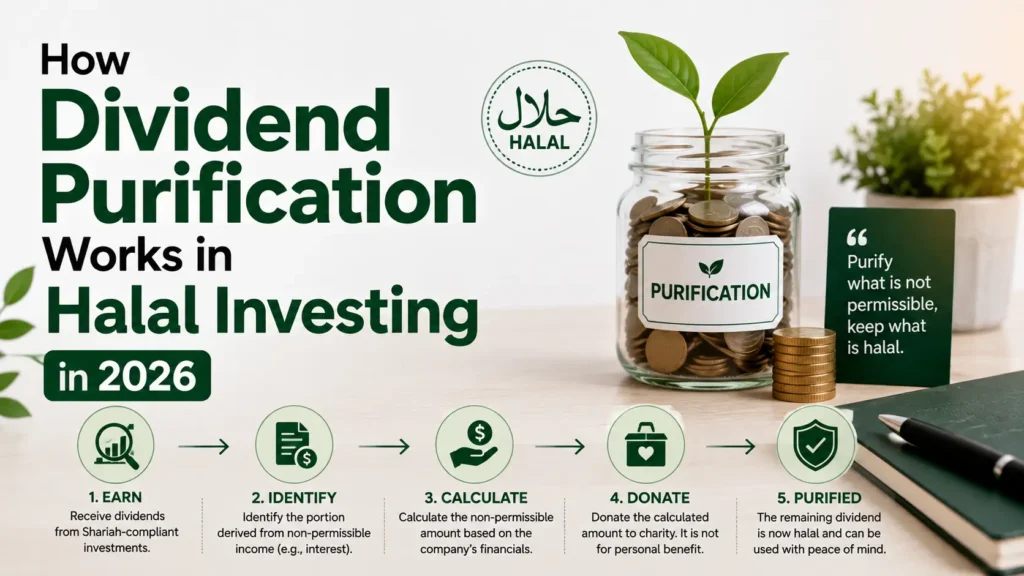
The simple idea behind dividend purification
Dividend purification is the process of removing the small portion of income from a Shariah-screened investment that may have come from non-permissible sources.
The investor does not treat that portion as a personal return. Instead, the amount is given away for a charitable or public-benefit purpose under the guidance of a qualified Shariah adviser. The exact treatment can differ. That detail matters.
Purification is not a way to make every investment halal. It is not a substitute for screening. It does not repair a company whose main business is prohibited or whose financial structure fails the relevant Shariah rules.
That is the first point I would keep in front of any reader: screening decides whether an investment can be considered for a particular Shariah methodology; purification deals with a limited amount of mixed income after that screen.
The idea can sound technical. The practical workflow is easier:
- Identify a stock, fund, or portfolio that has been screened under a stated Shariah method.
- Find the purification guidance or ratio for the relevant period.
- Apply that ratio to the dividend amount actually received, if that is what the method instructs.
- Give the calculated amount away through an acceptable channel.
- Keep a record of the calculation and donation.
My view is that the best purification process is the one a normal person can understand, repeat, and document. A mysterious number on an app is not enough. A responsible investor should know where the number came from and what it is meant to cover.
Read the guide to how halal stock screening works.
Why purification is not the same as screening
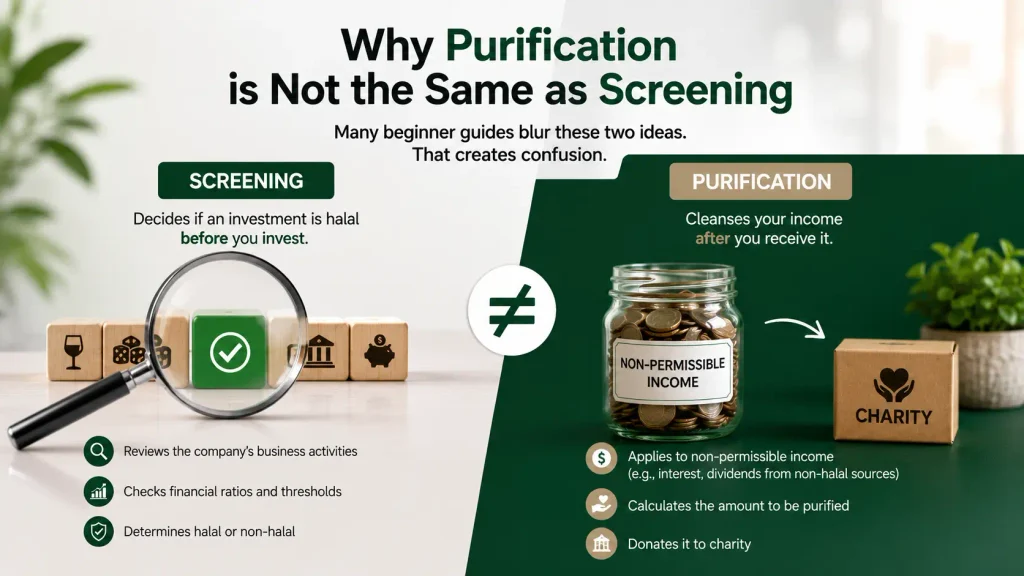
Many beginner guides blur these two ideas. That creates confusion.
Shariah screening usually examines two broad areas. The first is the company’s business activity. The second is its financial structure. Different index providers and Shariah boards may use different categories, data sources, thresholds, and review schedules.
For example, the current MSCI Islamic Index methodology describes business-activity screening and financial-ratio screening as separate parts of its process. It also includes a dividend-purification section in the same methodology. 1. This is an index rulebook. It is not automatically a personal religious ruling for every investor.
A company might pass a particular screen while still having a small amount of income connected to interest or another non-permissible source. Under the methodology used, that mixed income may create a purification amount.
A company that fails the main business screen is a different case. If its primary activity is conventional banking, gambling, alcohol production, or another prohibited activity under the method being followed, donating a small part of the dividend does not solve the main problem.
Think of it this way:
| Question | What it examines |
|---|---|
| Does the investment pass the screen? | Business activity and financial ratios under a stated methodology |
| Is purification required? | The method’s treatment of mixed or non-permissible income |
| How much is purified? | The provider’s or adviser’s calculation for the relevant period |
| Where does the money go? | A charity or public-benefit channel accepted by the adviser or method |
AAOIFI lists Shariah Standard No. 21, “Financial Paper (Shares and Bonds)”, as an official standard covering this area. 2 The existence of the standard does not mean every public website explains all of its details. Readers should avoid treating a short blog post as a replacement for the standard or a scholar’s advice.
What income can create a purification amount?
The answer depends on the method. That is why a single universal percentage should make you cautious.
In general, purification discussions focus on income that a company received from a source that the relevant Shariah methodology treats as non-permissible. The most familiar example is interest income earned on cash or financial instruments. Some methods may also consider income linked to prohibited business activities when the company remains within an allowed screening tolerance.
The calculation may use company-wide income data. It may then convert that data into an amount per share. A fund may publish a purification ratio for each distribution. An index provider may describe a methodology that calculates the proportion of non-permissible income and applies it to dividends.
These details can change from one provider to another. They can also change from one period to the next because the underlying financial statements and dividend amounts change.
Do not assume that the following items are always treated in the same way:
- Interest income.
- Interest earned on cash balances.
- Income from a minor non-permissible business line.
- Income from a company subsidiary.
- Capital gains from selling a share.
- Fund distributions that include income from several holdings.
- Dividends received in different currencies.
Some advisers distinguish between dividend income and capital gains. Some provide separate instructions for funds. Some publish a ratio that already reflects the method’s chosen treatment. Others expect the investor to do more work.
This is where careful reading beats confidence. If the fund gives you a purification ratio, read the explanation beside it. Check the period. Check whether the ratio applies to the gross distribution, the net distribution, or another base. If the document is unclear, ask the fund or a qualified adviser.
A worked example with simple numbers
Here is a simplified example. It is for learning, not for calculating your own donation.
Suppose you own 200 shares. The company declares a dividend of $0.50 per share. Your gross dividend is:
200 shares × $0.50 = $100
Now suppose the relevant Shariah methodology publishes a purification ratio of 1.5% for that dividend period. The simplified purification amount would be:
$100 × 1.5% = $1.50
The remaining $98.50 is the amount left after setting aside $1.50 for purification, before considering taxes, fees, currency conversion, or other account adjustments.
The example is intentionally simple. Real situations can be harder. A fund may distribute income from many companies. A broker may show a net amount after withholding tax. A dividend may be paid in one currency while your donation is made in another. The published ratio may be stated per share rather than as a percentage.
Before using a calculation, confirm these points:
- Is the ratio for the exact fund, stock, and distribution date?
- Does it apply to gross dividend income or the amount that reached your account?
- Is the calculation based on shares held on the record date?
- Does the method give instructions for partial shares?
- How should currency conversion be handled?
- Does the method address withholding tax or brokerage fees?
- Is the published figure approved or reviewed by a named Shariah adviser?
A calculator can multiply two numbers. It cannot decide which two numbers belong in the calculation.
Use the dividend income tracking worksheet.
How to find the right purification ratio
Start with the investment provider. Look for a page titled “purification”, “charity”, “non-permissible income”, “Shariah methodology”, or “distribution details”. The information may be in a fund report rather than on the main product page.
If you own an individual stock, check the Shariah screening service or adviser whose methodology you follow. Do not mix a purification ratio from one provider with a screening decision from another without understanding the difference.
For an exchange-traded fund, check the fund issuer first. The issuer may publish purification guidance for distributions. It may also state that the fund’s Shariah board or adviser calculates the amount.
For a managed portfolio, ask the manager whether purification is handled for you. Get the answer in writing if possible. “The portfolio is halal” is not a complete explanation. You want to know:
- Who performs the screening?
- Which standard or methodology is used?
- How often are holdings reviewed?
- Who calculates purification?
- Is the amount deducted automatically or left to the investor?
- What records are provided?
A public methodology can help you understand the process. For example, MSCI’s methodology explains that its Islamic indexes use specific business and financial screens and have their own maintenance rules. 1 It also makes clear that the methodology is tied to its indexes. That is useful evidence about one provider’s system. It is not proof that every provider uses the same thresholds.
AAOIFI’s official page identifies Standard No. 21 but does not turn the landing page into a complete personal calculation tool. 2 That is a small but important distinction between an authoritative source and a simplified online summary.
Where should the purified amount go?
The destination is a matter for the Shariah method or scholar you follow. Many purification guides describe giving the amount to charity or a public-benefit cause. The investor should not treat it as ordinary sadaqah for personal spiritual reward if the adviser’s guidance says the purpose is to remove non-permissible income.
Do not assume that every charity is suitable. Some methods may exclude certain uses. Some investors may need to avoid donating to a cause that creates a direct personal benefit. Local rules may also affect how donations are documented or treated for tax purposes.
A sensible process is to choose a transparent organization, keep the receipt, and follow the instructions from the relevant Shariah adviser. If you are unsure, ask before donating rather than trying to fix the record later.
This article does not recommend a specific charity. A recommendation would require checking the charity’s jurisdiction, governance, eligibility, and the reader’s own circumstances.
The mistake I would not hide
I cannot honestly claim a personal investing failure because you did not provide one, and I will not invent a story for the sake of sounding experienced. The failure worth keeping in this article is a common one: using a purification percentage without checking what it applies to.
A reader may see “1% purification” and multiply it by the amount sitting in a brokerage account. That can be wrong. The figure may apply only to a dividend distribution. It may use the gross amount. It may be calculated per share. It may belong to a previous reporting period.
The lesson is simple:
Do not ask only, “What is the percentage?” Ask, “What is the base, period, provider, and instruction behind the percentage?”
My opinion is that a transparent small error is easier to correct than a confident, unexplained number. Keep the source document. Write down the shares, dividend, ratio, currency, and date. If the method changes, start a new line instead of silently editing the old one.
If you have a genuine first-hand failure, this is the place to add it. Keep it specific. Explain what you misunderstood, what you checked afterwards, and what you do differently now. Do not add a dramatic story that cannot be verified.
A practical purification workflow
A repeatable workflow reduces mistakes. It does not remove the need for judgement.
Step 1: Record the holding
Write down the fund or stock name, ticker, number of shares, currency, and the date on which you were entitled to the distribution. Save the official dividend notice.
Step 2: Identify the method
Record the screening provider, Shariah board, fund issuer, or adviser. Note the publication date of the relevant purification guidance.
Step 3: Identify the calculation base
Check whether the method uses gross dividend income, net dividend income, a per-share amount, or another base. Do not infer this from a chart or a social-media post.
Step 4: Calculate and review
Do the arithmetic. Then review it. If the amount is unusual, ask why. A second review can catch a misplaced decimal or an old ratio.
Step 5: Donate through an accepted channel
Follow the relevant guidance. Keep a receipt or other record. If the adviser gives a specific instruction, that instruction should control.
Step 6: Store the evidence
Keep the dividend statement, ratio source, calculation, donation record, and any written explanation from the adviser. A simple folder is enough.
This workflow is also useful when you use a portfolio app. Automation can save time, but it can hide assumptions. The investor remains responsible for understanding the method being used.
See the investing record-keeping checklist.
Common mistakes to avoid
The same problems appear repeatedly in beginner discussions.
- Treating purification as permission. It is not a repair mechanism for an investment that fails the main screen.
- Using an old ratio. A figure from last year may not apply to this year’s dividend.
- Mixing providers. A ratio from one fund or index method may not apply to another.
- Calculating from the account balance. Purification normally relates to specified income, not the value of the whole portfolio.
- Ignoring partial shares. Fractional holdings can change the result.
- Forgetting funds. A fund distribution may not behave like a single-company dividend.
- Confusing tax with purification. Withholding tax and purification serve different purposes. Ask a tax professional about tax treatment.
- Failing to keep records. Without the source and calculation, you cannot explain how you reached the amount.
There is another mistake that receives less attention: making the process sound more certain than it is. Islamic finance includes different scholarly opinions and standards. A careful article should state which source it is using and where its limits are.
Questions to ask a halal investment provider
Before opening an account or buying a fund, ask direct questions. The answers will tell you more than a “halal” label by itself.
Ask:
- Which Shariah standard or screening method do you use?
- Is the screen reviewed by a Shariah board or adviser?
- How often are holdings screened?
- What happens when a holding fails after purchase?
- Do you publish purification ratios for each distribution?
- Is purification handled automatically?
- If it is automatic, can I see the calculation and donation record?
- How do you treat funds, fractional shares, and foreign currencies?
- Where can I read the methodology and current disclosures?
A provider that cannot explain its process clearly may still have a product worth investigating, but the burden on you is higher. Clarity is not proof of compliance. It is simply a basic sign that the process can be examined.
Review the questions to ask before choosing a halal fund.
FAQs about dividend purification
Is dividend purification the same as zakat?
No. They are different concepts. Purification concerns the treatment of income identified as non-permissible under a relevant method. Zakat is a separate religious obligation with its own rules, conditions, and calculations. Ask a qualified scholar about how each applies to your situation.
Does every halal stock require purification?
Not necessarily. The answer depends on the screening method and the company’s income profile. Some providers may publish a zero amount for a period. Others may calculate a small amount. Follow the guidance attached to the investment rather than assuming one rule applies everywhere.
Can I purify a conventional stock and keep it?
Purification is not a general way to make a non-compliant investment acceptable. If the investment fails the relevant business or financial screen, a small donation does not automatically change that conclusion.
Should I calculate purification on capital gains?
Do not assume so. Some methods focus on dividend income. Some scholars or providers may give separate guidance. Check the exact method you follow before including capital gains.
What if I received a net dividend after tax?
The correct base depends on the method. Taxes, fees, and purification are not interchangeable. Keep the original dividend statement and ask a qualified adviser or tax professional how the published instruction applies.
What if no ratio is published?
Contact the fund issuer, screening provider, or Shariah adviser. Do not invent a ratio from a similar-looking fund. If no reliable information is available, that uncertainty should affect your decision to proceed.
Can software calculate the amount for me?
Software can handle multiplication and record-keeping. It cannot judge whether the data source, period, base, or methodology is correct. Treat automated output as a draft calculation until you understand its inputs.
Is this article a fatwa or an investment recommendation?
No. It explains a common process and points to public methodologies. It does not decide whether a particular investment is permissible for you, and it does not recommend a security, fund, broker, or charity.
Final thoughts
Dividend purification becomes less intimidating when you separate the ideas.
First, screening asks whether the investment fits a stated Shariah method. Second, purification deals with a limited amount of income identified by that method. Third, the investor follows the donation and record-keeping instructions attached to the method.
The hard part is not the multiplication. It is using the right source, the right period, and the right calculation base.
My view is that responsible halal investing should feel deliberate, not secretive. Read the methodology. Ask plain questions. Keep the documents. Admit uncertainty when the public information is incomplete. That habit protects both your money and your integrity.
This article makes no medical or health claims, so medical sources are not cited. Adding medical references to a finance and religious-finance explainer would be irrelevant and could mislead readers. For investment decisions, verify the current methodology with the relevant Shariah adviser and seek licensed financial or tax advice where appropriate.
References
[1] MSCI Islamic Index Series Methodology, current methodology page
[2] AAOIFI, Shariah Standard No. 21: Financial Paper (Shares and Bonds)