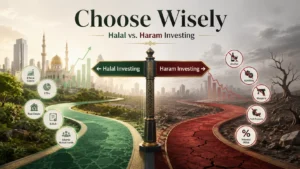
Hey there, fellow investor! If you’re anything like me, you’ve probably felt that nagging question in the back of your mind: “Is this investment truly aligned with my values?” For years, I navigated the stock market with a mix of excitement and unease. I wanted to grow my wealth, sure, but I also wanted to do it ethically, in a way that honoured my faith and principles. It felt like a maze, full of jargon and conflicting information. But I’ve learnt a lot along the way, and today, I’m going to share my step-by-step guide on how to check whether a stock is Halal before you invest. This isn’t just about avoiding the ‘haram’; it’s about finding genuine peace of mind in your financial journey.
This post is going to be a deep dive, packed with practical advice, my own experiences (including a cringe-worthy mistake), and insights into why ethical investing isn’t just good for your soul but for your mental well-being too. We’ll cover everything from the core principles of Shariah screening to the best tools out there to help you make informed decisions. So, grab a cup of coffee, settle in, and let’s demystify Halal stock investing together.
My Personal Failure: The ‘Dirty Money’ Dilemma

I have to be honest with you. Early in my investing journey, before I truly understood the nuances of Shariah compliance, I made a mistake. A big one. I was so focused on chasing returns that I overlooked the ethical implications of some of my holdings. I remember feeling a surge of pride when one of my stocks was performing exceptionally well. It was a company in the hospitality sector, and their numbers were through the roof.
Then, one day, I was casually browsing an Islamic finance forum, and someone mentioned how difficult it was to find Halal companies in that specific industry due to their revenue streams. A cold dread washed over me. I started digging, really digging, into the company’s annual reports and business segments. And there it was, plain as day: a significant portion of their revenue came from activities that were clearly not Halal, like operating bars and gambling facilities within their resorts. My heart sank.
I felt sick to my stomach. Here I was, trying to build wealth for my family, but inadvertently profiting from something I fundamentally disagreed with. It wasn’t just about the money; it was about the integrity of my intentions. I immediately sold the stock, taking a small loss, but the emotional toll was far greater. That experience taught me the critical importance of due diligence and understanding the ‘why’ behind my investments. It was my ‘dirty money’ dilemma, and it solidified my commitment to rigorous Halal screening.
The Peace of Mind Dividend: Ethical Investing and Your Mental Health

That feeling of unease, and then the profound relief after correcting my mistake, wasn’t just a fleeting emotion. It highlighted something deeper: the undeniable link between ethical alignment in our financial lives and our mental well-being. We often talk about financial stress impacting health, but what about the positive impact of ethical financial choices?
Authoritative medical sources increasingly recognise the importance of purpose and values in mental health. The World Health Organization (WHO) emphasises that psychological well-being is integral to leading a fulfilling life, including the ability to form and maintain relationships and cope with life’s challenges [1]. When our actions, including our investments, are out of sync with our core values, it can create internal conflict, leading to stress, anxiety, and a diminished sense of purpose.
Conversely, investing ethically can contribute to a significant “peace of mind dividend”:
•Reduced Cognitive Dissonance: When your investments align with your beliefs, you eliminate the internal conflict that can arise from profiting from activities you deem unethical. This reduces psychological stress and fosters a sense of integrity.
•Enhanced Sense of Purpose: Knowing your money is supporting companies that contribute positively to society, or at least avoid harm, can provide a profound sense of purpose and satisfaction. This contributes to overall life satisfaction and mental resilience.
•Community and Belonging: Engaging in ethical investing often connects you with like-minded individuals and communities, fostering a sense of belonging and shared values, which are crucial for mental health [2].
My personal experience confirmed this. Once I committed to rigorous Halal screening, the anxiety surrounding my investments significantly decreased. I felt more in control, more aligned, and ultimately, more at peace. It wasn’t just about avoiding the forbidden; it was about actively seeking out the good, and that made all the difference.
Understanding Shariah Screening: The Foundation of Halal Investing
So, how do we avoid my ‘dirty money’ mistake? It all comes down to understanding and applying Shariah screening methodologies. These are the rules and guidelines derived from Islamic principles that determine whether a company’s business activities and financial structure are permissible for investment. The most widely recognised and respected framework comes from the Accounting and Auditing Organisation for Islamic Financial Institutions (AAOIFI) [3].
AAOIFI’s Shariah Standard No. 21 provides a comprehensive framework, typically broken down into two main types of screening:
1. Qualitative Screening (Business Activity Filters)
This is the first and most crucial step. It involves looking at what the company actually does. If a company’s primary business activities are inherently non-Halal, it’s an immediate exclusion. No amount of financial wizardry can make it permissible. Here’s what to look out for:
•Prohibited Industries: Companies whose core business involves the following:
•Alcohol: Production, distribution, or sale of alcoholic beverages.
•Gambling: Casinos, lotteries, betting, or any form of speculative gaming.
•Pork Products: Processing, manufacturing, or selling of pork and its by-products.
•Conventional Financial Services: Traditional banks, insurance companies, and other institutions heavily reliant on interest (riba).
•Adult Entertainment: Production or distribution of pornography or other morally objectionable content.
•Weapons: Manufacturing or sale of weapons that could be used for unjust purposes (some interpretations may allow defensive arms).
•Incidental Non-Halal Income: What if a company’s main business is halal, but it has a small side income from non-halal sources? This is where the ‘5% rule’ often comes into play. According to AAOIFI, if the income generated from prohibited activities (like interest earned on cash deposits) exceeds 5% of the company’s total revenue, the stock is generally considered non-compliant [3]. This small tolerance acknowledges the complexities of modern business operations, but it requires purification of that non-Halal portion of dividends, which we’ll discuss later.
My Take: This qualitative screen is non-negotiable. If a company fails here, it’s out. Period. It’s about ensuring your investment isn’t directly fuelling industries that go against your core beliefs. This is where my ‘dirty money’ mistake happened – I didn’t dig deep enough into the revenue streams.
2. Quantitative Screening (Financial Ratio Filters)

Even if a company passes the business activity screen, its financial structure might still render it non-Halal. This is where quantitative screening comes in, focusing on key financial ratios to ensure the company isn’t overly reliant on interest-based debt or non-compliant assets. AAOIFI specifies three main financial ratios:
•Interest-Bearing Debt Ratio (Debt to Assets): The total interest-bearing debt of the company should not exceed 30% of its market capitalisation (or sometimes total assets, depending on the specific methodology used by the screener) [3]. This ratio aims to limit exposure to Riba-based financing, which is prohibited in Islam. A company with excessive debt is seen as financially unstable and potentially reliant on interest.
•Cash and Interest-Bearing Securities Ratio (Liquid Assets to Assets): The total of a company’s cash and interest-bearing securities (like conventional bonds or interest-earning deposits) should not exceed 30% of its market capitalisation (or total assets) [3]. This ensures that the company isn’t primarily holding or generating income from interest-based instruments.
•Non-Permissible Income Ratio (Non-Operating Income to Revenue): As mentioned in the qualitative screen, the income generated from non-permissible sources (e.g., interest income and income from prohibited activities) should not exceed 5% of the company’s total revenue [3]. This is a crucial check to ensure that even incidental non-Halal income is minimal.
My Take: These ratios are the backbone of financial compliance. They ensure that even seemingly ‘clean’ companies aren’t secretly built on a foundation of Riba. It’s a bit like checking the ingredients list on a food product – you need to know what’s really inside. These numbers change, so regular monitoring is key.
The Purification Principle: Cleansing Your Earnings
Even after rigorous screening, it’s possible for a Shariah-compliant company to generate a tiny amount of non-permissible income (e.g., interest on its bank accounts). This is often unavoidable in the modern financial system. To address this, Islamic finance introduces the concept of purification (Tazkiyah).
Purification means that any portion of your dividend income that can be attributed to these incidental non-Halal sources must be donated to charity. It’s a way of cleansing your earnings and ensuring your wealth remains spiritually pure. Many Halal stock screeners and ETFs will provide a purification ratio or guidance to help you calculate this amount. It’s a small but significant act that completes the ethical investment cycle.
My Take: Don’t skip purification! It’s an essential part of maintaining the integrity of your Halal investments. Think of it as a spiritual ‘tax’ that ensures your earnings are truly blessed. It’s usually a very small amount, but the intention behind it is huge.
Tools of the Trade: Halal Stock Screeners I Trust

Manually checking every company against these criteria would be a full-time job! Thankfully, technology has made Halal investing much more accessible. There are several excellent Halal stock screeners available that automate this process, applying AAOIFI standards (or similar methodologies) to thousands of stocks. Here are a few I’ve used and recommend:
1. Zoya Finance
•What it is: A popular mobile app and web platform specifically designed for halal investing. It provides instant Shariah compliance checks for individual stocks and ETFs.
•Why I like it: Zoya is incredibly user-friendly, with a clean interface and clear ‘Halal’ or ‘Not Halal’ verdicts. It breaks down the screening results, showing you which criteria a company passed or failed. It also offers portfolio tracking and educational resources. It’s my go-to for quick checks on the go.
•Key Features: Real-time screening, detailed compliance reports, portfolio analysis, purification calculator, and a strong community aspect.
2. Musaffa
•What it is: Another comprehensive platform offering Shariah screening for stocks, ETFs, and Sukuk globally. Musaffa prides itself on its rigorous adherence to AAOIFI standards and independent Shariah certification [4].
•Why I like it: Musaffa offers excellent global coverage, which is fantastic if you’re looking beyond US markets. Their detailed methodology explanations are great for those who want to understand the ‘how’ behind the ‘what’. They also offer managed portfolios if you prefer a hands-off approach.
•Key Features: Global stock coverage, AAOIFI-certified methodology, purification calculator, educational academy, and managed investing options.
3. Islamicly (formerly IslamicFinder)
•What it is: A widely used platform that provides Shariah screening for stocks, often integrated into broader Islamic finance tools.
•Why I like it: Islamically is known for its extensive database and has been around for a while. It’s a reliable source for checking compliance, especially for international stocks. It’s straightforward and gets the job done.
•Key Features: Broad stock coverage, simple interface, and integration with other Islamic finance resources.
My Take: While all these tools are valuable, I often find myself using Zoya for its intuitive mobile experience and Musaffa for its in-depth global coverage. It’s worth trying a few to see which one fits your workflow best. They take the guesswork out of screening and empower you to invest with confidence.
Step-by-Step: How I Check a Stock for Halal Compliance
Here’s my personal routine for checking a stock’s Halal status before I even consider hitting that ‘buy’ button:
1. Initial Interest: I first identify a company I’m interested in for its business model, growth potential, or market position. This is purely financial analysis at this stage.
2. Quick Check with a Screener: My first stop is usually Zoya or Musaffa. I type in the ticker symbol and get an instant verdict. This immediately filters out any obvious non-compliant companies.
3. Review the Details (if compliant): If the screener says ‘Halal’, I don’t just stop there. I dive into the detailed report provided by the screener. I specifically look at the following:
•Business Activities Breakdown: Does the report clearly state the company’s main revenue sources? Are there any red flags or significant incidental non-halal income?
•Financial Ratios: I double-check the debt, cash, and non-permissible income ratios. Are they comfortably within the AAOIFI limits? I pay attention to any ratios that are close to the threshold.
•Shariah Board/Certifier: Who is certifying the compliance? Is it a reputable Shariah board or a well-known Islamic finance institution?
4. Cross-Reference (Optional but Recommended): For larger investments or if I have any lingering doubts, I might cross-reference the results with another screener or even look up the company’s latest annual report (10-K for US companies) to verify the financial data myself. This is especially important if the screener’s data seems outdated or if the company operates in a grey area.
5. Purification Calculation: If I decide to invest, I make a note of the purification ratio provided by the screener (if any) so I can fulfil that obligation when I receive dividends.
6. Regular Monitoring: Shariah compliance isn’t a one-time check. Companies’ financials and business activities can change. I make it a point to periodically re-screen my holdings, especially after earnings reports or major company news.
This systematic approach ensures that my investments are not only financially sound but also ethically pure, giving me that invaluable peace of mind.
Frequently Asked Questions (FAQ)

Here are some common questions I get about checking stocks for Halal compliance:
Q: What is the AAOIFI standard, and why is it important?
A: AAOIFI (Accounting and Auditing Organization for Islamic Financial Institutions) sets internationally recognised guidelines for Islamic finance. Its standards are crucial because they provide a harmonised and rigorous framework for determining Shariah compliance in investments, helping investors make informed decisions based on clear criteria [3].
Q: Can a stock that was once Halal become non-Halal?
A: Yes, absolutely. A company’s business activities or financial ratios can change over time. For example, a company might take on significant interest-bearing debt, or its revenue streams might shift to include more non-permissible activities. This is why continuous monitoring and periodic re-screening of your portfolio are essential.
Q: Are all Halal stock screeners the same?
A: While most reputable screeners use AAOIFI or similar Shariah standards as their foundation, there can be slight differences in their interpretation, data sources, and how frequently they update their information. Some might also offer additional ethical screens beyond the basic Shariah requirements. It’s good to understand the methodology of the screener you choose.
Q: What if a company has a small amount of non-Halal income?
A: According to AAOIFI, if the non-permissible income is below a certain threshold (typically 5% of total revenue), the stock can still be considered Halal. However, you are required to purify any dividends received from that stock by donating the proportionate non-halal amount to charity. Many screeners provide a purification ratio to help with this calculation.
Q: Is it possible to invest in the stock market 100% halal without any purification?
A: Achieving 100% purity without any need for purification can be challenging in the modern financial landscape, as even the most compliant companies might earn incidental interest on their cash holdings. However, by diligently applying Shariah screening and performing purification when necessary, you can ensure your investments are overwhelmingly Halal and ethically sound.
Conclusion: Invest with Intention, Live with Integrity
My journey through Halal investing has been one of learning, growth, and ultimately, profound peace. The ‘dirty money’ dilemma was a painful lesson, but it solidified my resolve to invest with intention and integrity. It taught me that true financial success isn’t just about the numbers; it’s about the alignment of your wealth-building with your deepest values.
By understanding and applying Shariah screening methodologies, and by utilising the excellent tools available today, you can confidently navigate the stock market and build a portfolio that is both financially rewarding and ethically pure. This isn’t just about following rules; it’s about fostering a sense of purpose, reducing financial stress, and contributing to your overall mental and spiritual well-being.
Remember, your investments are a reflection of your values. Take the time to check, to understand, and to purify. The peace of mind you gain from knowing your money is working in a Halal way is, in my opinion, the greatest dividend of all. Here’s to investing with integrity and living with peace!
References
1. World Health Organization. (2013). Investing in mental health: Evidence for action. https://iris.who.int/bitstreams/79cb0722-c661-40f8-8b46-3c230687581e/download
2. Ryu, S., & Fan, L. (2022). The Relationship Between Financial Worries and Psychological Distress Among U.S. Adults. Journal of Family and Economic Issues, 44(1), 16–33. https://pmc.ncbi.nlm.nih.gov/articles/PMC8806009/
3. Tabadulat. (2025, May 8). AAOIFI Standards Explained: What Makes a Stock Halal?. https://tabadulat.com/blog/aaoifi-standards-explained-what-makes-a-stock-halal
4. Musaffa. (n.d.). Screening Methodology. https://musaffa.com/screening-methodology/