Investing your money can feel like navigating a maze, especially when you want to align your financial goals with your faith. I remember when I first started investing. I had just saved up my first few thousand dollars and was eager to put it to work. But then I realised something: as a Muslim, I couldn’t just buy any stock. I had to ensure my investments were halal.
At first, I was overwhelmed. The stock market seemed complicated enough without adding religious guidelines into the mix. I bought a few shares in a company that looked promising, only to find out later that it was heavily involved in interest-bearing debt—a strict no-no in Islamic finance. That was my biggest failure as a beginner investor. I felt a bit guilty, thinking I had unknowingly supported a business that went against my values. It took me months to figure out how to properly screen stocks and build a portfolio I could be proud of.
If you’re in the same boat, don’t worry. This guide will break down halal versus haram investments in a way that’s easy to understand. We’ll cover what makes an investment permissible, what to avoid, and how you can start building your wealth without compromising your faith in 2026.
What Exactly is Halal Investing?
At its core, halal investing is about putting your money into businesses that comply with Islamic law (Shariah). It’s not just about avoiding bad things; it’s about actively supporting ethical, socially responsible companies.
When you invest in a halal way, you’re looking for companies that do good in the world. You want your money to grow in companies that produce food, develop technology, or provide essential services.

Here are the main principles behind halal investing:
•No Riba (Interest): You cannot invest in businesses that make their money primarily through charging or paying interest. This means conventional banks and insurance companies are generally off-limits.
•No Gharar (Uncertainty/Speculation): Investments should be clear and transparent. You shouldn’t be gambling your money away on highly speculative ventures where the outcome is entirely uncertain.
•No Maysir (Gambling): Any company whose primary business is gambling or games of chance is strictly prohibited.
Investments to Avoid: The Haram List
If you want to build a halal portfolio, you need to know what to steer clear of. It’s like grocery shopping; you read the labels to avoid ingredients you can’t eat. With investing, you “read the labels” of companies to see how they make their money.

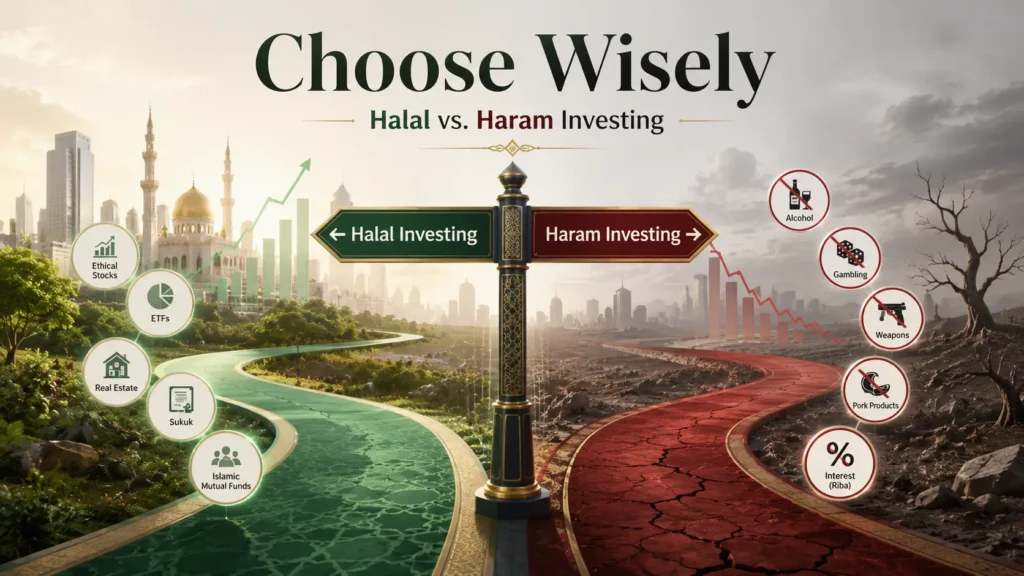
Here is a clear list of industries that are generally considered haram:
•Conventional Financial Institutions: Banks, insurance companies, and brokerages that deal with interest (riba) are not permissible.
•Alcohol and Tobacco: Companies that produce or sell beer, wine, liquor, or tobacco products are off-limits.
•Gambling and Casinos: Any business involved in betting, lottery services, or operating casinos is prohibited.
•Weapons and Defence: Companies that manufacture weapons, firearms, or military hardware are not considered halal.
•Adult Entertainment: Businesses in the pornographic or adult entertainment industry are strictly forbidden.
•Pork and Non-Halal Food: Companies that process or sell pork products or other non-halal meats cannot be part of your portfolio.
My biggest mistake, mentioned earlier, was buying into a financial services company without checking its debt levels. I thought because they offered “ethical” banking, they were fine. But their underlying structure was heavily reliant on interest-based loans. It was a hard lesson, but it taught me to always look deeper.
How to Screen for Halal Stocks in 2026
So, how do you find the good stuff? In 2026, screening for halal stocks is easier than ever, but you still need to understand the criteria. Most scholars agree on a two-step process: checking the business activity and then checking the financial ratios.

Step 1: The Business Activity Screen
First, look at what the company actually does. If its primary business is haram (like making weapons or selling alcohol), it’s an automatic “no”.
But what if a company does a bit of everything? For example, a conglomerate might make computers but also have a small division that sells insurance. Generally, scholars say that if less than 5% of a company’s total revenue comes from non-permissible activities, it might still pass the first screen.
Step 2: The Financial Ratio Screen
Even if a company sells perfectly halal products (like a tech company making software), it might still have too much debt. This is where the financial ratios come in.
The most widely accepted standard (often based on AAOIFI guidelines) uses a 33% threshold:
•Debt-to-Total Assets Ratio: The company’s interest-bearing debt should be less than 33% of its total assets.
•Interest-Bearing Securities-to-Total Assets Ratio: The cash or interest-bearing securities the company holds should be less than 33% of its total assets.
• Accounts Receivable-to-Total Assets Ratio: The company’s receivables (money owed to it) should be less than 49% (or sometimes 33%, depending on the scholar) of its total assets.
If a company passes both screens, it’s considered halal.
Halal Investment Options for Beginners
If you’re just starting out, picking individual stocks can be daunting. You have to look at balance sheets and calculate ratios yourself. Fortunately, there are other ways to invest that take the guesswork out of the process.

Halal Exchange-Traded Funds (ETFs)
ETFs are like baskets of stocks. A halal ETF is a basket where a Shariah board has already done the screening for you. They buy a bunch of halal stocks, bundle them together, and you can buy a share of the basket.
In 2026, there are several strong halal ETF options available. For example, funds like the SP Funds S&P 500 Sharia Industry Exclusions ETF (SPUS) or the Wahed Dow Jones Islamic World ETF (UMMA) track major indices but strip out all the haram companies. This is a great way to get broad market exposure without the headache of screening stocks yourself.
Halal Investing Apps and Robo-Advisors
If you want a hands-off approach, robo-advisors are your best friend. Apps like Wahed Invest or Zoya make it incredibly simple to start.
• Wahed Invest: This platform acts as a digital financial advisor. You tell them your risk tolerance (low, medium, or high), and they build a diversified portfolio of halal stocks and sukuk (Islamic bonds) for you. They handle all the rebalancing and screening.
• Zoya: If you prefer to pick your own stocks, Zoya is an incredible app. You can search for any company, and it will instantly tell you if it’s halal or haram based on the latest financial data.
Real Estate
Real estate is inherently halal. Buying a property to rent out or selling it for a profit is a great way to build wealth. Many Muslims in 2026 are turning to real estate investment trusts (REITs) that are screened for Shariah compliance. This allows you to invest in real estate without having to manage physical properties.
The Concept of Purification
Even if you invest in a perfectly halal company, there might still be a tiny fraction of their revenue that comes from interest-bearing accounts they keep their cash in. Because it’s almost impossible for a large company to avoid all forms of interest in the modern banking system, Islamic scholars require “purification”.

Purification means taking the small percentage of your gains that came from impure sources and giving it to charity.
Here’s how it usually works:
1. Find the Purification Rate: Halal stock screeners (like Zoya or Islamicly) will often provide a “purification factor” for each stock. This is usually a tiny percentage, like 0.5% or 1%.
2. Calculate Your Dividends: If you receive dividends from the stock, multiply the amount by the purification factor.
3. Give It Away: Donate that calculated amount to a charity. You don’t keep it for yourself.
It might seem like a small hassle, but it’s a crucial step to ensure your entire wealth remains pure and blessed (barakah).
My Personal Lessons and Advice for 2026
Looking back at my journey from a confused beginner to a confident halal investor, here is the most important advice I can give you:
Start small, but start now.
The biggest mistake I made wasn’t just buying the wrong stock; it was waiting too long to start because I was terrified of making a mistake. I spent two years saving money and keeping it in a regular savings account, earning almost nothing. The stock market will always have ups and downs. By waiting for the “perfect” time or the “perfect” knowledge, you miss out on years of compound growth.
Use Technology to Your Advantage.
Ten years ago, screening stocks took hours of reading annual reports. Today, apps do it in seconds. Don’t try to be a hero and calculate everything in a spreadsheet. Use apps like Zoya or invest in halal ETFs. It saves time and reduces errors.
Focus on the long term.
Islamic investing isn’t about getting rich quick. It’s about sustainable, ethical growth. Ignore the daily news hype and focus on building a portfolio that will serve you for decades.
Frequently Asked Questions (FAQs)
Can I invest in cryptocurrency?
This is a hot topic in 2026. The general consensus among many scholars is that major cryptocurrencies like Bitcoin and Ethereum are permissible to invest in, provided they are used as a medium of exchange and not for gambling or speculation. However, avoid “meme coins” or tokens that are clearly scams.
What is the difference between Halal and SRI (Socially Responsible Investing)?
While they overlap, they aren’t the same. SRI focuses on environmental, social, and governance (ESG) factors, like green energy or fair labour practices. Halal investing specifically focuses on Islamic law, which includes prohibitions against interest, alcohol, and gambling. A company can be SRI but not Halal, and vice versa.
Do I have to pay Zakat on my halal investments?
Yes. Once your halal investments have been held for a full lunar year and reach the minimum threshold (nisab), you are required to pay Zakat on the current market value of those investments (usually 2.5%). This is separate from the purification of impure dividends.
Is it okay to invest in companies that make a little bit of impure income?
Yes, as long as it’s below the threshold (usually 5% of total revenue) and you purify your earnings by donating the equivalent percentage to charity. The screening tools will tell you exactly what to donate.
Conclusion
Investing your money in a halal way isn’t about limiting your opportunities; it’s about making conscious choices that align with your values. Yes, it requires a bit of education and diligence, but the peace of mind that comes from knowing your wealth is built ethically is priceless.
Don’t let the fear of making a mistake stop you from starting. Use the tools available in 2026, start with a small amount, and watch your wealth grow the right way.
Disclaimer: I am an investor sharing my personal experiences, not a certified financial advisor or an Islamic scholar. Always consult with a qualified financial professional and a Shariah advisory board before making major investment decisions.
References
[1] Islamic Finance Guru. “Halal Investing for Beginners Guide”. Accessed July 29, 2026.
[2] Zoya Finance. “Best Halal ETFs to Buy in 2026. “Accessed July 29, 2026.
[3] Halal Wallet. 8 Best Halal ETFs (2026) — Fees & Returns Compared.” Accessed July 29, 2026.
[4] AAOIFI. “Shariah Standard No. 21.” Accessed July 29, 2026.
[5] Zoya Finance. “Best Halal Investing Apps in 2026. ” Accessed July 29, 2026.
Halal vs. Conventional Investing: A Quick Comparison
To really understand why halal investing is unique, it helps to compare it side-by-side with conventional investing. Here is a quick breakdown of how they differ in practice:
| Feature | Halal Investing | Conventional Investing |
| Primary Goal | Financial growth while adhering to Islamic principles | Maximum financial return, regardless of industry |
| Interest (Riba) | Strictly prohibited. No banks or interest-based bonds. | Often the primary driver of returns (e.g., bonds, savings accounts). |
| Forbidden Industries | Avoids alcohol, gambling, weapons, pork, and adult entertainment. | No restrictions; invests in all profitable sectors. |
| Financial Ratios | Companies must have low debt (usually < 33%) and low cash reserves. | Debt levels are evaluated for profitability, not religious compliance. |
| Dividends | May require “purification” (donating a small percentage) if the company has minor impure income. | Dividends are kept entirely by the investor. |
| Risk Profile | Often lower risk because it avoids highly leveraged (high debt) companies. | Can be higher risk due to exposure to volatile or highly leveraged sectors. |
As you can see, halal investing naturally filters out a lot of the highly leveraged, speculative sectors of the market. In 2026, this means your portfolio is often more resilient during economic downturns because you aren’t heavily exposed to massive corporate debt bubbles.
The Psychology of Ethical Investing
When you invest your hard-earned money, you are essentially voting with your wallet. You are saying, “I believe in this company’s future, and I want to be a part of its growth.”
When I first realised that my conventional portfolio was funding industries I strongly disagreed with, it created a lot of cognitive dissonance. I felt a strange disconnect between my daily actions—praying, fasting, trying to live ethically—and where my money was actually going at night while I slept.
Switching to halal investing resolved that internal conflict. It brought a sense of peace to my financial life. I wasn’t just chasing numbers on a screen anymore; I was building wealth that I could feel good about. This psychological benefit is often overlooked, but it’s incredibly powerful. When you believe in what you’re investing in, you are much less likely to panic-sell during a market dip. You have conviction.
Step-by-Step Guide to Starting Your Halal Portfolio
If you are ready to take the plunge, here is a simple, actionable plan to get you started in 2026:
1. Define Your Goals: Are you saving for a house in five years? Retirement in thirty? Knowing your time horizon dictates your risk tolerance.
2. Choose Your Method: Decide if you want to pick individual stocks (using an app like Zoya) or if you prefer a hands-off approach with a halal ETF or robo-advisor (like Wahed Invest).
3. Open an Account: Sign up with a broking that supports halal investments. If you are using a robo-advisor, you will open an account directly with them.
4. Fund Your Account: Start with an amount you are comfortable with. Remember, time in the market beats timing the market.
5. Monitor and Rebalance: If you are using a robo-advisor or ETF, they do this for you. If you are picking stocks, check their halal status periodically, as a company’s financial ratios can change.
6. Purify Your Earnings: At the end of the year, calculate your purification amounts and donate them to charity.
Final Thoughts
The world of investing doesn’t have to be intimidating, and it certainly doesn’t have to compromise your faith. Halal investing in 2026 is more accessible, transparent, and profitable than ever before.
You don’t need to be a Wall Street expert to build a halal portfolio. You just need to understand the basic rules, use the right tools, and be patient. I made mistakes when I started, but those mistakes taught me the importance of research and conviction.
Take that first step today. Your future self—and your peace of mind—will thank you.