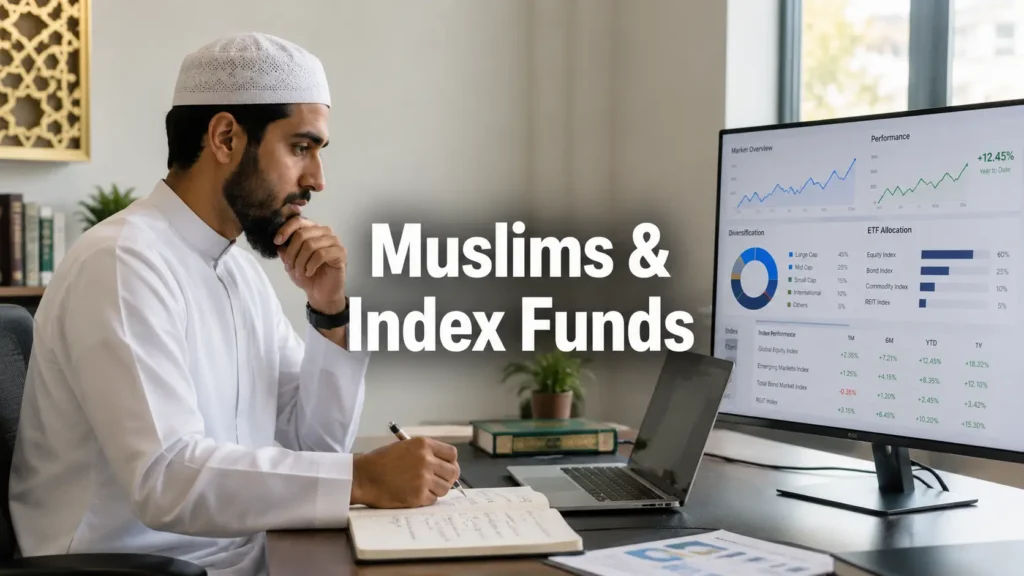
When I first started investing in 2022, I did what everyone told me to do. I opened a brokerage account, typed in the ticker “VOO”, and bought shares of the S&P 500 index fund. I thought I was being a smart, disciplined investor.
I didn’t realise I was making a massive mistake until a friend pointed it out.
Vanguard’s S&P 500 ETF is full of companies that a Muslim simply cannot invest in. When I looked at the top holdings, I saw conventional banks earning massive profits from interest (riba). I saw alcohol producers. I saw gambling companies.

That was my wake-up call. I had to liquidate my portfolio and start over from scratch.
If you are a Muslim trying to build wealth in 2026, you have probably faced the same dilemma. The traditional financial advice is always, “Just buy an index fund and hold it.” But does that work for us? Can Muslims invest in index funds without compromising their faith?
The short answer is yes. But you cannot just buy any index fund.
In this complete 2026 guide, I am going to explain exactly how Shariah screening works, why conventional index funds are problematic, and the best halal ETF alternatives available to you today.
The Problem with Conventional Index Funds
To understand why index funds pose a challenge, we have to look at how they are constructed.
An index fund is designed to mirror the performance of a broad market index. If you buy an S&P 500 fund, you are buying a tiny fractional share of all 500 companies in that index.

According to the Accounting and Auditing Organization for Islamic Financial Institutions (AAOIFI), which sets the global standards for Islamic finance, only about 32% of US-listed stocks pass Shariah screening.
This means that if you buy a standard, unscreened index fund like VOO, SPY, or QQQ, roughly two-thirds of the companies you are indirectly owning are non-compliant.
By holding these funds, you become a part-owner of businesses involved in:
•Conventional banking and insurance (Riba)
•Alcohol production and distribution
•Gambling and casinos
•Tobacco production
•Adult entertainment and weapons manufacturing
For these reasons, the majority of Islamic finance scholars consider investing in conventional index funds to be impermissible (haram).
How Shariah Screening Works
So, how do we fix this? The Islamic finance industry has developed a solution: Shariah-compliant indices.
Instead of buying every stock in the market, a Shariah-compliant fund applies a strict filter to the index before buying the stocks. This filter has two main stages.

Stage 1: Business Activity Screening
The first stage is the easiest to understand. The fund simply removes any company that derives more than 5% of its total revenue from impermissible activities.
If a company makes money primarily from alcohol, gambling, or conventional interest-based banking, it gets kicked out of the index immediately.
Stage 2: Financial Ratio Screening
The second stage is a bit more complex. Some companies operate in permissible industries (like technology or healthcare), but they might be burdened by massive amounts of debt.
Because dealing with debt (riba) is haram, scholars have set strict financial ratio limits based on AAOIFI guidelines. For a company to be considered halal, it must pass these three tests:
1. The Debt Test: The company’s interest-bearing debt must be less than 30% of its total market capitalisation (or total assets, depending on the specific board).
2. The Cash Test: The company’s cash and interest-bearing securities must be less than 30% of its total assets.
3. The Income Test: The company’s revenue from impermissible activities (like a tech company that earns a little interest on its bank account) must be less than 5% of its total revenue.
Only companies that pass both the business activity screen and the financial ratio screen are allowed into a halal index fund.
The Best Halal ETFs for 2026
If you want to invest in index funds as a Muslim, you need to look for Halal ETFs (Exchange Traded Funds). These are funds that track these specially constructed, Shariah-compliant indices.

1. SP Funds S&P 500 Shariah Industry Exclusions ETF (SPUS)
•Expense Ratio: 0.45%
•Focus: Tracks the S&P 500 Shariah Index.
•Why it’s good: This is the closest halal equivalent to the traditional VOO fund. It holds about 210 large-cap US companies that have passed the screening process. It has over $2 billion in assets under management, making it highly liquid and reliable.
2. Wahed FTSE USA Shariah ETF (HLAL)
•Expense Ratio: 0.50%
•Focus: Tracks the FTSE USA Shariah Index.
•Why it’s good: Managed by Wahed Invest, this fund is heavily weighted toward the technology sector. It holds around 200 companies and is a great option if you want broad US exposure with a slight growth tilt.
3. Manzil Russell Halal USA Broad Market ETF (MNZL)
•Expense Ratio: 0.40%
•Focus: Tracks the Russell 1000 Index.
•Why it’s good: This is the newest and cheapest option on the market. It has the lowest fee of any halal ETF and holds about 461 companies, giving you exposure to both large-cap and mid-cap stocks.
4. SP Funds S&P Global Technology ETF (SPTE)
•Expense Ratio: 0.55%
•Focus: Global technology companies.
•Why it’s good: If you believe tech is the future, this fund gives you global exposure to Shariah-compliant tech giants.

My opinion: If you want a simple, set-it-and-forget-it portfolio, SPUS or MNZL are your best bets. They offer broad US market exposure with very competitive fees for 2026.
The Purification Process: Why It Matters
You might be wondering: “If a company passes the Shariah screening, does that mean it is 100% pure?”
The answer is no.
Even a Shariah-compliant tech company might have a tiny percentage of its revenue coming from interest earned on its bank account. It is impossible to run a modern global business without having at least a little bit of interaction with the conventional banking system.

Because of this, scholars require Muslims to perform purification (Tazkiyah) on their investments.
‘Purification’ means calculating the small percentage of your investment returns that came from impermissible activities and donating that exact amount to charity.
For individual stock investors, this calculation can be tedious. You have to look up the “impure revenue ratio” of every single company you own and do the math on your dividends.
However, many modern halal ETFs (like SPUS and HLAL) handle this for you. They publish an annual “purification ratio”. If your ETF pays you $100 in dividends, and the purification ratio is 2%, you simply donate $2 to charity, and the remaining $98 is yours to keep or reinvest.
How to Build a Diversified Halal Portfolio
One of the main criticisms of halal investing is that it lacks diversification. Because so many companies are filtered out, your portfolio can become overly concentrated in specific sectors, like technology and healthcare.
To fix this, you need to diversify across different asset classes, not just US tech stocks.

Here is a simple, diversified portfolio structure you can use in 2026:
1. Core US Equities (60%): Use SPUS or MNZL to get broad exposure to the US market.
2. Global Equities (20%): Use a fund like UMMA (Wahed Dow Jones Islamic World ETF) to get exposure to international markets.
3. Fixed Income / Sukuk (15%): Use a halal bond fund like SPSK (SP Funds Dow Jones Global Sukuk ETF) to reduce volatility and earn halal interest-like returns.
4. Real Estate (5%): Use a halal REIT fund like SPRE to get exposure to the property market.
This approach ensures that you are not putting all your eggs in one basket while still strictly adhering to Islamic principles.
Frequently Asked Questions (FAQs)
Can I invest in the Vanguard S&P 500 ETF (VOO)?
No. The vast majority of Islamic finance scholars consider VOO to be impermissible because it is an unscreened index fund. It includes conventional banks, alcohol companies, and highly leveraged companies that do not meet Shariah financial ratios.
What is the cheapest halal index fund in 2026?
As of 2026, the MNZL (Manzil Russell Halal USA Broad Market ETF) has the lowest expense ratio of any halal ETF on the market at 0.40%.
How do I calculate purification for my halal ETFs?
You need to find the specific purification ratio published by the fund provider for the current year. Once you have that percentage, multiply it by the total dividends you received from that ETF, and donate the resulting amount to charity.
Are all “ESG” or “ethical” funds halal?
No. ESG (Environmental, Social, and Governance) funds often exclude things like fossil fuels, but they rarely screen for interest-bearing debt (riba) or conventional banking activities. You must specifically look for “Shariah-compliant” or “Islamic” funds.
What if a company in my halal ETF fails the financial screening?
Shariah-compliant indices are rescreened quarterly. If a company’s debt levels rise above the 30% threshold, it is removed from the index and replaced with a compliant company. You do not need to manually monitor the individual stocks inside a halal ETF.
Conclusion: You Don’t Have to Choose Between Faith and Finance
When I first realised my VOO shares were haram, I felt like I had wasted months of potential growth. I thought being a faithful Muslim meant I was destined to have a lower net worth than my peers.
I was wrong.
The halal investing landscape has exploded in 2026. With options like SPUS, HLAL, and MNZL, you can build a highly diversified, low-cost, and globally competitive portfolio without ever compromising your faith.
You don’t have to pick individual stocks. You don’t have to read complex financial statements. You just need to buy the right screened index funds and handle your purification.
Build your wealth. Stay true to your values. Let your money work for you while you work for the Hereafter.
Disclaimer: I am an investor and blogger, not a licensed financial advisor or an Islamic scholar. The information in this article is for educational purposes only. Please consult with a certified financial planner and a qualified Islamic finance advisor before making investment decisions.
References
[1] HalalScreener. “Is Investing in Index Funds Halal? ETF Screening Guide.” February 27, 2026.
[2] HalalWallet. “8 Best Halal ETFs for 2026.” July 29, 2026.
[3] AAOIFI. “Shariah Standard No. 21: Financial Papers (Shares and Bonds).”
[4] HalalWallet. “MNZL vs SPUS vs HLAL Comparison Data.” July 2026.
[5] Zoya Finance. “How to Purify Stocks: A Step-by-Step Guide.” September 16, 2023.
The Psychology of Halal Investing: Why It’s Harder Than You Think
When I first switched my portfolio from VOO to SPUS, I experienced something unexpected: financial anxiety.
Even though my portfolio was now 100% Shariah-compliant, I felt like I was missing out. Every time the market had a massive rally, I would open my app and see that my halal fund was up 14%, while my friends were bragging about their conventional fund being up 16%.
It is a very real psychological phenomenon. We are wired to compare ourselves to our peers. When you see a conventional index fund outperforming your halal fund by 2%, it is easy to feel like you are paying a “faith tax”.
But here is what I learned over the last three years: that “tax” is actually a premium for peace of mind.
A 2024 study published in the Journal of Islamic Accounting and Business Research found that Shariah-compliant funds often outperform conventional funds during periods of high inflation and market volatility. Why? Because the screening process naturally filters out highly leveraged companies (like banks) that are most vulnerable to rising interest rates.
When the market crashes, your halal portfolio is often your best defence.
How to Start Investing in Halal Index Funds Today
If you are ready to take the leap, here is my exact 4-step process for building a halal portfolio in 2026.
Step 1: Choose Your Brokerage
You need a brokerage account that allows you to buy ETFs. If you are in the US, traditional brokers like Fidelity, Charles Schwab, and E*TRADE work perfectly. If you want an app designed specifically for Muslim investors, you can use platforms like Wahed Invest, Manzil, or Islamicly.
Step 2: Set Up Automatic Transfers
The secret to index fund investing is consistency. You do not want to try and “time the market”.
Set up an automatic transfer of $100 (or whatever you can afford) to your brokerage account every payday. Treat it exactly like a monthly bill.
Step 3: Buy Your Chosen Halal ETF
When the money arrives in your account, immediately use it to buy shares of your chosen halal ETF (like SPUS or MNZL). Do this every single month, regardless of whether the market is up or down. This strategy is called “dollar cost averaging”, and it is the single most effective way to build wealth over time.
Step 4: Schedule Your Purification
Once a year, usually around tax season, log into your brokerage account and look at your total dividend payments for the year.
Multiply that amount by the purification ratio provided by your ETF. Write a cheque to your favourite charity and update your tax records.
Advanced Strategy: Building a Custom Portfolio
If you have a larger account balance (say, over $50,000), you might want to move beyond just buying one ETF.
Instead of relying on an automated ETF, you can build your own custom index fund.
Here is how:
1. Use a Shariah Screening App: Tools like Zoya, Islamicly, or HalalScreener allow you to screen thousands of individual stocks in real-time.
2. Select 30 to 50 Stocks: Pick a diverse mix of companies that pass the screening. Make sure you have representation in tech, healthcare, industrials, and consumer staples.
3. Equal Weight Them: Invest an equal amount of money into each stock. (e.g., $1,000 into each of 30 stocks).
4. Rescreen Quarterly: Every three months, run the stocks through the app again. If any company’s debt has gotten too high, sell it and buy a new company that passes.
This approach gives you absolute control and avoids the ETF expense ratio (the 0.45% fee). However, it requires much more effort and emotional discipline. For most beginners, I highly recommend sticking to the halal ETFs like SPUS.
Frequently Asked Questions (FAQs) – Part 2
Is investing in crypto halal?
That is a highly debated topic among scholars. Some consider all crypto halal, while others consider it impermissible because it lacks intrinsic value. However, the major halal ETFs discussed in this article do not include crypto. If you want to invest in crypto, you must do your own independent research or consult a scholar.
Can I use a robo-advisor for halal investing?
Yes. Platforms like Wahed Invest offer automated, halal robo-advisory services. You answer a few questions about your risk tolerance, and their algorithm builds a diversified portfolio of halal ETFs and Sukuk for you.
What happens if a company gets kicked out of a halal ETF?
The fund manager automatically sells the shares of the non-compliant company and buys a new, compliant company. You do not need to do anything. The ETF handles the rebalancing behind the scenes.
Final Thoughts: Grow with Barakah
There is a concept in Islam called ‘Barakah’ (divine blessing). It means that a small amount of something can yield extraordinary results when Allah is pleased with how it was obtained.
When you invest in a conventional index fund full of alcohol and gambling companies, you are building your wealth on a shaky, impermissible foundation.
When you invest in a halal index fund, you are building your wealth with pure money.
The returns might not always be the absolute highest number on your screen. But the peace of mind, the lack of anxiety, and the Barakah in your life will be worth infinitely more.
Start small. Buy a few shares of SPUS or HLAL. Purify your dividends. And watch your halal wealth grow over the next decade.
Disclaimer: I am an investor and blogger, not a licensed financial advisor or an Islamic scholar. The information in this article is for educational purposes only. Please consult with a certified financial planner and a qualified Islamic finance advisor before making investment decisions.
References
[1] HalalScreener. “Is Investing in Index Funds Halal? ETF Screening Guide.” February 27, 2026.
[2] HalalWallet. “8 Best Halal ETFs for 2026.” July 29, 2026.
[3] AAOIFI. “Shariah Standard No. 21: Financial Papers (Shares and Bonds).”
[4] HalalWallet. “MNZL vs SPUS vs HLAL Comparison Data.” July 2026.
[5] Zoya Finance. “How to Purify Stocks: A Step-by-Step Guide.” September 16, 2023.