The short answer
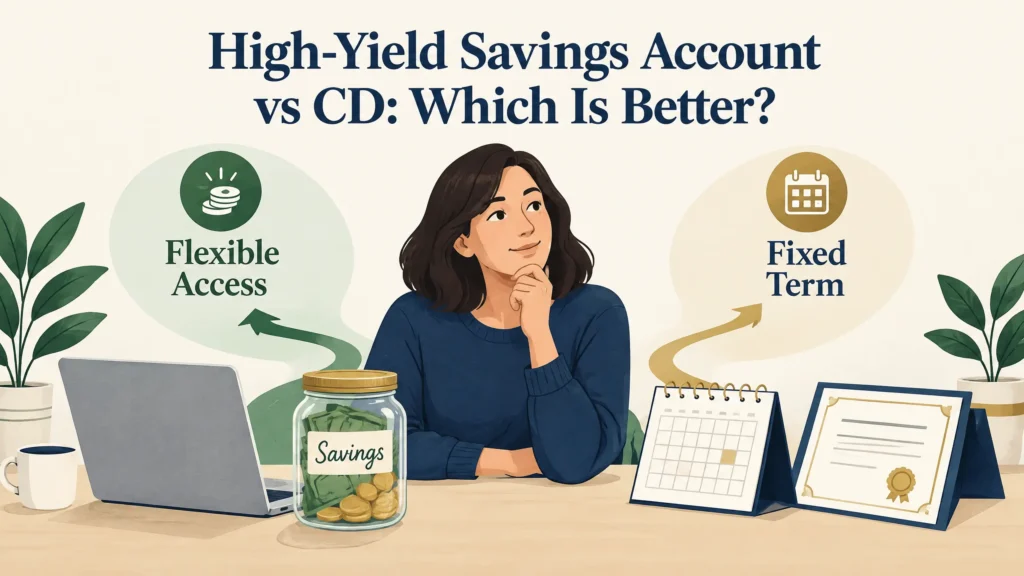
A high-yield savings account is usually better for money you may need soon. A certificate of deposit, or CD, can be better for money you can leave untouched until a known future date.
Neither product wins for everyone.
The savings account gives you flexibility. Its rate can change. The CD gives you a defined term and often a fixed rate. Its early-withdrawal rules can make access costly or difficult.
My opinion is simple: do not lock up emergency money just to earn a little more interest. Use a CD for money with a clear timeline. Use a high-yield savings account for money that needs to stay ready.
The right choice depends on four questions:
•When will you need the money?
•Can the rate change?
•What happens if you withdraw early?
•Is the extra return worth the lost flexibility?
What is a high-yield savings account?
A high-yield savings account is a deposit account designed to pay more interest than a basic savings account. You can usually add money and request withdrawals or transfers, subject to the bank’s terms.
The rate is commonly variable. The bank can change it. The account may have no fixed maturity date, which means you do not have to choose a date when the money comes back.
That flexibility is the main benefit.
A high-yield account can suit:
•An emergency fund.
•A house or car fund when the purchase date is uncertain.
•Cash waiting for a planned expense.
•A short-term savings goal.
•Money you want separate from everyday spending.
Do not assume “high-yield” means high forever. Check the current APY, minimum balance, monthly fee, transfer rules, and whether the account is held at an insured bank or credit union.

What is a CD?
A CD is a type of savings account in which you agree to leave money deposited for a specified term. The Consumer Financial Protection Bureau says that withdrawing early generally means paying a penalty to the bank.
Terms can range from a few months to several years. The exact choices vary by institution.
A CD can suit:
•Money for a known future expense.
•A portion of savings you will not need during the term.
•A saver who values a known rate.
•A planned CD ladder with several maturity dates.
•Cash that would otherwise sit untouched.
The trade-off is access. The CD may pay a fixed rate, but you give up some control over the money until maturity.
A CD is not automatically better because its rate is higher. A higher rate attached to a term you cannot complete may be a poor fit.
High-yield savings account vs CD: the main differences
| Feature | High-yield savings account | CD |
| Access | Usually flexible transfers or withdrawals | Money is committed for a term. |
| Rate | Usually variable | Often fixed for the term |
| Maturity date | None | Yes |
| Early withdrawal | Usually no CD-style penalty, but account rules apply. | Penalties are common |
| Best for | Emergency funds and uncertain timing | Known timelines and untouched cash |
| Main risk | Rate may fall. | Access may be costly or restricted. |
| Deposits | Often flexible | May have minimum opening deposit |
| Planning | Easy to add money | Usually opened for a set amount |
Bank disclosures control the details. Read them before deciding.

The return difference may be smaller than it looks.
Suppose you have $10,000.
•A 4.50% APY savings account earns about $450 over one year if the rate stays unchanged and the balance stays constant.
•A 5.00% one-year CD earns about $500 under a simplified annual comparison.
•The gross difference is about $50.
That $50 is meaningful. It is not always enough to justify giving up access to the money.
The calculation changes when the rates, term, compounding method, fees, and balance change. Use the APY shown in the account disclosure. Do not compare a CD’s nominal interest rate with a savings account’s APY as if they were identical measures.
Here is a simple comparison table:
| Starting balance | 4.50% annual yield | 5.00% annual yield | Approximate difference |
| $1,000 | $45 | $50 | $5 |
| $5,000 | $225 | $250 | $25 |
| $10,000 | $450 | $500 | $50 |
| $25,000 | $1,125 | $1,250 | $125 |
| $50,000 | $2,250 | $2,500 | $250 |
These are illustrations. They assume a constant rate and balance. They do not include tax, fees, or early-withdrawal penalties.
When a high-yield savings account is better
You may need the money at any time.
Emergency savings should be available when life changes. A repair, medical bill, job loss, or family need does not wait for a CD to mature.
Keeping emergency savings in a CD can create pressure. You may delay a necessary withdrawal. You may accept a penalty. You may have to use expensive credit instead.
The ability to access cash has value even when it does not appear on an interest-rate table.
Your timeline is uncertain.
A savings account works well when you know you are saving for something but do not know the exact date.
Maybe you are considering a move. Maybe you are waiting for a contractor. Maybe you are building a business reserve. Locking the money for twelve months could create a problem if the timing changes.
You expect to add money regularly.
A savings account is usually easier for recurring deposits. You can add money when you receive a paycheck or complete a sale.
A CD is more rigid. Some products allow additional deposits, but many are opened with a specific amount and term.
You think rates may rise
A fixed CD locks the rate for its term. That is helpful if rates fall. It can feel limiting if comparable rates rise soon afterward.
No one knows the future path of rates with certainty. Choose based on your need for certainty, not a confident prediction.
When a CD is better
You have a known date for the money.
A CD can fit a bill, tuition payment, planned move, or purchase that will happen after the maturity date. The date should be realistic. Do not choose a term that ends after you need the cash.
The CFPB recommends comparing the term, interest rate, and early-withdrawal penalty when shopping for a CD.
You want a fixed rate.
A fixed CD rate can make planning easier. You know the rate for the agreed term, subject to the CD’s terms and any call features or special conditions.
A savings account may start higher and end lower. A CD removes some of that uncertainty.
You can leave the money alone.
A CD is most useful when you do not need to touch the money. The best CD rate in the market is not helpful if the term forces an expensive withdrawal.
Before opening one, ask yourself what would happen if your income stopped for several months. If the answer is “I would need this exact money,” a liquid savings account may be a better home.
You want to build a CD ladder.
A CD ladder spreads money across different maturity dates. For example, instead of putting $12,000 into one twelve-month CD, you might place portions into three-, six-, nine-, and twelve-month terms.
A ladder can create regular opportunities to access or reinvest funds. It adds planning work, but it can reduce the all-or-nothing problem of one maturity date.
The biggest CD risk: early withdrawal
A CD penalty may reduce some or all of the interest you expected. The exact formula depends on the institution and product.
Read these details:
•The penalty amount.
•Whether the penalty can reduce principal.
•Whether partial withdrawals are allowed.
•Whether the CD automatically renews.
•How much time you have to withdraw after maturity.
•Whether the bank sends a maturity notice.
•Whether the CD is callable or brokered.
The SEC warns that brokered CDs can be more complex than CDs purchased directly from a bank. It recommends identifying the issuing bank, checking insurance coverage, and understanding maturity, call, and sales-fee terms.
A traditional bank CD and a brokered CD are not interchangeable. Use extra care when a brokerage account presents a CD as a simple cash alternative.
Deposit insurance and account safety

In the United States, CDs and savings accounts at FDIC-insured banks are generally covered up to $250,000 per depositor, per ownership category, at each insured bank. The FDIC identifies both savings accounts and CDs as deposit products, but coverage limits and account ownership rules still matter.
Credit unions use a different federal insurance system through the National Credit Union Administration. Check the institution rather than relying on the name of an app or marketplace.
The FDIC does not insure ordinary investments such as stocks, mutual funds, bonds, or crypto assets. A product can be offered through a familiar financial company without every product being a bank deposit.
Safety checklist:
•Identify the legal institution holding the deposit.
•Confirm FDIC or NCUA coverage where applicable.
•Check your total deposits at the same institution.
•Read whether the product is a direct CD or brokered CD.
•Keep records of account ownership and beneficiaries.
Taxes can change the result.
Interest from both savings accounts and CDs may be taxable. The IRS says most interest credited to an account that can be withdrawn without penalty is taxable income when it becomes available. It lists interest from bank accounts and certificates of deposit among taxable-interest examples.
A CD may create a tax issue even when you do not withdraw the interest immediately, depending on the product and tax rules that apply. Do not assume that “I left the money locked up” means the interest is tax-free.
Tax treatment varies by country and individual situation. If the dollar amount is significant, ask a qualified tax professional how interest should be reported.
My illustrative failure: locking up the wrong money
I cannot honestly claim a personal CD mistake that was not provided. Here is a clearly labelled illustrative scenario.
A saver puts an entire emergency fund into a twelve-month CD because its rate is higher than the savings account. Two months later, the saver needs the money for an urgent repair. The bank allows early withdrawal but takes a penalty. The saver loses much of the extra interest and has to manage the disruption at the same time.
The mistake was not choosing a CD. The mistake was treating emergency money like money with a known future date.
My view is that the first layer of savings should be boring and accessible. A CD can be useful after the liquid reserve is in place.
A simple decision rule
Use this order:
1. Protect the purpose of the money
Emergency money needs access. A known future expense may tolerate a term.
2. Match the maturity date to the need
If you need the money in nine months, do not automatically choose a twelve-month CD.
3. Compare the real return
Include APY, fees, taxes, minimum balances, and penalties.
4. Check the institution and coverage.
Verify the deposit-protection status and understand the ownership category.
5. Read automatic-renewal terms.
A CD may renew if you do not act during the notice period. Put the maturity date on your calendar.
6. Choose flexibility when the difference is small.
A modest extra return may not compensate for losing access.
Which one should you choose?
| Your situation | Likely fit |
| Emergency fund | High-yield savings account |
| Money needed on an uncertain date | High-yield savings account |
| Cash you will not need for a fixed term | CD |
| You want a fixed rate | CD |
| You expect to add deposits regularly | High-yield savings account |
| You are building a ladder | Multiple CDs |
| You may need to withdraw early | High-yield savings account |
| You are comparing a brokered CD | Read SEC and issuer terms carefully |
This is a decision framework, not a personalized recommendation.
Frequently asked questions
Is a CD safer than a high-yield savings account?
Both can be insured deposit products when offered by an eligible FDIC-insured bank or NCUA-insured credit union and held within applicable limits. The main difference is liquidity and rate structure, not that one is automatically “safe” and the other is not.
Can I lose money in a CD?
An early-withdrawal penalty can reduce your interest and, depending on the terms, may affect principal. A brokered CD can have additional risks and complexity. Check the issuer, insurance, fees, call features, and withdrawal terms.
Is a high-yield savings account better for an emergency fund?
Usually, yes, because the money remains more accessible. You still need to check transfer times, limits, account access, and the bank’s terms.
What happens when a CD matures?
The bank may return the principal and interest, move the money to another account, or automatically renew the CD. The exact process and notice period are in the account agreement. Set a reminder before maturity.
Can a CD rate change?
A standard fixed-rate CD generally holds its stated rate during the term, but special products may have variable, callable, or other features. Read the disclosure rather than assuming every CD works the same way.
Should I put all my savings into a CD?
Usually, no. A more careful approach is to separate emergency cash, near-term spending, and money with a longer known timeline. Each bucket can have a different home.
Do savings accounts and CDs pay compound interest?
It depends on how interest is credited and whether it remains in the account. Compare APY, not just the stated interest rate, and read the product disclosure. Brokered CDs may distribute simple interest rather than automatically compounding it, as the SEC explains.
How often should I compare rates?
Review a savings account periodically because its rate can change. Review a CD at maturity or before opening a new term. Do not move money solely for a tiny rate difference if the new account adds risk, fees, or inconvenience.
Final checklist
Before choosing, ask:
•Do I need this money before a specific date?
•Is the date certain?
•Is the rate fixed or variable?
•What is the early-withdrawal penalty?
•Will the CD renew automatically?
•Is the product insured?
•Are there fees or minimum deposits?
•Have I considered taxes?
•Am I comparing APY with APY?
•Is the extra return worth losing flexibility?
Conclusion
A high-yield savings account is usually the better tool for flexibility. A CD is often the better tool for a known timeline and a rate you want to lock.
The strongest choice is not the product with the most impressive headline. It is the product that matches the job of the money.
Keep emergency cash available. Use CDs for funds you can leave alone. Read the penalty and renewal terms. Check insurance. Compare the real return.
My opinion is that many people need both. A liquid savings account can handle uncertainty. A carefully chosen CD or CD ladder can handle money with a date.
Suggested internal links:
•How Much Should an Emergency Fund Be?
•4% vs 5% High-Yield Savings Account: Which Is Better?
•How to Compare Bank Account Fees
•What Is APY? A Beginner’s Guide
References
[1] Consumer Financial Protection Bureau: What Is a Certificate of Deposit?
[2] Investor.gov: Brokered CDs—Investor Bulletin
[4] IRS: Topic No. 403, Interest Received
Financial Disclaimer: I am not liable for the financial advice given in this article. This article is written by an AI and therefore shouldn’t be used for any personal financial planning or investment advice. If you are looking for financial advice, consult a financial advisor and double-check their information with the IRS and any other government agencies. You are strongly encouraged to do your own research when it comes to finances and taxes.