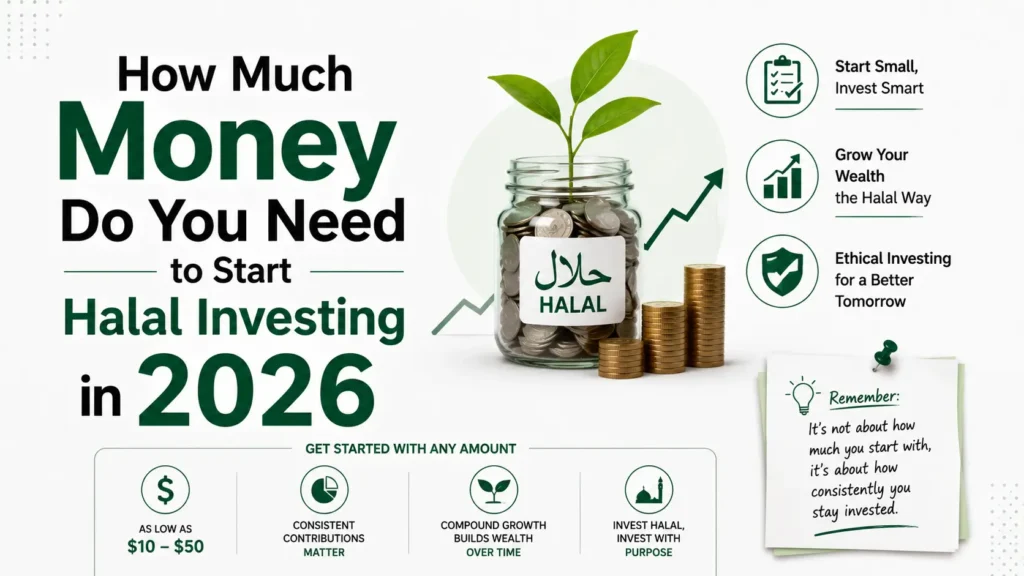
For years, many Muslims walked around with a quiet financial anxiety. On one hand, modern financial advice shouted from every corner of the internet: invest early, compound your wealth, and beat inflation. On the other hand, traditional banking and investment markets felt like a minefield of interest-bearing bonds, prohibited derivatives, and companies dealing in non-halal industries. How Much Money Do You Need to Start Best Halal Investing in 2026.
People assumed you needed thousands of dollars in cash reserves, an accountant on speed dial, and a degree in Islamic jurisprudence just to buy your first compliant share. The truth is much simpler and far more liberating. You do not need a massive inheritance or a five-figure bank balance to begin building wealth ethically. In fact, you can start halal investing with as little as the cost of a single dinner out.
Let us unpack the real capital requirements, examine the platforms available today, look at how modern Shariah screening works, and explore the hard lessons learned from my own early investment missteps.

1. Dispelling the Myth of the High-Net-Worth Barrier
When people first encounter the concept of halal investing, they often suffer from analysis paralysis. They assume that because Islamic financial instruments require rigorous screening (avoiding riba or interest, steering clear of excessive uncertainty or gharar, and bypassing prohibited sectors like alcohol, gambling, and conventional finance), the infrastructure must be exclusive and expensive.
Historically, that perception had some truth. Decades ago, accessing Shariah-compliant mutual funds required steep minimum investments—often starting at $5,000 or $10,000 per fund. For a college graduate or young working professional, that barrier kept them parked in low-yield savings accounts that barely kept pace with inflation.
Today, financial technology has completely dismantled those walls. Fractional shares, automated robo-advisors, and specialised Shariah screening apps mean that entry barriers have dropped close to zero. According to financial inclusion studies published by Islamic finance research groups, digital democratisation has enabled millions of retail investors globally to enter capital markets with minimal initial capital. 1.
“Shariah-compliant investing is no longer reserved for institutional funds or high-net-worth families. Modern fractional share infrastructure allows everyday individuals to build diversified, ethically screened portfolios with pocket change.” — Islamic Finance Advisory Review 2
To understand how little you actually need, let us examine the real entry thresholds across different investment vehicles.
2. Platform Comparison: How Much Do Different Options Require?
Choosing where to invest dictates your starting capital. Different tools serve different investor profiles, ranging from hands-off automated portfolios to do-it-yourself stock picking.
| Platform / Vehicle Type | Minimum Initial Deposit | Management / Platform Fee | Best Suited For |
|---|---|---|---|
| Robo-Advisors (e.g., Wahed Invest) | $100 | ~0.39% to 0.95% AUM | Hands-off beginners wanting diversified portfolios |
| DIY Brokerage + Shariah Apps (e.g., Zoya + Interactive Brokers) | $0 (zero minimum brokers) | Free screening / Low brokerage commissions | Active investors wanting full control over stock selection |
| Halal ETFs (e.g., SPUS, HLAL) | Price of 1 share (~$40 to $50) | Expense ratio (~0.40% to 0.50%) | Long-term buy-and-hold index investors |
| Specialized Islamic Funds (e.g., Amana Mutual Funds) | $500 to $1,000 | Variable expense ratios | Traditional mutual fund investors |
As you can see, the financial barrier to entry is virtually non-existent. If you can scrape together $50 or $100, you have more than enough capital to open a fully compliant investment account today.
3. My Personal Failure: Chasing High-Yield “Miracles” with Too Little Capital
I need to share a personal failure because sugarcoating financial missteps helps no one. Back when I first learned about halal investing, I suffered from a dangerous combination of impatience and a small starting budget. I only had about $300 saved up to invest, and my brain instantly rebelled against the idea of buying boring, stable Shariah-compliant exchange-traded funds (ETFs) that would grow slowly over decades.
Convinced that $300 wouldn’t make a dent in the market, I went looking for shortcuts. I found an obscure micro-cap stock that passed a loose online Shariah screen, hyped up across online forums as a guaranteed multi-bagger. Without doing proper fundamental analysis or diversifying, I dumped my entire $300 capital stack into that single stock.
Within three weeks, the company released a disappointing earnings report, regulatory questions arose regarding its debt ratios, and the stock plummeted by 65%. I panicked, sold at the bottom, and watched my $300 shrink to barely $100.
The lesson was burned into my psyche: Small capital is not an excuse for reckless speculation. Trying to rush wealth creation with a tiny amount of money by taking oversized risks is just gambling dressed up in religious terminology. Real halal investing is about disciplined, consistent compounding. Starting small with broad-based ETFs or automated robo-advisors beats speculative stock-picking every single time.
4. The Mathematics of Starting Small: How Compound Growth Works
One of the greatest psychological hurdles for beginners is believing that small amounts do not matter. If you can only invest $50 a month, you might wonder, “What is even the point?”
Let us look at the mathematics of compounding. Suppose you start investing just $100 a month into a diversified Shariah-compliant equity ETF (such as the SP Funds S&P 500 Sharia Industry Ex-US ETF or similar broad market funds) averaging an annualised historical return of 7% to 8%.
📈 THE 20-YEAR COMPOUNDING TRAJECTORY ($100 / MONTH):
-----------------------------------------------------
- After 5 Years:  ~$7,300   (Principal: $6,000 | Growth: $1,300)
- After 10 Years: ~$17,300  (Principal: $12,000 | Growth: $5,300)
- After 20 Years: ~$48,500  (Principal: $24,000 | Growth: $24,500)
Notice what happens around the years 15 to 20: the growth earnings begin to match and eventually surpass your total out-of-pocket contributions. That is the magic of compounding. Waiting until you have “enough” money to start is the single most expensive mistake you can make. Time in the market always beats timing the market.
5. Understanding Shariah Screening: What Makes an Investment Halal?
Before depositing a single dollar, you must understand what separates halal investing from conventional investing. Islamic law governs not just how we spend money but how our money works for us.
Three core prohibitions dictate Shariah-compliant equity screening:
- Riba (Interest): Investing in traditional banks, lenders, or companies whose primary business model relies on generating interest income is strictly prohibited.
- Gharar (Excessive Uncertainty/Speculation): Highly speculative derivatives, options trading, and margin gambling violate Islamic ethical boundaries.
- Prohibited Industries: Companies involved in alcohol, pork, gambling, adult entertainment, conventional weapons, and interest-based financial institutions are screened out.
Modern Financial Screening Standards
Today, standards established by organisations like the Accounting and Auditing Organisation for Islamic Financial Institutions (AAOIFI) provide clear quantitative thresholds for stock screening. For example, a company may still be considered compliant if its non-compliant debt-to-market-capitalisation ratio remains below 33% and non-compliant interest income does not exceed 5% of total revenue.
Apps like Zoya or Islamic Finance Guru (IFG) make these calculations transparent, allowing retail investors to verify stock compliance instantly with a simple search. For further reading on ethical finance standards and market compliance, review guidance from the Islamic Finance Council Global.
6. Step-by-Step Blueprint: How to Begin With Minimal Funds
If you are ready to take your first steps into halal investing without getting overwhelmed, follow this practical, four-step framework:
- Establish an Emergency Fund First: Never invest money you might need in the next three to six months. Keep a cash cushion in a high-yield, compliant savings account or cash management vehicle.
- Choose Your Investment Vehicle:
- If you want complete automation and have $100 to start, open a robo-advisor account like Wahed Invest.
- If you want zero minimums and prefer buying ETFs or individual stocks yourself, open a zero-fee brokerage account (like Interactive Brokers or Fidelity) and pair it with a screening tool like Zoya.
- Set Up Automated Monthly Contributions: Consistency matters more than lump-sum timing. Automate a transfer of $50, $100, or whatever fits your budget every single payday.
- Diversify Across Sectors: Avoid putting all your money into tech stocks or a single geography. Spread your investments across broad indexes, healthcare, technology, and utilities that meet Shariah standards.
7. Psychological Health and Financial Wellbeing
Managing money without stress is deeply tied to emotional resilience and ethical clarity. Financial uncertainty can trigger acute cognitive fatigue and anxiety, which clinical research shows impacts both mental focus and long-term decision-making [3]. When your investments align with your moral and religious convictions, you eliminate the underlying spiritual friction that causes anxious second-guessing during market downturns.
Frequently Asked Questions (FAQ)
Can I really start halal investing with just $50 or $100?
Yes. Modern robo-advisors like Wahed Invest allow starting deposits as low as $100, while many online brokerages have zero account minimums, allowing you to buy fractional shares of Shariah-compliant ETFs for the price of a single share.
Are Halal ETFs as profitable as conventional stock market funds?
Historically, Shariah-compliant indices (such as the S&P 500 Shariah Index) have performed competitively with or even outperformed conventional broad-market indices during certain economic cycles, largely because Shariah screens naturally filter out heavily indebted companies and speculative financial institutions.
Do I need to pay Zakat on my halal investments?
Yes. Wealth accumulated through stocks, ETFs, and investment funds is subject to Zakat once it meets the Nisab threshold and is held for a full lunar year. Many modern financial apps offer built-in Zakat calculators to simplify this calculation.
What is the difference between a Halal robo-advisor and buying individual stocks?
A robo-advisor automatically manages, rebalances, and diversifies your portfolio based on your risk tolerance for a small management fee. Buying individual stocks or ETFs yourself via a broking gives you direct control over your holdings but requires active research and monitoring.
Is crypto considered halal?
Cryptocurrency compliance is a nuanced topic among contemporary Islamic scholars. While native tokens with real utility and transparent governance (like Bitcoin or Ethereum, according to several mainstream scholarly rulings) are often deemed permissible, speculative meme coins, interest-bearing staking, and leveraged trading derivatives are generally prohibited.
References
8. Deep Dive: Calculating Zakat on Modern Investment Portfolios
One of the most common questions new halal investors ask is how to calculate Zakat on stocks, mutual funds, and ETFs. When your money is locked inside fluctuating equities, calculating purification and Zakat can feel intimidating, but the principle is straightforward once broken down.
Zakat is an annual obligation of 2.5% on qualifying wealth that has reached the Nisab threshold and remained in your possession for one lunar year. When calculating Zakat on stock portfolios, contemporary scholarly consensus distinguishes between two primary investment intents:
- Trading Intent (Short-Term): If you bought stocks with the intention of short-term trading and capital gains, Zakat is calculated based on the entire market value of your portfolio on your Zakat anniversary date.
- Long-Term Investment Intent: If you bought shares as long-term equity stakes in companies (buy-and-hold investing), you do not owe Zakat on the total market value of the company’s assets. Instead, you calculate Zakat based on the underlying liquid assets of the company—specifically cash, accounts receivable, and inventory—minus current liabilities.
Fortunately, modern screening apps and Islamic finance portals (such as Zoya and Islamic Finance Guru) frequently provide Zakat multiplier percentages for major halal ETFs and stocks. For instance, if an ETF has a Zakat coefficient of 0.05, you multiply your total holding value by that coefficient and then pay 2.5% on that resulting figure. This eliminates guesswork and ensures your wealth remains purified and spiritually aligned.
9. Sector Diversification: Why Halal Portfolios Outperform More Than You Think
A common misconception among beginner investors is that Shariah screening severely restricts growth potential by eliminating major sectors like conventional banking, defense contractors, and alcohol conglomerates. In reality, screening out highly indebted companies and speculative financial institutions often protects portfolios from systemic shocks.
Consider the tech and healthcare sectors. Many of the world’s most innovative, cash-rich technology giants—such as Microsoft, Apple, and various semiconductor manufacturers—easily pass Shariah debt and revenue screens. Because halal screening filters out companies carrying unsustainable debt burdens, halal portfolios often exhibit greater resilience during high-inflation or high-interest-rate environments where heavily leveraged firms struggle.
When starting with a modest capital stack (say, $100 to $500), diversification can be achieved instantly through a single broad-market Shariah ETF rather than attempting to buy ten individual stocks. This provides immediate exposure to hundreds of compliant global enterprises, spreading your risk across multiple industries without requiring thousands of dollars in capital.
10. Automating Your Wealth: The Secret to Long-Term Consistency
The greatest enemy of the retail investor is not market volatility; it is human emotion. Panic selling during market corrections and hesitation during market dips destroy more wealth than any bear market.
The antidote to emotional investing is ruthless automation. Once you determine how much money you can comfortably spare each month—whether it is $50, $200, or $500—set up an automated transfer from your checking account straight to your halal brokerage or robo-advisor.
When your deposits occur automatically every two weeks or every month, you practise dollar-cost averaging. You buy fewer shares when prices are high and more shares when prices dip, smoothing out market volatility without ever having to log in and stress over daily price swings. This hands-off discipline is how ordinary people build extraordinary financial security over time.
11. Final Thoughts: The Journey of a Thousand Dollars Begins With One
Starting your halal investing journey does not require wealth; it requires intention and consistency. Whether you begin with fifty dollars in a robo-advisor or a single share of a Shariah-compliant ETF, the most critical step is simply beginning.
Avoid the trap of waiting for the “right time” or a larger paycheck. Markets reward time in the game far more than initial magnitude. By honoring your ethical principles, avoiding speculative traps, embracing small and steady contributions, and letting compound growth work its quiet magic, you can build lasting financial freedom while staying true to your values.
12. Common Pitfalls to Avoid When Building Your First Halal Portfolio
Even with the best intentions, beginner investors often stumble into avoidable traps that drain their returns and increase stress. Recognising these pitfalls before you invest your hard-earned money will save you both capital and emotional energy.
Falling for the “Halal Label” Trap Without Due Diligence
Not every fund or stock marketed as “Islamic” or “Halal” has been vetted by reputable scholars. Always check the Shariah board overseeing the fund or verify compliance independently using rigorous screening tools like Zoya or Islamic Finance Guru. Transparency is the hallmark of legitimate ethical investing.
Ignoring Expense Ratios and Management Fees
When you are investing small amounts—such as $50 or $100 a month—high management fees can eat away a significant chunk of your returns over time. Pay close attention to expense ratios on ETFs and management fees on robo-advisors. Opt for low-cost, broad-market index products whenever possible to keep your compounding engine efficient.
Timing the Market Instead of Time in the Market
Waiting for the market to crash so you can “buy at the absolute bottom” is a fool’s errand. Even professional fund managers struggle to time market bottoms consistently. By deploying capital regularly through automated monthly contributions, you eliminate timing anxiety and participate smoothly in long-term economic growth.
Failing to Rebalance Over Time
As different sectors within your portfolio grow at varying rates, your initial asset allocation will drift. Periodically review your portfolio—once or twice a year is plenty—to ensure your risk exposure matches your personal financial goals and risk tolerance.
13. Summary Checklist for Your Halal Investment Journey
To wrap everything together into a clean, actionable framework, here is your quick-reference checklist for starting your halal investing journey today:
- Audit Your Finances: Calculate your monthly cash flow, eliminate high-interest consumer debt, and set aside a 3 to 6-month emergency fund in cash.
- Define Your Budget: Decide on a sustainable monthly contribution amount—even if it is just $50 or $100 to start with.
- Select Your Platform: Choose between a hands-off robo-advisor (like Wahed) or a DIY brokerage combined with Shariah screening tools (like Zoya).
- Automate Transfers: Set up recurring monthly deposits so your investments happen automatically without emotional interference.
- Review Annually: Check your portfolio performance and calculate Zakat obligations once a year without obsessing over daily price swings.
By adhering to this disciplined, fluff-free roadmap, you can take control of your financial future while keeping your investments 100% aligned with your faith and values.