12 min read
Disclaimer: I am not a financial advisor. This post reflects my personal research and opinions only. Always do your own research before investing, and consult a licensed financial professional if you need guidance tailored to your situation.
Let me start with a confession.
I bought Wendy’s stock at around $15 per share. I thought it was a solid, boring dividend stock from a brand everyone knows. I thought, “People always eat fast food. How bad can it get?”
I found out.
By mid-June 2026, WEN had dropped to $6.07 per share. That is a 59% loss from where the stock was trading in 2024. That kind of drop does not happen to just one person. A lot of regular investors got hurt holding this one. I was one of them.
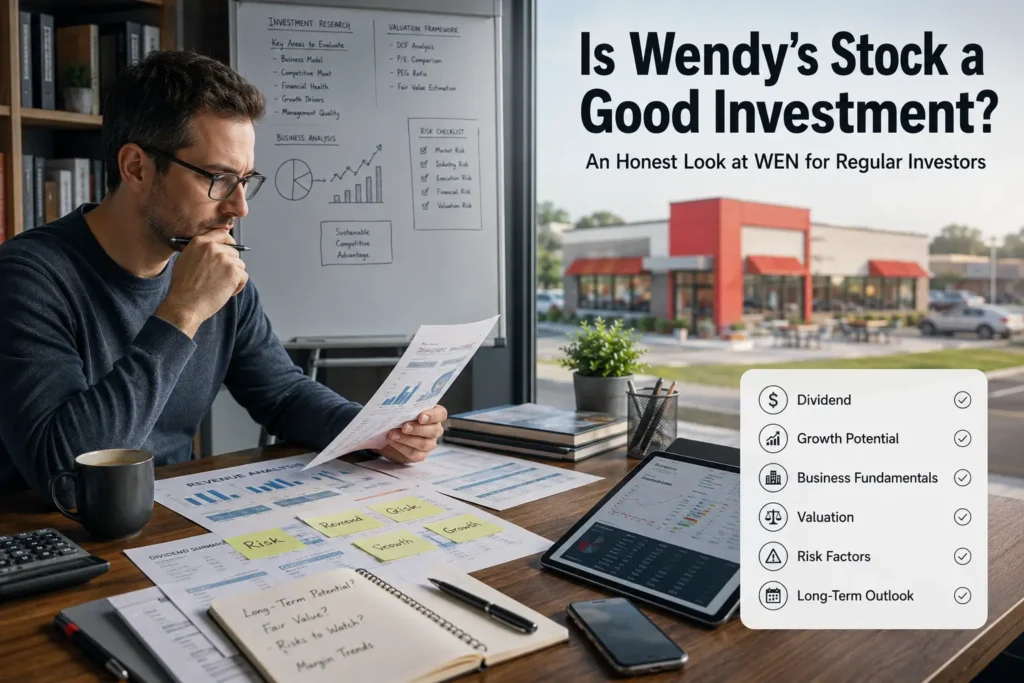
So when I say I have looked honestly at Wendy’s stock, I mean it. I have skin in this game. I have also spent the last several months actually reading earnings reports, digging into the debt situation, and trying to figure out whether WEN is worth adding to, holding, or selling.
Here is everything I found.
First, What Does Wendy’s Actually Do?
Wendy’s operates and franchises quick-service restaurants. As of late 2025, there were about 5,969 locations in the United States and another 1,428 across 38 countries and territories internationally. The vast majority of those locations are franchised. That means Wendy’s does not cook the food itself at most of its restaurants. It collects royalty fees and rent from the people who do.
This is actually a pretty attractive business model in theory. You collect predictable income, you do not bear the full cost of running every kitchen, and your margins look clean on paper.
The problem is what happens when fewer people walk through the door.
The Recent Story: How WEN Got Here
This part of the story matters a lot.
Wendy’s entered 2026 in rough shape. U.S. same-store sales — that is, the measure of how existing restaurants are performing year over year — fell about 7.8% in the first quarter of 2026. Globally, same-store sales were down about 5.5%. And this was not a one-quarter blip. Same-store sales had been declining on average for two straight years.
That is a real problem. The franchise model only works beautifully when restaurants are growing their sales. When traffic falls, royalty income falls, franchise fees fall, and the whole equation gets painful fast.
The company also went through leadership turbulence. The previous CEO, Kirk Tanner, lasted less than two years before leaving for Hershey’s in early 2026. The CFO Ken Cook stepped in as interim. Then on May 21, 2026, Wendy’s appointed Robert Wright as CEO — a man who actually knows the company well, having previously served as Wendy’s chief operating officer from 2013 to 2019. A new CFO, Steve Cirulis, was also named in June 2026.
Leadership changes can mean fresh energy. Or they can just mean more uncertainty. We will not know which one this is for a while.
Then something unexpected happened. In late June 2026, WEN started spiking. The stock jumped from around $6.26 to over $8.20 in a matter of days. The reason? A mix of things — short squeeze activity from retail traders on Reddit, the new CEO and CFO appointments, and the stock being added to the Russell 2000 Growth index. At one point, the trading was so volatile that Wendy’s stock was temporarily halted.
This is worth understanding. The recent price action in WEN has more to do with Reddit momentum and short squeeze speculation than with any fundamental improvement in the business. The restaurants are not suddenly busier. The debt has not shrunk. The stock went up because a lot of traders were betting against it, and a coordinated retail push squeezed them out.
That can create real gains in the short term. It also makes the stock harder to evaluate right now.
The Numbers You Need to Know
Let me lay out the key figures as clearly as I can.
Stock price (as of early July 2026): Around $8.26–$8.29, up sharply from a 52-week low of $6.07 hit just days earlier. The 52-week high was $12.04 in July 2025.
Market cap: About $1.58 billion. That puts WEN in the small-cap category now, which is a significant shift. A company that used to be considered a mid-cap has seen its market value roughly cut in half over the past couple of years.
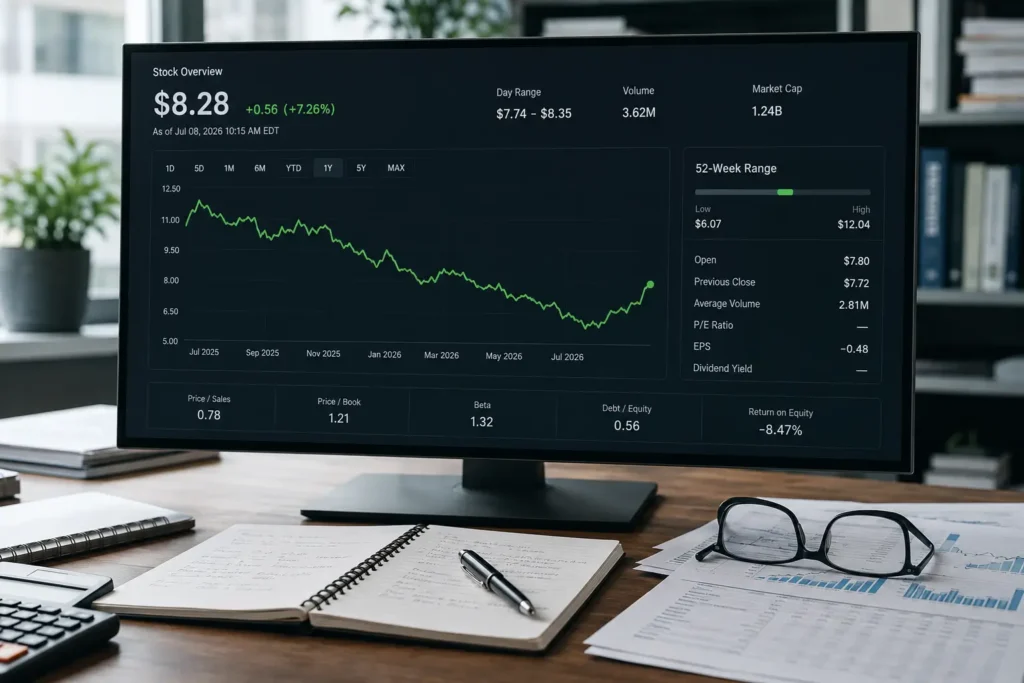
Dividend: Wendy’s pays $0.56 per share annually, distributed quarterly at $0.14 per quarter. At recent prices around $8.30, that works out to a dividend yield of roughly 6.76%–7.7% depending on which source you look at.
Debt: This is the big number. Wendy’s carries about $4.12 billion in total debt. Their cash on hand is roughly $298–447 million depending on the quarter. That means their net debt position is somewhere around $3.7–3.8 billion. For a company with a market cap of $1.58 billion, that is a very heavy debt load. We are talking about a debt-to-equity ratio of around 2,900–3,500%.
Free cash flow: About $222 million over the last twelve months. The company does generate real cash. It is not losing money operationally. But that cash has to service all that debt, fund operations, and pay the dividend.
P/E ratio: Trailing P/E is around 10.6x. Forward P/E is around 14.5x. By raw valuation, the stock looks inexpensive compared to the broader restaurant industry.
Analyst consensus: As of late June 2026, 19 analysts have a Hold consensus on WEN. The average price target sits around $7.84–$8.70. One analyst at Morgan Stanley maintained a Sell rating with a $7.00 target as recently as June 2026.
The Dividend: The Main Reason People Buy This Stock
Here is what attracted me to WEN in the first place. And honestly, what still makes it interesting to some investors.
A dividend yield above 6% is genuinely high. Most S&P 500 stocks yield under 2%. So when you see a recognisable brand paying out 7%, it catches your eye.
But there is a catch — and it is a big one.
The dividend has not been growing. It has actually been cut before. WEN cut its dividend significantly in the past, and one analysis noted a history of unstable dividend payments with at least one annual drop of over 20%.
With same-store sales declining and debt this heavy, a future dividend cut is not impossible. If traffic stays negative through the rest of 2026 and into 2027, and cash flow comes under more pressure, the board may eventually decide the dividend is not sustainable.
A dividend that looks great today but gets cut in twelve months is not actually a good deal. So the yield alone is not enough reason to buy this stock. You have to believe the business can stabilise.
The Case FOR Wendy’s Stock
Let me steelman the bull case, because it is not crazy.
The franchise model has structural advantages. When you strip away the recent troubles, Wendy’s underlying business — owning the brand and collecting fees from franchisees — is a decent business. It does not require huge capital expenditures. Free cash flow is still positive. The model can recover if traffic improves.

The new leadership could matter. Bob Wright actually knows this company. He was there during a turnaround before. He oversaw the “4 for $4” value campaign that resonated with price-conscious customers. If he can find that kind of answer again — a simple, clear value message — foot traffic can come back. These things have happened before in fast food.
International growth is still working. Domestically, Wendy’s is struggling. But the international business has been holding up better. There are expansion opportunities outside the U.S. that could add to the revenue picture over time.
The stock is cheap on earnings. A forward P/E of around 14–15x is not expensive for a restaurant brand with global recognition. If the company can stabilise earnings, the current price could look low in hindsight.
The Altman Z-Score is a concern, not a death sentence. WEN’s Z-score of 1.09 is technically in the zone that suggests financial stress. But this metric does not account for the fact that franchise businesses carry structural debt by design. It is not the same as a manufacturer or retailer with a similar number. Context matters.
The Case AGAINST Wendy’s Stock
This is where I have to be honest with you, because I wish someone had been this direct with me before I bought.
The debt is genuinely scary. $4.12 billion in debt for a company with a $1.58 billion market cap is not something to brush aside. Interest payments are not well covered by earnings — one analysis estimated only 2.5x net interest coverage. That is thin. If anything goes wrong — another revenue decline, rising interest costs, or a recession — this debt becomes a serious problem.
Same-store sales are still falling. The most recent quarter showed U.S. same-store sales down about 7.8%. The quarter before was down about 10%. These are not small dips. This is sustained traffic loss. Until that trend reverses, the fundamentals are getting worse, not better.
The recent stock rally is not about the business. I want to be very clear about this. The jump from $6.26 to $8.26 in late June was driven by retail traders, short squeeze dynamics, and index inclusion. The actual restaurants did not get busier. The debt did not shrink. The same-store sales trend did not flip. Buying into a short squeeze late is one of the easier ways to lose money quickly, and comparisons have been made to the Beyond Meat short squeeze of late 2025, which spiked and then collapsed.
The dividend could be cut. This is not just theoretical. WEN has cut its dividend before. With earnings per share at about $0.78 over the last twelve months and a $0.56 annual dividend, the payout ratio is high. Any earnings deterioration puts that dividend at risk.
Leadership was unstable. Wendy’s had a CEO leave after less than two years; an interim CEO who was also a relatively new CFO; and now a new CEO and new CFO both starting within weeks of each other. That is a lot of change in a short period. New leaders can bring good things. They also take time to get results, and during that time the ship keeps drifting.
My Personal Failure With This Stock
I want to return to what I mentioned at the beginning, because I think it is useful.
I bought WEN shares when the stock was around $15. My thinking was simple: strong brand, reliable dividend, defensive sector. Fast food does well in downturns because people trade down from more expensive restaurants.

All of that reasoning was technically sound. But I made a classic mistake.
I did not look seriously at the debt.
I saw the dividend yield and stopped thinking. I did not ask, ‘What happens to this dividend if foot traffic drops?’ What happens to a company carrying $4 billion in debt if its cash flow shrinks? What is the real buffer here?
There was not enough buffer. And I paid for that oversight.
I am not sharing this to sound dramatic. I am sharing it because a lot of people buy dividend stocks the exact same way I did — they see the yield, recognise the brand, and assume the rest will take care of itself. Sometimes it does. This time it did not.
That lesson cost me real money. Hopefully it saves you some.
So Who Should Actually Consider WEN?
Here is my honest take on who this stock makes sense for right now.
Patient investors who believe in the turnaround. If you think Bob Wright is the right person, that same-store sales can stabilise within 2–3 quarters, and that the debt is manageable — then the current price could look attractive in two or three years. You are essentially betting on a business recovery. That is a speculative bet right now, not a conservative one.
Income-focused investors who accept the risk. If you understand the dividend could get cut, understand the debt picture, and still want the income at this yield, small positions might make sense. But going heavy into this stock for the dividend alone is how people get hurt.
Short-term traders who got in early. If you bought WEN at $6 or below based on the short squeeze setup, you may already be sitting on good gains. That is a different conversation entirely. Just know that momentum-driven moves can reverse just as fast as they came.
Who should probably avoid it: Anyone looking for a stable, conservative, low-risk investment. Anyone who cannot afford to see their position drop another 20–30% while waiting for a turnaround. Anyone who is mostly attracted to the yield without understanding the risks attached to it.
The Bottom Line
Wendy’s is not a bad company. It has been around since 1969. It has a globally recognised brand, a real franchise business, and a new leadership team that has a chance to turn things around.
But the stock is not a simple, easy buy right now.
The debt is heavy. Same-store sales have been declining for two years. The recent price spike was driven by traders, not business results. And the dividend, while attractive on paper, has real question marks around its sustainability.
Is there a scenario where WEN stock is at $12 or $14 in two years? Yes. That scenario requires same-store sales to stabilise, new leadership to execute, and the broader consumer spending environment to improve. It is possible.
Is there also a scenario where the dividend gets cut, the debt becomes a bigger issue, and the stock slides back below $7? Also yes. Maybe more likely in the short term.
My take: WEN is a watchlist stock. Not a panic sell, but not an obvious buy either. The story needs another quarter or two of data before we know whether the turnaround has any real traction.
If you already own it, I would not rush to sell at these levels — especially if you bought lower. If you do not own it and you are thinking about starting a position, be very honest with yourself about how much risk you are actually comfortable with.
And please — whatever you do — do not buy it just because Reddit is excited about it.
I learnt that lesson the expensive way so you do not have to.
This post reflects my personal opinions and is for informational purposes only. It is not financial advice. Always consult a licensed financial advisor before making investment decisions.