
I watched it happen in real time. Here is everything I know, everything I think, and the one decision I deeply regret.
I was not supposed to be awake at 11 PM on June 24.
But I had a position in Micron. A modest one. And the earnings report was dropping after the market closed that evening. So there I was, sitting in bed with my laptop, refreshing my broking app like a person with very questionable life priorities.
Then the numbers came through.
Revenue of $41.46 billion. Against analyst expectations of around $35.84 billion. Earnings per share of $25.11. Against estimates of roughly $20.28.
I sat there for a moment just reading those numbers again. Not because I didn’t understand them. But because they were so far ahead of what Wall Street expected that I needed a second to make sure I was reading them correctly.
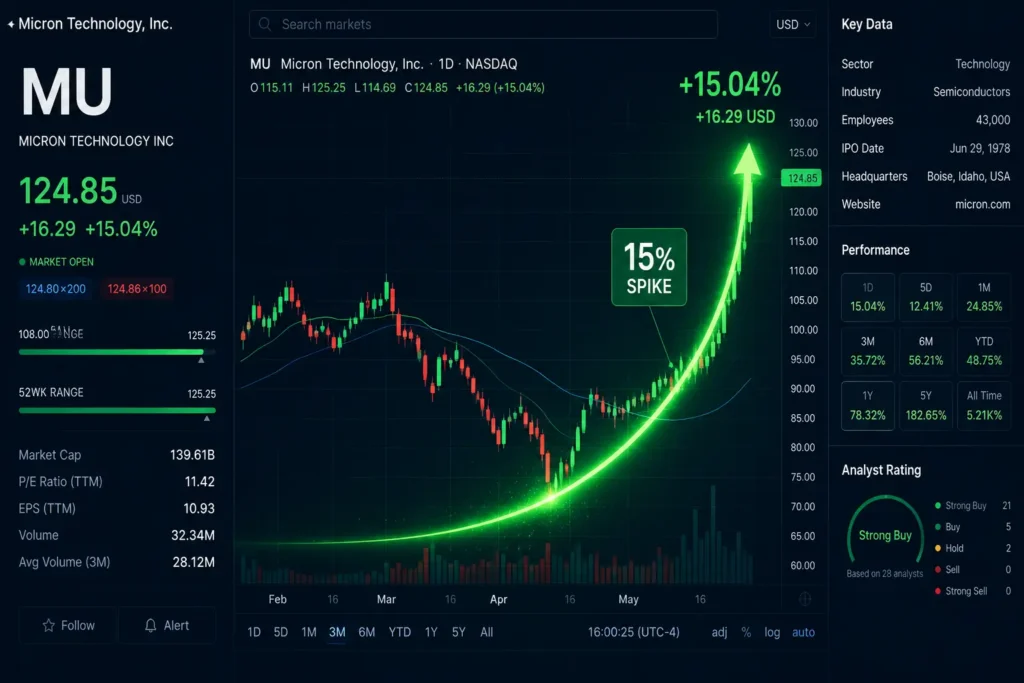
The stock was already up 12% in after-hours trading.
By the next morning it had settled at a 15% gain. Trading around $1,200 per share.
I have been following Micron for about two years. I have never seen a single-night move like that on a stock this size. This is a company with a market cap that recently crossed one trillion dollars. A 15% overnight move on a trillion-dollar company is not normal. At all.
So let me break down exactly what happened. Why the market reacted the way it did. And whether MU is still worth buying at $1,200 now that the dust has settled.
What Micron Actually Reported
Before anything else, you need to understand the numbers. Because without the numbers, the rest of this doesn’t make sense.
Micron reported fiscal third quarter 2026 results on June 24, after US markets closed.
Revenue came in at $41.46 billion. One year ago, in the same quarter, Micron reported revenue of $9.3 billion. That is not a typo. Revenue more than quadrupled year over year. In a single twelve-month period.
Earnings per share came in at $25.11. Against analyst estimates of around $20.28. That is a beat of nearly 24%. In the world of large-cap earnings, a 24% beat is extraordinary. Most stocks pop 5% on a 5% earnings beat. Micron beat by nearly five times that margin.
Gross margins came in at 84.6%. A year ago, gross margins were 37.7%. The improvement in profitability over twelve months is the kind of thing that makes people do double-takes.
And then there was the guidance.
For the next quarter, Micron guided revenue of approximately $50 billion. Analysts had been expecting around $43.58 billion. That guidance alone would have moved the stock. Combined with the earnings beat, it sent it into another dimension.
The company also announced that it has signed 16 long-term agreements with customers, including data centre operators and automakers. These agreements are binding commitments to purchase Micron chips over three to five years. Total financial commitments from these agreements: $22 billion.
That last part matters a lot. I will explain why shortly.
Why the Market Reacted So Strongly
A 15% move on a trillion-dollar company needs more than a good earnings quarter to explain it. So what was really going on?
Three things came together at once.
The first was the size of the beat. Wall Street had already set high expectations for Micron going into this report. The stock had run up significantly ahead of earnings. When a stock runs up into earnings, it usually means the market expects good numbers. When Micron then beat those already-high expectations by nearly 24%, the market was caught off guard in the best possible way.

The second was the guidance. Guiding $50 billion in revenue for the next quarter was not just better than expected. It was the kind of guidance that forces analysts to completely rebuild their models. Several major banks raised their price targets on Micron within hours of the report. When analyst price targets move significantly higher at the same time, it creates buying pressure that compounds the initial move.
The third was the long-term agreements.
Here is the thing about Micron that investors have wrestled with for years. Memory chips are a cyclical business. What goes up comes down. Prices spike during shortages and collapse during oversupply. Micron has historically been a company where you made money by timing the cycle correctly, not by holding forever.
The 16 long-term agreements change that story. If approximately half of Micron’s revenue is now locked into multi-year contracts with binding purchase commitments, the company looks much less cyclical than it used to. That is a genuine structural change to the investment case. And the market priced it in overnight.
The HBM Story You Need to Understand
I cannot talk about Micron without talking about HBM. High-bandwidth memory.
Most people outside the chip industry have never heard of HBM. But if you use any AI product, anywhere, you are depending on it every single time.
AI chips, the kind Nvidia makes, need enormous amounts of memory bandwidth to function. Standard memory chips are too slow. HBM solves this by stacking memory chips vertically and connecting them through tiny vertical channels, creating far higher data transfer speeds than traditional memory.
Every major AI chip in production today uses HBM. Nvidia’s chips use it. Google’s custom chips use it. AMD’s AI accelerators use it. Without HBM, modern AI infrastructure would not function.
Only three companies in the world make HBM at scale. SK Hynix is the largest. Samsung is second. Micron is third. But Micron is the only US-headquartered manufacturer of HBM at a meaningful scale. That gives it a unique position in the context of US government efforts to build domestic semiconductor supply chains.
Micron’s entire 2026 HBM production is already sold out under binding contracts. That is not a marketing claim. Those are real contracts. Demand extending well into 2027 and 2028. And Micron is already shipping its newest generation, HBM4, for Nvidia’s next platform.
When you understand the HBM situation, the earnings numbers make complete sense. Micron is not selling a commodity product into a spot market. It is selling a specialised, irreplaceable component into a market where demand significantly exceeds supply. That combination produces the kind of margins and earnings growth that appeared in the Q3 report.
The Failure I Have to Tell You About
I need to pause here and tell you something that embarrasses me.
Eight months ago, in October 2025, I sold a significant portion of my Micron position.
The stock had run up sharply earlier in the year. My cost basis was well below where it was trading. I had made a solid gain, and I decided to take some money off the table. Lock in the profit. Be sensible.
I told myself I was being disciplined. I told myself that memory chips are cyclical. I told myself the valuation looked stretched.
All of that was reasonable thinking. None of it was wrong, exactly.
But I sold at around $200 per share.
The stock is now trading at $1,200.
I did not need to hold all of it. I did not need to be a hero. But selling the size I did, at the point I did, based on a generic concern about cyclicality that did not account for the structural change that HBM was creating, was a mistake. A costly one.
The lesson I took from it is not that you should never take profits. Taking profits is fine. The lesson is that when a company’s business model is genuinely changing, you have to update your thinking. I applied an old mental model for Micron to a new version of the company. The old Micron was a cyclical memory vendor. The new Micron was becoming something different. I missed that shift.
I am not telling you this to be dramatic. I am telling you because I think it is the most honest and useful thing I can share. Investors make these mistakes all the time. The important thing is understanding what went wrong so you do not repeat it.
So Is MU Still a Buy at $1,200?
This is the question everyone is asking right now. And I want to give you an honest answer rather than a vague one.
Let me lay out both sides clearly.
The case for buying at $1,200 is not obviously wrong.
At current prices, Micron trades at roughly 10 to 14 times forward earnings. That is a low multiple for a company growing earnings at the rate Micron is growing them. Compare that to Nvidia, which trades at around 25 times forward earnings, doing similar things in the AI supply chain. If you believe Micron’s earnings power is durable rather than cyclical, the stock is arguably cheap relative to its peers.
The long-term agreements reduce the cyclical risk that has historically capped Micron’s valuation. If half the company’s revenue is locked in at pre-agreed pricing, the memory cycle has less power over Micron’s earnings than it used to. That is a legitimate reason to value the company differently than the market has historically valued it.
HBM supply is constrained through at least 2027. Demand from AI infrastructure is not going away. Micron is one of three companies on earth that can meet that demand at scale. That supply and demand picture is favourable for at least the next year.
Thirty out of thirty analysts who cover Micron currently rate it a buy. That is a strong consensus.
Now here is the honest other side.
The stock is up roughly 700% over the past year. That kind of move prices in a lot of good news. When a stock’s price is in a lot of good news, even small disappointments create large selloffs.
Memory has always been cyclical. Long-term agreements reduce but do not eliminate that cyclicality. When new fabrication capacity comes online in 2027 and 2028, from Micron’s new facilities, from SK Hynix’s expansion, and from Samsung’s recovery, supply could increase meaningfully. If supply increases while AI model efficiency also improves, demand for memory per AI chip could grow more slowly than the market currently expects. That combination would pressure pricing.
Goldman Sachs, one of the more cautious voices on the street, has a price target well below current trading levels. Their concern is that today’s margins represent a peak, not a sustainable floor.
The CEO of Micron sold stock heavily in late May at prices between $942 and $979. Insider selling is not always a signal. Executives sell shares for many reasons. But selling that volume at those prices while the stock was not yet at current levels is something an honest analysis has to acknowledge.
My opinion? At $1,200, Micron is not obviously cheap, and it is not obviously expensive. It is a company with genuinely strong fundamentals trading at a price that requires things to continue going well. If the AI infrastructure build continues at its current pace through 2027, the current price will look reasonable in hindsight. If something disrupts that picture, whether a slowdown in AI spending, a supply surge, or something nobody can predict today, the stock has significant room to fall from here.
What I Am Actually Doing With My Position Right Now
I said I sold too much at $200. So where do I stand today?
I still hold a smaller position than I wish I did. But I am holding what I have.
I am not adding significantly at $1,200. Not because I think the company is a bad business. I think it is an excellent business in a genuinely favourable position. But I try to be honest with myself about the difference between what I know and what I am hoping. At $1,200, a meaningful portion of the return requires things to continue going exactly right. That is a different risk profile than buying a fundamentally strong company at a reasonable price.
If the stock pulls back to the $900 to $1,000 range, I would be interested in adding. That would still be a very high price relative to where Micron was one year ago. But it would represent a more reasonable entry point given the current earnings power.
If you have no position in Micron and you are thinking about starting one, a small position at current prices is not unreasonable. But think carefully about sizing. A stock that can go up 15% in one night can also go down 15% in one night. That is just the reality of how volatile this stock has become.
The Bigger Picture
Zoom out for a moment.
What Micron’s earnings report told us is not just about Micron. It is about the state of AI infrastructure spending.
When a company reports that revenue more than quadrupled year over year, that money is coming from somewhere. It is coming from the hyperscalers. Amazon, Microsoft, Google, and Meta. These companies are spending at a scale that is generating the kind of demand that turns a memory chip company into a trillion-dollar business in twelve months.
That spending is real. It is happening. And it is feeding through into the earnings of every company in the AI supply chain.
Whether that spending continues at this rate, accelerates, or eventually normalises is the central question for technology investing right now. Micron’s results give you one very current, very detailed data point. The data point says the spending is holding up.
That is worth knowing, regardless of whether you own Micron or not.
A Final Honest Note
I am not a financial advisor. I am not your financial advisor. Nothing in this post is investment advice.
What I am is someone who has followed this company for two years, watched last week’s earnings in real time, and tried to think clearly about what it means. I have shared my honest thinking and my genuine mistake.
The decision about whether to buy, hold, or sell MU at any price is yours to make based on your own research, your own financial situation, and your own risk tolerance.
What I can tell you is that the earnings report was real. The numbers were real. The structural change in how Micron is selling its products is real. And the uncertainty about what happens next is also real.
All of that is true at the same time. That is usually what investing looks like.
Are you holding Micron right now or thinking about starting a position? Tell me in the comments what you are thinking. I read everything and I find these conversations genuinely useful.
This post reflects my personal experience and opinions and is not financial or investment advice. I may hold a position in the securities mentioned. Always do your own research and consult a financial professional before making investment decisions.