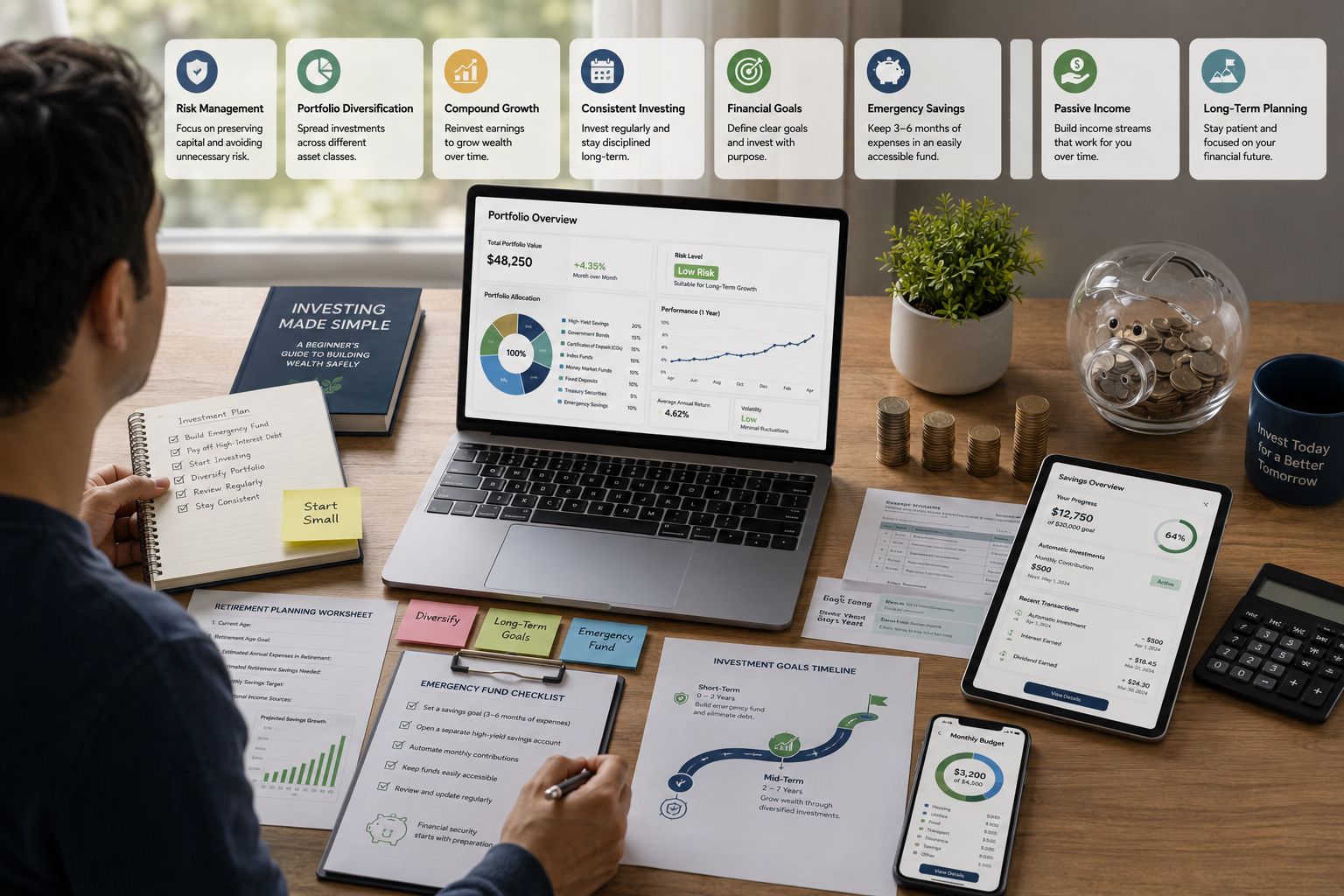
Starting your investment journey can feel overwhelming, but 2026 offers fresh opportunities to build real wealth. This step-by-step roadmap is designed for complete beginners who want to start investing but don’t know where to begin, as well as those looking to refine their financial planning approach.
You’ll discover how to set clear financial goals and build a rock-solid foundation for your investment portfolio. We’ll walk through mastering tax-advantaged strategies that can save you thousands over time, plus show you how to assess your risk tolerance so you invest at a comfort level that lets you sleep well at night.
By the end of this guide, you’ll have a practical investing roadmap that takes the guesswork out of building wealth. No complicated jargon or confusing theories – just straightforward steps you can start using today to create your financial future.
Set Clear Financial Goals and Build Your Foundation

Create SMART financial goals with specific targets and timelines
Successful investing starts with establishing clear, measurable financial goals that provide direction for your investment strategy. When setting your investment goals, specificity is crucial for creating an effective investment plan and staying focused on your progress.
Rather than setting vague objectives like “saving for the future,” create precise goals such as saving $100,000 for a down payment within 10 years or building a $500,000 retirement fund by age 65. This level of specificity helps you make more informed investment decisions and celebrate milestones along the way.
Your investment goals should be categorized by time horizons to optimize your asset allocation strategy:
Short-term goals (1-3 years): Emergency fund, vacation, car purchase, wedding expenses
Medium-term goals (3-10 years): House down payment, graduate school funding, starting a business
Long-term goals (10+ years): Retirement savings, wealth accumulation, estate planning
The time horizon directly influences your investment approach. Short-term goals require lower-risk investments emphasizing liquidity and stability, while long-term goals can pursue higher growth potential investments that may fluctuate in value year-to-year but tend to generate stronger returns over extended periods.
For medium-term objectives, balance risk and return by selecting investment options offering moderate growth potential while minimizing significant loss risk. This goals-based investing approach customizes your investment strategies to match your personal objectives rather than simply trying to “beat the market.”
Open a brokerage account and automate monthly investments
With your financial goals established, the next critical step involves choosing the appropriate investment accounts to house your investments. Your account selection should align with your specific objectives and time horizons established in your goal-setting process.
For most beginners, opening a taxable brokerage account provides flexibility for various investment goals beyond retirement. These accounts offer unrestricted access to your funds and no contribution limits, making them ideal for medium-term goals like home purchases or education funding.
Additionally, consider tax-advantaged retirement accounts such as 401(k)s and IRAs for long-term wealth building. These accounts provide significant tax benefits that can accelerate your progress toward retirement goals through tax-deferred growth or tax-free withdrawals.
Automation plays a crucial role in investment success by removing emotional decision-making and ensuring consistent progress toward your goals. Set up automatic monthly transfers from your checking account to your investment accounts, treating these contributions as non-negotiable expenses.
Start with an amount you can comfortably sustain, even if it seems small initially. The power of compounding rewards consistency over time, and you can increase contributions as your income grows. Regular investing through dollar-cost averaging also helps smooth out market volatility by purchasing more shares when prices are low and fewer shares when prices are high.
Build optimal cash reserves without over-saving
Building an emergency fund represents a fundamental short-term investment goal that provides financial security for unexpected expenses. This safety net should be kept in low-risk, easily accessible investments such as high-yield savings accounts, cash management accounts, or money market funds.
The key principle is ensuring your emergency funds remain liquid and readily available when needed most. Unlike long-term investments that can weather market volatility, emergency funds prioritize preservation of capital and immediate accessibility over growth potential.
However, avoid over-saving in low-yield accounts at the expense of long-term wealth building. Once you’ve established an adequate emergency fund covering 3-6 months of expenses, additional savings should be directed toward investment goals that offer greater growth potential.
This balanced approach prevents the common pitfall of keeping excessive amounts in savings accounts earning minimal interest while missing opportunities for compound growth in diversified investment portfolios. Your cash reserves should serve their specific purpose as a financial safety net without hindering your overall investment strategy.
Regular review of your cash position ensures you maintain optimal liquidity without sacrificing long-term financial growth. As your income and expenses change, adjust your emergency fund accordingly while directing surplus savings toward your medium and long-term investment objectives.
Master Tax-Advantaged Investing Strategies

Maximize IRA and HSA contributions before deadlines
With this in mind, next, we’ll explore the new landscape of tax-advantaged accounts available to investors in 2026. The introduction of Trump Accounts has fundamentally expanded the investment planning options for families, particularly those with children under 18.
Trump Accounts represent a revolutionary approach to long-term wealth building, offering tax-deferred growth similar to custodial Traditional IRAs but with unique advantages. Unlike traditional IRAs, these accounts don’t require earned income for contributions, making them accessible to families regardless of their employment status. The government provides a $1,000 seed deposit for children born between 2025-2028, jumpstarting the investment journey from birth.
The contribution structure allows up to $5,000 per year per child from family members, with an additional $2,500 potential from employer contributions. This creates significant opportunities for accelerated wealth building, as illustrated by projections showing accounts growing to $742,000 with maximum annual contributions of $5,000 over 18 years.
For HSA maximization, remember that these accounts offer triple tax advantages deductible contributions, tax-free growth, and tax-free withdrawals for qualified medical expenses. Combined with Trump Accounts, families can create a comprehensive tax-advantaged investment strategy that spans healthcare costs and long-term financial security.
Understand capital gains implications for taxable accounts
Now that we have covered the tax-advantaged account opportunities, understanding capital gains implications becomes crucial for your broader investment portfolio strategy. While Trump Accounts offer tax-deferred growth until withdrawal, taxable investment accounts require careful consideration of timing and tax efficiency.
The reference to tax-deferred growth in Trump Accounts highlights the importance of understanding how different account types are taxed. In taxable accounts, you’ll face capital gains taxes on profitable investments when sold, making strategic timing essential for tax optimization.
Trump Accounts function similarly to Traditional IRAs regarding tax treatment, with contributions and earnings growing tax-deferred. This means understanding the distinction between tax-deferred accounts and taxable accounts becomes vital for comprehensive financial planning in 2026.
Implement tax-loss harvesting to reduce tax burden
Previously, I’ve emphasized the importance of understanding various account types, and tax-loss harvesting represents a sophisticated strategy for managing your taxable investment accounts alongside your tax-advantaged options.
While Trump Accounts grow tax-deferred and don’t require active tax management until withdrawal, your taxable accounts benefit significantly from strategic tax-loss harvesting. This involves selling investments at a loss to offset capital gains from profitable investments, thereby reducing your overall tax burden.
The key is coordinating your tax-loss harvesting strategy with your Trump Account contributions and overall investment planning approach. Since Trump Account contributions aren’t tax-deductible until the child reaches 18, maintaining a balanced approach across all account types ensures optimal tax efficiency throughout your investment journey.
Consider implementing tax-loss harvesting in December each year to maximize the strategy’s effectiveness, while simultaneously planning your Trump Account contributions for the following year to maintain consistent progress toward your long-term financial goals.
Assess and Adjust Your Risk Tolerance

Take Risk Tolerance Questionnaires to Align Investments with Comfort Level
Understanding your risk tolerance is fundamental to developing a successful investment strategy for 2026 and beyond. Risk tolerance questionnaires, such as those developed by university financial planning professors Dr. Ruth Lytton at Virginia Tech and Dr. John Grable at the University of Georgia, provide scientifically-backed assessments to determine your comfort level with investment fluctuations.
These questionnaires evaluate subjective factors including your financial situation, investment experience, and emotional response to market volatility. There are no “right” or “wrong” answers the goal is to honestly assess your personal comfort with risk. Professional platforms like Vanguard’s Investor Questionnaire suggest asset allocations across three broad investment classes: stocks, bonds, and short-term reserves based on your responses.
The assessment process considers your investment objectives, time horizon, and current financial circumstances. Your results will indicate an appropriate asset allocation that balances potential returns with your risk tolerance level. Remember that these tools provide general guidelines rather than comprehensive investment advice, and your risk tolerance may evolve as your financial situation and experience change.
Rebalance Portfolio Quarterly to Maintain Target Allocation
Now that we have established your risk tolerance through proper assessment, maintaining your target asset allocation becomes crucial for long-term financial success. Quarterly rebalancing ensures your portfolio stays aligned with your intended investment mix as market movements cause allocations to drift from their targets.
Market fluctuations naturally alter your portfolio’s composition when stocks perform well, they may represent a larger percentage of your holdings than originally planned. Regular rebalancing involves selling overweight positions and purchasing underweight assets to restore your target allocation. This disciplined approach forces you to sell high-performing assets and buy underperforming ones, following the fundamental investment principle of buying low and selling high.
The quarterly timeframe provides an optimal balance between staying on track and avoiding excessive trading costs. More frequent rebalancing may result in unnecessary transaction fees and tax implications, while less frequent adjustments allow allocations to drift too far from targets. Consider making modifications gradually to lessen the impact of significant market changes and potential tax consequences.
Review Investment Mix After Major Life Changes
With quarterly rebalancing established as your maintenance strategy, it’s essential to recognize that major life events require more comprehensive portfolio reviews. Significant changes in your financial circumstances, career, family situation, or goals necessitate reassessing your entire investment approach.
Life events such as marriage, divorce, job changes, inheritance, or approaching retirement fundamentally alter your financial landscape. These circumstances may shift your time horizon, risk capacity, and investment objectives, requiring adjustments beyond routine rebalancing. Your answers to risk tolerance questionnaires may change based on new experiences and evolving goals.
During these reviews, reassess your asset allocation across stocks, bonds, and short-term reserves to ensure alignment with your updated situation. Consider factors such as changes in income stability, new financial responsibilities, or shifts in your investment timeline. The investor questionnaire should be completed again when major life changes occur, as your previous asset allocation may no longer serve your current needs.
Professional consultation with investment advisors, accountants, or financial planners becomes particularly valuable during these transition periods. They can help navigate complex decisions and ensure your investment strategy adapts appropriately to your changing circumstances while maintaining focus on your long-term wealth-building objectives.
Consolidate and Optimize Your Investment Accounts

Roll over old 401(k)s and consolidate scattered accounts
Managing multiple investment accounts across different providers can create unnecessary complexity in your financial planning journey. When you have investments scattered across various institutions, it becomes challenging to maintain a complete view of your portfolio and make strategic decisions about asset allocation. The most common consolidation opportunity involves rolling over your 401(k) from a former employer to either your new employer’s 401(k) plan or to a rollover IRA.
A rollover IRA typically offers more investment options and access to different services compared to employer-sponsored plans. However, before making this decision, carefully consider the unique investment choices in your current 401(k), including potentially lower-cost institutional shares, fees and expenses, and tax implications. Additionally, evaluate the plan’s withdrawal rules and the creditor protection it generally offers, as employer plans are typically better shielded from creditors than IRAs.
For self-employed individuals or those considering entrepreneurship, rolling over your 401(k) into a small business retirement plan such as a SEP IRA or self-employed 401(k) presents another consolidation opportunity. This strategy can streamline your investment management while potentially providing additional tax advantages.
Consolidating accounts provides a complete view of your investments, making it easier to track your overall asset mix and implement effective rebalancing strategies. When all your investments are in one place, you can avoid duplicating exposure to certain investment types and maintain your intended asset allocation more efficiently.
Update beneficiaries and contact information regularly
Maintaining current beneficiary information across all your investment accounts is a critical but often overlooked aspect of financial planning. As you consolidate your accounts, this presents an ideal opportunity to review and update all beneficiary designations to ensure they reflect your current wishes and life circumstances.
Regular updates become even more important when you’re managing multiple accounts, as outdated information can lead to complications during estate settlement. Life events such as marriage, divorce, birth of children, or death of previously named beneficiaries require immediate attention to your account details.
When consolidating with a single provider, you can more easily track and maintain consistent beneficiary information across all your accounts. This centralized approach reduces the risk of overlooking updates on scattered accounts and ensures your estate planning intentions are properly documented.
Contact information updates are equally important, as financial institutions need current details to communicate important account changes, tax documents, and other critical information. Keeping this information current across consolidated accounts becomes more manageable and helps prevent missed communications that could affect your investment strategy.
Transfer assets to preferred investment platforms
Once you’ve identified opportunities for consolidation, the actual transfer process requires careful consideration of potential costs and benefits. Some transfers may require liquidating certain investments, which could trigger tax consequences that need to be weighed against the advantages of consolidation.
When evaluating investment platforms, consider the fees and commissions you’re currently paying across multiple providers. You might be paying more than necessary when investing through various institutions. Some providers offer lower overall costs than others, and consolidating assets with a single company may make you eligible for reduced fees, lower commissions, or additional services based on your total account value.
Technology and security features should also influence your platform selection. Look for institutions that provide strong encryption, advanced firewalls, and secure communication methods. Essential security features include two-factor authentication for extra protection on logins and sensitive transactions, money transfer locks to block unauthorized electronic transfers, and security text alerts for instant notifications about account activity.
Consider the protection your money receives through FDIC insurance for cash deposits (generally up to $250,000 per account) and SIPC protection for securities (up to $500,000, including $250,000 for cash in brokerage accounts). Understanding these protections helps ensure your consolidated assets remain secure.
The transfer process becomes more effective when you can implement tax-efficient strategies more easily. With consolidated accounts, tax-loss harvesting in taxable accounts becomes simpler as you can readily see gains and losses in one place. Asset location strategies also become more convenient, allowing you to keep tax-efficient investments in taxable accounts while placing less tax-efficient assets in tax-advantaged accounts like IRAs.
Protect Your Wealth Through Estate Planning

Create essential estate documents including wills and powers of attorney
Now that we have covered optimizing your investment accounts, protecting your wealth through proper estate planning becomes paramount for long-term financial success. Essential estate documents serve as the foundation for safeguarding your assets and ensuring your wishes are carried out according to your intentions.
The cornerstone of any estate plan is a comprehensive will that clearly outlines how your assets should be distributed upon your death. Without a proper will, your estate could face unnecessary complications, costly legal proceedings, and potential disputes among beneficiaries. Powers of attorney documents are equally critical, designating trusted individuals to make financial and healthcare decisions on your behalf should you become incapacitated.
Beyond basic wills, consider implementing revocable and irrevocable trusts as powerful estate planning tools. Revocable trusts allow you to maintain control over your assets during your lifetime while avoiding the lengthy and public probate process. Irrevocable trusts, though requiring you to relinquish control, provide superior protection from creditors, lawsuits, and estate taxes.
For those with significant assets, advanced strategies like Asset Protection Trusts (APTs) offer maximum protection against creditor claims and legal challenges. These sophisticated instruments can shield your wealth from potential future liabilities while preserving your legacy for beneficiaries.
Understand gift tax limits and estate tax exemptions
Strategic gift planning represents a powerful method for reducing your taxable estate while benefiting loved ones during your lifetime. The IRS establishes annual gift exclusions that allow you to transfer wealth without triggering gift taxes – currently $18,000 per individual or $36,000 per couple in 2024.
Understanding these limits enables you to implement systematic wealth transfer strategies that gradually reduce your estate’s size over time. By maximizing annual exclusions year after year, you can transfer substantial assets to heirs while minimizing tax implications. This approach proves particularly effective for families seeking to preserve wealth across generations.
Estate tax exemptions work in conjunction with gift planning to protect larger estates from excessive taxation. Proper planning around these thresholds ensures your beneficiaries receive maximum value from your life’s work, rather than losing significant portions to unnecessary tax burdens.
Family Limited Partnerships (FLPs) offer another sophisticated approach to gift planning, allowing parents or grandparents to maintain majority control while gradually transferring limited partnership shares to heirs. This strategy provides asset protection benefits while generating favorable tax treatment, especially for families with substantial business or real estate holdings.
Review and update estate plans after major life events
Estate planning requires ongoing attention and periodic updates to remain effective as your circumstances evolve. Major life events such as marriage, divorce, birth of children, significant changes in wealth, or relocation to different states all necessitate comprehensive reviews of your estate planning documents.
Changes in tax laws and regulations also impact the effectiveness of existing estate planning strategies. What worked optimally under previous tax regimes may require adjustment to maintain maximum benefit under current legislation. Regular reviews ensure your estate plan continues serving your evolving needs and objectives.
Professional advisors specializing in estate planning, business succession, and taxation can help navigate these complexities and identify opportunities for enhanced wealth preservation. Their expertise proves invaluable when dealing with sophisticated strategies like Qualified Personal Residence Trusts (QPRTs) or charitable remainder trusts that combine philanthropy with tax advantages.
Good estate planning means adapting to both changing personal circumstances and evolving legal landscapes. Proactive planning and regular updates help secure your legacy while providing peace of mind that your wealth will transfer efficiently to your intended beneficiaries according to your wishes.
Secure Your Digital Financial Assets

Implement Strong Passwords and Two-Factor Authentication
Creating robust security for your digital financial assets starts with implementing strong authentication measures. Rather than using traditional passwords, consider using passphrases when available. A strong passphrase consists of random words strung together with a mix of symbols, numbers, and both uppercase and lowercase letters. Avoid common phrases from literature, music, or personal information like your name or birthday.
If passphrases aren’t available, select a strong password with at least twelve characters that includes symbols, numbers, and mixed-case letters. Never use dictionary words or personal information, and avoid sharing passwords via electronic messaging or phone calls. Change your passwords regularly and use different passwords for different accounts – using the same password across multiple financial accounts is equivalent to using one key for your car, house, and mailbox.
Enable two-step verification or multifactor authentication whenever possible. This practical security layer requires a second factor beyond your username and password. When logging in from an unrecognized device, your investment firm sends a unique code to your email or mobile device, which you must enter along with your password to gain access.
Consider adding biometric safeguards such as fingerprint, facial recognition, voice recognition, or iris scanning if your brokerage firm offers these options. These can work alongside or instead of traditional passwords, providing an additional layer of security for your investment accounts.
Monitor Account Access and Review Login Histories
With your strong authentication in place, consistently monitoring your account access becomes crucial for maintaining security. Turn on account alerts to receive real-time notifications about various account activities. These alerts can notify you of account logins, failed login attempts, password changes, personal information updates, securities transactions, money transfers, and the addition or deletion of external financial accounts.
The availability and types of alerts vary by investment firm, so contact your provider to determine which options are available and how to activate them. Make sure your current email address and mobile phone number are up to date with all financial institutions to ensure you receive these important notifications.
Regularly review your account statements and trade confirmations for suspicious activity. Check for discrepancies such as misspelled names, inaccurate account information, or unauthorized transactions. If you discover any mistakes or unauthorized activity, contact your investment firm in writing immediately, as written complaints may be your only proof of reporting issues. Keep written records of all communications with your investment firm regarding security concerns.
When accessing accounts on mobile devices, secure them with password protection and automatic locking features. Enable remote location and device wiping applications that allow you to locate or remotely wipe data from lost or stolen devices. Install anti-virus protection on all mobile devices, just as you would on desktop computers.
Protect Against Phishing Scams and Online Fraud
Digital threats require constant vigilance to protect your investment accounts from sophisticated fraud attempts. Exercise extreme caution before clicking on any links sent to you via email or text messages. Always verify that communications containing links regarding your investment accounts come from legitimate sources.
Malicious links can direct you to fraudulent websites designed to steal sensitive account information or automatically install malware that allows criminals to access your financial data. Never click on links from unknown businesses or entities. Even for businesses you recognize, verify link legitimacy by going directly to the company’s website or calling them with a confirmed telephone number rather than clicking the link.
Be particularly careful when using public computers or wireless connections. Avoid accessing investment accounts on public computers in hotel business centers or libraries. If you must use public computers, disable password saving, delete history files and cookies, and always log out completely using the website’s logout button rather than just closing the browser.
When using public Wi-Fi networks, ensure websites use secure connections by checking that URLs begin with “https” rather than “http.” Turn off file sharing to prevent other devices on the network from accessing your files. Configure your devices to avoid automatically connecting to available Wi-Fi networks.
Keep all software and applications updated with the latest security patches, and choose privacy settings that minimize data sharing. Never allow browsers or apps to automatically save your account usernames and passwords. Store sensitive personal financial information offline rather than in cloud storage whenever possible, and if you must use cloud services, research providers thoroughly and ensure they offer encryption and two-step verification.
Develop Long-Term Wealth Building Habits

Invest in Personal Development and Skill Enhancement
Building long-term wealth extends beyond traditional investment strategies and requires continuous investment in yourself. The greatest legacy you can leave behind is knowledge, as financial wisdom becomes the foundation for sustained wealth creation. When you enhance your skills and financial literacy, you create multiple income streams and better decision-making capabilities that compound over time.
Consider dedicating a portion of your investment planning budget toward courses, certifications, or mentorship programs that align with your career goals. Professional growth in areas like market analysis, risk management, or specific trading strategies can significantly impact your earning potential and investment success. The knowledge gained from these investments often provides returns that far exceed traditional financial instruments.
Have Regular Financial Conversations with Family Members
Now that we’ve established the importance of personal development, it’s essential to share your financial wisdom with family members. Regular financial conversations create a multiplier effect, building a “wealth snowball” that grows exponentially across generations. These discussions empower your heirs with the knowledge and skills needed to manage and grow wealth responsibly.
Start these conversations early – it’s never too early to talk about money with your children. Create engaging “money lessons” that combine fun with learning, establishing memories that last a lifetime. Lead by example by demonstrating responsible financial management and sharing your financial experiences. Discuss concepts like portfolio diversification, long-term goals, and the importance of consistent investing habits.
Make these conversations structured by covering topics such as budgeting, emergency funds, and the power of compound interest. Share real examples of how your investment strategies have evolved and the lessons learned from market trends. This knowledge transfer helps break cycles of financial instability and builds a foundation for future success.
Stay Disciplined with Consistent Monthly Investment Contributions
With a solid foundation of knowledge and family engagement, maintaining disciplined investment contributions becomes crucial for long-term wealth building. Research consistently shows that successful investors build wealth by regularly investing a portion of their income over extended periods, rather than attempting frequent trading or seeking overnight riches.
Implement the proven formula: your regular investments + time = wealth. The earlier you start, the longer you have to build wealth through investing. Set up automatic contributions to ensure consistency – this “set it and forget it” approach removes emotional decision-making from your investment process.
Consider contributing 10-15 percent of your annual income to your investment portfolio, starting with tax-advantaged accounts like 401(k)s and IRAs. These vehicles provide immediate tax benefits while your employer may match contributions up to certain amounts – essentially free money that accelerates your wealth building journey.
Target date funds offer an excellent autopilot solution, automatically adjusting your asset allocation from aggressive, stock-heavy portfolios early in your career to more conservative investments as you approach retirement. This removes the complexity of constant portfolio rebalancing while maintaining appropriate risk management throughout different life stages.
Remember that market volatility is normal, and consistent contributions during both market highs and lows help average out your investment costs over time. Resist the temptation to time the market or make dramatic changes based on short-term fluctuations. Instead, focus on your long-term financial goals and trust in the power of compound growth to work in your favor.

Building wealth isn’t about making one perfect investment decision it’s about creating a comprehensive system that works in your favor over time. From setting clear financial goals and maximizing tax-advantaged accounts to protecting your digital assets and establishing solid estate planning, each component of this roadmap plays a vital role in your long-term success. The key is understanding that progress comes through small, consistent actions rather than dramatic moves.
Your financial journey doesn’t end with reading this guide it begins with taking action. Start with one area that resonates most with your current situation, whether that’s opening your first brokerage account, consolidating old retirement plans, or simply having that important money conversation with family. Remember, even Rome wasn’t built in a day, but every successful empire started with a strong foundation. Take control of your financial future today by implementing these strategies one step at a time.