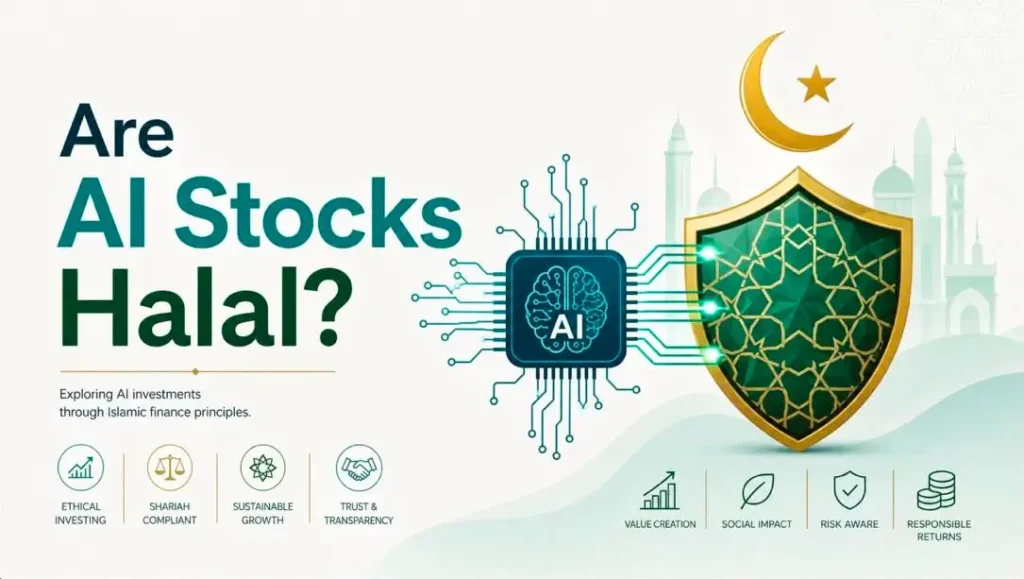
We are living in the golden age of artificial intelligence. Everywhere you look, AI is changing how we work, live, and make money. For Muslim investors, this raises a massive question: Are AI stocks halal?
I remember when I first started hearing about AI stocks in early 2023. Everyone was making a fortune overnight. I felt left out. I wanted to be part of the next big tech revolution. But then, my Islamic finance conscience kicked in. I couldn’t just buy a tech ETF and call it a day. I needed to know if the companies building the future of AI were actually compliant with Shariah law.
I spent weeks researching, talking to scholars, and analysing balance sheets. It was confusing at first. But I learned a lot. And I made some costly mistakes along the way.
If you are wondering whether you should invest in NVIDIA, Microsoft, or some hot new AI startup, this guide is for you. We are going to break down the Islamic perspective on AI, look at the financial ratios of top AI companies in 2026, and figure out how to build a halal AI portfolio without losing your shirt.
The Islamic Perspective on Artificial Intelligence
Before we look at stock tickers, we have to ask: Is AI itself halal?
The short answer is yes. Artificial intelligence is a tool, much like a hammer or a calculator. It is not inherently good or bad. It depends on how it is used.
According to contemporary Islamic scholars, AI is “conditionally permissible”. The Yaqeen Institute for Islamic Research states that AI can be viewed as permissible in principle, but its application determines its halal or haram status. ¹.

Here is how Islamic ethics view AI:
- Benefit to Humanity: AI should be used to improve welfare, establish justice, and promote mercy. If a company uses AI to cure diseases or optimise energy, that is a good thing.
- Avoiding Harm: AI should not be used to develop harmful technology, invade privacy, or create addictive pursuits.
- No Deception: AI cannot be used to create deepfakes that deceive people or manipulate markets.
So, when you invest in an AI company, you are investing in the infrastructure of this technology. As long as the company’s primary business is lawful and its financials are clean, the stock is halal.
How to Screen AI Stocks for Shariah Compliance
Just because a company uses AI doesn’t mean it’s halal. You still have to apply the standard Shariah screening criteria. In 2026, most scholars rely on the AAOIFI (Accounting and Auditing Organization for Islamic Financial Institutions) standards.

There are three main hurdles a company must clear:
1. The Business Activity Screen
First, the company must not derive its primary revenue (usually less than 5% is tolerated) from haram industries.
Most major AI companies (like NVIDIA, AMD, and Microsoft) make their money by selling hardware, software, and cloud services. This is permissible. However, if an AI company makes most of its money from gambling algorithms or advertising for pork products, it fails this screen.
2. The Financial Ratio Screen
Even if the business is halal, the balance sheet must be clean. The company cannot be overly reliant on interest-bearing debt. The AAOIFI standard sets these limits:
- Debt-to-Market Cap: Must be less than 30% (some scholars use 33%).
- Cash and Interest-Bearing Securities: Must be less than 30% (some scholars use 33%).
3. The Impure Income Screen
No large company in the modern banking system can completely avoid earning a tiny bit of interest on its cash reserves. Therefore, scholars allow a small amount of impure income, provided it is less than 5% of total revenue. If a company passes this, you just have to purify your dividends by donating that small percentage to charity.
Top Halal AI Stocks to Watch in 2026
So, which companies are actually passing these screens in 2026? The good news is that many of the biggest names in AI are fully halal.

Here are some of the top AI stocks that are currently Shariah-compliant 2:
- NVIDIA (NVDA): The undisputed king of AI hardware. As of July 2026, NVIDIA easily passes AAOIFI screening. Its debt ratio is incredibly low (around 0.2% of market cap), and its interest income is well below the 5% threshold.⁴ It has a solid halal rating from major screening services.
- Microsoft (MSFT): The giant behind OpenAI. Microsoft’s core business is software and cloud computing, which is permissible. Its financial ratios are also well within the halal limits.
- Advanced Micro Devices (AMD): Another major player in the semiconductor space, providing high-performance chips for AI computing. It passes the business activity and financial screens.
- Broadcom (AVGO): A massive player in semiconductor and infrastructure software solutions that power the AI era. It is currently considered halal.
- Taiwan Semiconductor (TSM): The world’s leading chip manufacturer. They actually build the processors for Apple, AMD, and NVIDIA. It is a highly compliant, halal stock.
The Danger of the AI Bubble: A Personal Failure
Now, I need to share something with you. Something that cost me a lot of money.
When I first started investing in halal AI stocks, I got greedy. I saw NVIDIA going up and up, and I wanted more. I thought I found the “next NVIDIA”. I put a massive chunk of my savings into a smaller, hyped-up AI software company. I didn’t check their valuation. I didn’t check their debt. I just chased the hype.

Then, the market shifted. As we move through 2026, financial experts like Fitch Ratings are warning that an AI-related market correction is emerging as a major global credit risk. ⁵ The AI boom has led to massive overvaluation in some sectors.
My hyped-up stock didn’t just drop; it crashed. I lost nearly 40% of my investment in that one trade. It was a painful lesson.
My advice to you: Do not chase hype. Just because a stock is halal does not mean it is a good investment at any price. You still have to look at valuation, earnings, and long-term growth potential. A halal stock can still go to zero if the company is poorly managed or overvalued.
Halal ETFs: The Easy Way to Invest in AI
If reading balance sheets and calculating debt ratios sounds like a headache, you are not alone. It took me years to get good at it.
The best way for beginners to invest in halal AI stocks in 2026 is through Shariah-compliant ETFs (Exchange-Traded Funds).

Here is why ETFs are great for this:
- Instant Diversification: Instead of betting your money on one AI company, you buy a basket of halal companies.
- Done-For-You Screening: A Shariah advisory board checks every single company in the ETF to ensure it meets Islamic guidelines.
- Less Stress: You don’t have to worry about purifying dividends yourself; many funds handle it for you.
If you want exposure to AI, look into broad halal tech ETFs. They usually have heavy weightings in NVIDIA, Microsoft, and other tech giants. Just search for “halal tech ETF” on your broking app.
Frequently Asked Questions (FAQs)
Can I invest in AI companies that work with defence or weapons?
This is a tricky one. If a company makes AI for military applications, it might fail the business activity screen, as weapons manufacturing is generally considered haram. Always check the specific revenue breakdown of the company before investing.
What if a company passes the financial ratios today but fails them tomorrow?
Companies are re-evaluated periodically. A company that is halal today could become haram if they take on massive debt to buy another company. This is why you should check their status at least once a year, or use an app that alerts you to status changes.
Is buying stock in an AI startup halal?
Buying stock in a private startup (venture capital) is halal as long as the startup’s business model is permissible. However, public stock market investing (which is what we usually talk about) is easier for beginners to access.
Do I have to purify my earnings from AI stocks?
Yes. Even the most halal companies usually have some cash sitting in an interest-bearing bank account. If your stock screener says the impure income is 1.5%, you should donate 1.5% of your dividends (and sometimes a percentage of your capital gains) to charity to purify your wealth.
Final Thoughts
Artificial intelligence is here to stay. It is reshaping the global economy, and Muslim investors should absolutely be part of this growth.
Are AI stocks halal? Yes, many of them are. Companies like NVIDIA, Microsoft, and TSMC are building the infrastructure of the future while maintaining financial structures that comply with Islamic law.
But remember the golden rule of investing: Invest with your head, not your heart. Do not let FOMO (fear of missing out) drive your decisions. Do your research, respect the risks of a tech bubble, and build a portfolio that you can be proud of.
Disclaimer: I am an investor sharing my personal experiences and research, not a certified financial advisor or an Islamic scholar. Always consult with a qualified financial professional and a Shariah advisory board before making major investment decisions.
References
AI vs. Traditional Tech: Is There a Difference in Halal Investing?
When we talk about AI stocks, we are usually talking about a subset of the broader technology sector. But is investing in AI different from investing in traditional tech (like a company that makes basic accounting software)?
From a Shariah perspective, the core screening rules remain exactly the same. A company is a company. You check its business activities, its debt, and its impure income.
However, the risks are different.

AI companies are currently experiencing massive capital expenditure. They are spending billions of dollars building data centers and buying hardware. This means their debt levels could rise quickly. A company that is halal today might take on too much interest-bearing debt to fund a massive AI project, causing it to fail the financial ratio screen next year.
Furthermore, the valuations of AI stocks are incredibly high right now. In 2026, we are seeing a lot of “hype” driving stock prices up, not necessarily underlying profits. For a Muslim investor, this brings up the concept of Gharar (excessive uncertainty). If you buy a stock at a wildly inflated price based on promises of future AI dominance, you are taking on massive speculative risk. Islam discourages gambling and excessive speculation.
Therefore, when investing in AI, you must be even more diligent than usual. Don’t just look at the hype; look at the balance sheet.
Building a Diversified Halal Tech Portfolio
You shouldn’t put all your eggs in the AI basket. Even if NVIDIA and Microsoft are halal, the tech sector is notoriously volatile.
A good halal portfolio in 2026 should be diversified. If you want to invest in AI, make it a specific percentage of your tech allocation (e.g., 20-30% of your stock portfolio).
Here is how you can balance an AI-heavy halal portfolio:
- The Core AI Holdings: Allocate a portion to the big, established players (NVIDIA, Microsoft, TSMC). These companies have massive cash reserves, low debt, and dominant market positions. They are the safest way to get AI exposure.
- The Halal Tech ETF: Instead of picking individual AI stocks, buy a Shariah-compliant technology ETF. This gives you exposure to the entire sector without the risk of a single company failing.
- Balance with Defensive Stocks: Balance your high-growth AI stocks with halal stocks in defensive sectors like healthcare, consumer staples, or utilities. This protects your portfolio if the AI bubble bursts.
The Future of Islamic Finance and AI
Interestingly, AI isn’t just changing the stocks we buy; it’s changing how we screen them.
In the past, I had to manually look up a company’s annual report, find its total debt, find its market cap, and do the math on a calculator. Today, apps like Zoya, Islamicly, and Musaffa use their own AI algorithms to scan thousands of companies in real-time and instantly tell you if a stock is halal.
This makes investing easier, faster, and more accurate for Muslim investors. We are seeing a beautiful convergence of Islamic ethics and modern technology.
Final Checklist Before You Buy
Before you click the “Buy” button on your brokerage app, run through this quick checklist:
- [ ] Is the business halal? Does it sell software/hardware, or does it sell alcohol/gambling?
- [ ] Is the debt ratio under 30%? Check the latest financials.
- [ ] Is the valuation reasonable? Are you buying because the company is good, or because the stock is going up?
- [ ] Do I know the purification rate? If it pays dividends, know how much you need to give to charity.
Conclusion
Yes, AI stocks can be halal. In fact, some of the best-performing stocks in the world right now are fully Shariah-compliant. But they come with high valuations and the risk of a tech bubble.
My biggest mistake was letting hype override my research. Don’t make the same mistake. Use the incredible tools available in 2026, check the financial ratios, and invest with a clear head and a pure heart.
The future is being built with AI. Make sure your money is a part of it, the right way.