Author: [Your Name] Published: August 2026 Reading Time: 11 minutes
I remember the first time I opened a brokerage account. I sat there, staring at hundreds of stocks, wondering which ones were actually halal. I thought I had done my research. I thought I was being careful.
I was wrong.
Within the first few months, I made mistakes that cost me money and, worse, caused me spiritual stress. I later learnt that I was not alone. Almost every beginner Muslim investor goes through the same painful lessons. The good news? These mistakes are completely avoidable once you know what to look for.
Let’s get into it.
Mistake 1: Not Investing at All

I know this sounds strange. This is an article about mistakes you make while investing. But the very first mistake is never starting at all.
Many Muslims keep their money in a regular savings account because they are afraid of accidentally doing something haram. They think that if they do nothing, they are safe.
Here is the problem: inflation eats away at cash every single year. If your savings account pays 1% interest but inflation is at 4%, you are losing 3% of your purchasing power annually. Over ten years, that adds up to a massive loss.
Islam actually encourages the productive use of wealth. The Quran and Sunnah contain numerous references to trade, commerce, and partnership — all forms of investment.¹ Hoarding money does not protect you. It slowly drains you.
How to avoid this: Start small. You do not need thousands of dollars. Many halal platforms allow you to start with as little as $100. Even $25 a month invested consistently will grow over time. The key is to begin.
Mistake 2: Using a Margin Account

When you open a brokerage account, the platform will often default you to a “margin account” or offer to upgrade you to one. A margin account lets you borrow money from your broker to buy more stocks than you can afford with your own cash.
Sounds great, right? You can buy more and make more.
Wrong. Here is why: borrowing money from your broker to invest involves paying interest (riba). That interest is haram, full stop. No matter how halal the stocks are, the borrowing mechanism itself violates Islamic finance principles.
Some brokers also pay interest on uninvested cash sitting in your account. That is also problematic from a Shariah perspective.
How to avoid this:
- Open a cash account instead of a margin account. A cash account only lets you invest what you actually have.
- Opt out of interest on uninvested cash if your broker offers that option.
- If you already have a margin account, contact your broker and ask them to downgrade you to a cash account.
Mistake 3: Skipping the Shariah Screen

This is the mistake that makes the entire investment potentially haram.
Just because a company is big, popular, or well-known does not mean it is halal. A massive tech company might pass the business activity screen (no alcohol, no gambling, no conventional banking), but it might have too much debt or earn too much from interest-bearing cash. It fails the financial ratio screen.
The Accounting and Auditing Organization for Islamic Financial Institutions (AAOIFI) sets the global standards for these ratios.² The common thresholds are:
- Debt ratio: Total interest-bearing debt should be below 30-33% of total assets or market cap
- Cash ratio: Interest-bearing cash and securities should be below 30-33% of total assets
- Impure income ratio: Interest income should be below 5% of total revenue
If you buy a stock without checking these ratios, you are essentially buying blind.
How to avoid this: Use a screening app before every purchase. Apps like Zoya, Musaffa, or IslamicStock can scan any stock and give you a clear “halal” or “not halal” verdict in seconds.³. Take the two minutes to check. It saves you from months of stress later.
Mistake 4: Ignoring Dividend Purification

This mistake is sneaky. It does not make your entire investment haram, but it leaves your income impure.
Even if a company passes all the screens, it might still earn a tiny amount of interest income. Maybe 1% or 2% of their revenue comes from cash sitting in a regular bank account. When that company pays you a dividend, a small fraction of that dividend comes from that impure interest.
Islamic scholars say you must purify this. You calculate the impure percentage of the company’s revenue, apply it to your dividends, and donate that exact amount to charity.
Most purification rates are small — typically 0.5% to 3% of your dividends.¹ But ignoring it means you are holding onto money that is not yours to keep.
How to avoid this:
- If you use Wahed Invest, they handle purification automatically.
- If you buy stocks individually, use apps like Zoya or Musaffa to track your purification obligations.
- Set up a separate “purification” savings account and transfer the impure amount there each quarter. Then donate it in one lump sum.
Mistake 5: Chasing Hype and Meme Stocks

We have all seen it. A stock goes viral on social media. Everyone is talking about it. The price is rocketing. You feel like you are missing out.
So you buy it.
Here is the truth: chasing hype is speculation, not investing. In Islamic finance, speculation is called gharar — excessive uncertainty. When you buy a stock purely because it is trending, you are not buying a piece of a real business. You are gambling on whether someone else will buy it from you at a higher price tomorrow.
Most Islamic scholars consider day trading and hype-chasing to be haram because of the gharar involved.¹
How to avoid this:
- If you cannot explain why a company is a good long-term investment in two sentences, do not buy it.
- Ignore social media stock tips. By the time a stock is trending, the smart money has already moved on.
- Stick to a long-term strategy. Buy quality companies and hold them for years, not hours.
Mistake 6: Investing Money You Need Soon

This mistake has nothing to do with halal or haram. It is just plain financial common sense. But beginners make it constantly.
They take money they need for rent next month or school fees in six months and put it into stocks. Then the market dips. They are forced to sell at a loss because they need the cash.
Stocks fluctuate. In the short term, they can drop 10%, 20%, or even more. If you need the money within the next 1-2 years, you should not have it in volatile assets.
How to avoid this:
- Only invest money you will not need for at least 3-5 years.
- Keep a separate emergency fund (3-6 months of expenses) in a safe, accessible place.
- Before investing anything, ask yourself: “Can I afford to not touch this money for five years?” If the answer is no, do not invest it.
Mistake 7: Not Diversifying Your Portfolio

A beginner gets excited about one stock. Maybe it is a great halal tech company. They put all their savings into it.
Then the tech sector has a bad year. Their entire portfolio crashes.
This is why we have the oldest saying in investing: do not put all your eggs in one basket. A farmer does not plant all his seeds in one spot. He spreads them across different fields. If pests attack one field, the rest of the farm still produces 3.
Diversification is one of the oldest wisdom principles in wealth-building. It protects you from a downturn in any single company or sector.
How to avoid this:
- Use halal ETFs like SPUS or HLAL, which automatically hold hundreds of diversified companies.
- If you buy individual stocks, aim for at least 15-20 companies across different sectors (tech, healthcare, consumer goods, energy, etc.).
- Include different asset classes: stocks, sukuk (Islamic bonds), gold, and cash.
Mistake 8: Forgetting to Pay Zakat

This is not a “halal investing” mistake in the screening sense. But it is a critical obligation that many beginner investors completely forget about.
Zakat is the annual charitable obligation of 2.5% on your wealth that exceeds the nisab threshold (the minimum amount of wealth that makes zakat obligatory). Your investment portfolio counts toward this.
If you have been investing for a year and your portfolio has grown, you owe zakat on it. Forgetting to pay it means you are holding onto wealth that belongs to those in need.
How to avoid this:
- Mark your Islamic calendar with a reminder for your annual zakat calculation date.
- Use a zakat calculator specifically designed for investment portfolios. These calculators account for the fact that your stocks are not liquid cash and adjust accordingly.
- Treat zakat as a non-negotiable part of your investment strategy, not an afterthought.
Mistake 9: Checking Your Portfolio Every Day

I get it. When you first start investing, it is exciting. You check your portfolio every morning. Then every afternoon. Then every hour.
This habit is dangerous for two reasons.
First, it creates unnecessary anxiety. The market moves up and down daily. If you watch it every day, you will experience daily emotional swings. A tree does not grow faster because you stare at it.
Second, it leads to panic selling. When the market dips (and it will), the daily checker panics and sells. They lock in their losses. Then the market recovers, and they are left on the sidelines.
Historically, despite wars, pandemics, and crashes, markets that represent real productive economies have trended upward over long periods.³ Short-term dips are normal. They are noise.
How to avoid this:
- Check your portfolio once a month, or even once a quarter.
- Delete the investing app from your phone’s home screen if you find yourself opening it compulsively.
- Set up automatic monthly investments and let the strategy work without your daily interference.
My Personal Failure: What I Got Wrong

I want to share something with you. Something I am not proud of.
About a year into my investing journey, I found a stock that everyone in a Muslim investing group was talking about. It was a mid-sized tech company. Someone posted the Zoya screening result showing it was halal. Green checkmark. Done.
I bought it without doing any further research. I did not look at the company’s business model. I did not check its debt levels myself. I did not ask whether it was actually a good business. I just saw “halal” and bought it.
Six months later, the company announced massive layoffs. The stock dropped 40%. I panicked and sold at a loss.
Here is the lesson: halal does not automatically mean good. A stock can be perfectly Shariah-compliant and still be a terrible investment. The screening tells you whether the money is clean. It does not tell you whether the business is sound.
My mistake was treating the halal screen as the only due diligence I needed. I confused “permissible” with “profitable”. They are two completely different things.
From that day forward, I changed my approach. I still screen for halal compliance first. But then I also ask: Does this company have a strong competitive advantage? Is its revenue growing? Is its leadership trustworthy? Only if the answer to both is yes do I buy.
If you take one thing from my failure, let it be this: screen for halal, but also screen for quality.
How to Avoid All These Mistakes: Your Action Plan

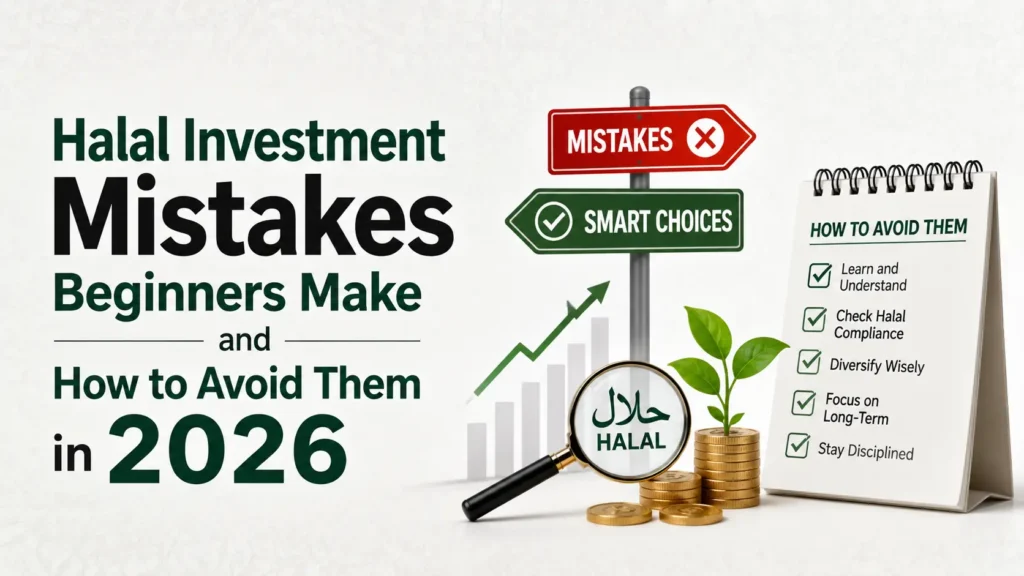
Let me put everything together into a simple, actionable checklist. Follow these steps, and you will avoid every mistake listed above.
Frequently Asked Questions (FAQ)
Is it a sin if I accidentally bought a non-halal stock? If you made an honest effort to screen the stock using reliable tools and it later turned out to be non-compliant, most scholars would not hold you accountable for what you could not have known. However, once you discover it is non-compliant, you should sell it as soon as reasonably possible.
Can I still make money if I only invest in halal stocks? Yes. Halal screening removes certain industries, but there are still thousands of compliant companies across technology, healthcare, consumer goods, energy, and many other sectors. Halal ETFs like SPUS have historically performed competitively against conventional index funds.
What if a stock I own becomes non-compliant? This happens. Companies take on more debt, or their impure income ratio crosses the threshold. When this happens, you should sell the stock. Some scholars give a grace period (often 3-6 months) to allow you to sell at a reasonable price rather than panic-selling at the bottom.
Is cryptocurrency halal? This is a complex and debated topic among Islamic scholars. Some consider certain cryptocurrencies permissible if they function as a genuine store of value or medium of exchange. Others consider them speculative and impermissible. The safest approach is to consult a qualified Islamic finance scholar and only invest what you can afford to lose.
Do I need to pay zakat on my stocks even if I have not sold them? Yes. Zakat is calculated on the current market value of your holdings, not on what you paid for them or whether you have realised gains. If your portfolio value exceeds the nisab threshold, you owe 2.5% annually.
Can I use options or futures to invest in halal stocks? Most Islamic scholars consider options and futures trading to be impermissible because they involve gharar (excessive uncertainty) and often involve paying or receiving interest. Stick to buying and holding actual shares of companies.
Disclaimer: I am a blogger sharing my personal experiences and research, not a certified financial advisor or a Shariah scholar. This article is for informational purposes only and does not constitute financial or religious advice. Always do your own due diligence and consult with a qualified Islamic finance advisor and scholar before making investment decisions.