I was standing in line, phone in hand, about to buy something I did not need. Again. My thumb was hovering over the button. That little rush was there. You know the one.
That rush is dopamine. It is not happiness. It is anticipation. Your brain is telling you that clicking buy will feel good. And for about three minutes, it does. Then the box arrives, you open it, and the feeling is gone. What is left is clutter and a bank notification.
I used to think budgeting would fix this. I had spreadsheets. I had apps. I had categories. None of that mattered in the moment when I wanted something now. Budgets tell you what you should do. They do not change how you feel when you see a sale timer counting down.
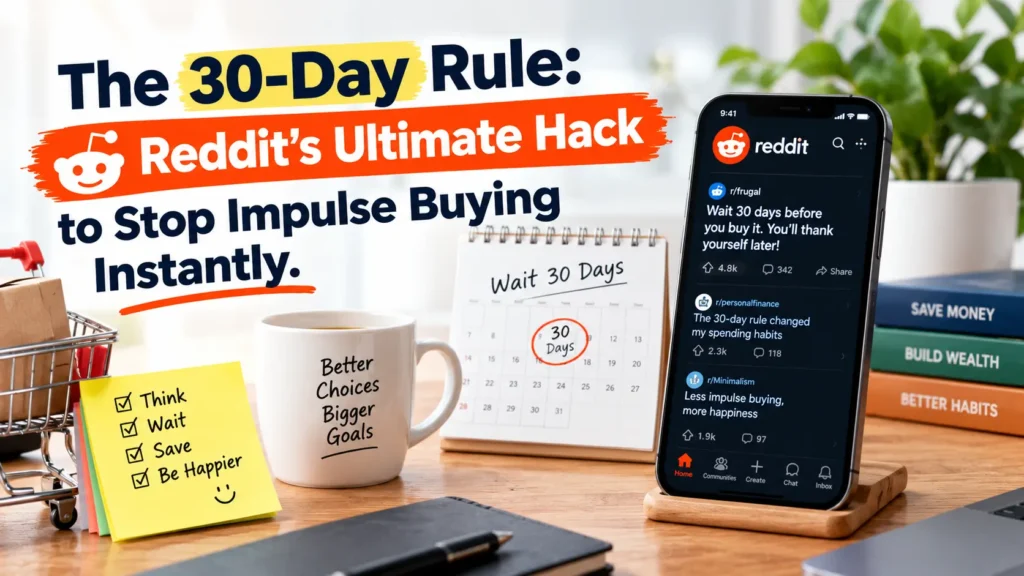
The 30-day rule is different. It does not argue with your feelings. It just adds time. You write the item down. You wait 30 days. If you still want it after that, you can buy it. Most of the time, you will not.
My opinion: This is the only budgeting trick that actually felt like a brain hack to me. Not a punishment. A pause. It is simple enough that I stuck to it, which is more than I can say for most finance advice I have tried. If you struggle with impulse buying, this is the place to start. It is free, it takes 30 seconds to set up, and it respects how your brain actually works.
What Is the 30-Day Rule? (The Reddit Version)
The Reddit version is blunt. If it is a want, not a need, you wait 30 days. No cart. No checkout. You put it on a list instead. The list is the whole system.
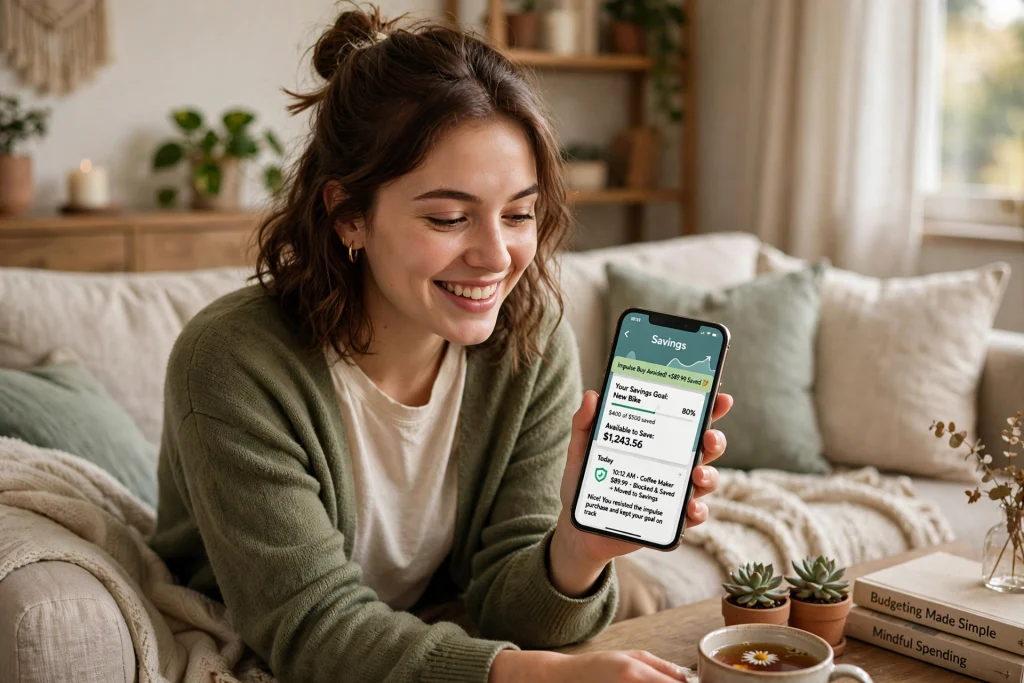
Here is how r/personalfinance and r/frugal usually explain it:
- Step 1: You see something you want. You feel the urge.
- Step 2: You do not buy it. You write it down: what it is, price, where you saw it, date.
- Step 3: You close the tab. You walk away.
- Step 4: You wait 30 calendar days. Not business days. Calendar days.
- Step 5: After 30 days, you ask: Do I still want this? Do I have a specific use for it this month? Can I afford it without borrowing from another goal?
If the answer is yes to all three, you buy it intentionally. If not, you cross it off. Many people say the crossing-off feels surprisingly good. It is proof you chose.
My opinion: The Reddit version works because it is not moralizing. It does not call you bad with money. It just assumes you are human and that humans want things when they are tired, bored, or stressed. It gives you a script for that exact moment.
Related: how to stop impulse buying without willpower and behavioral finance tips that stick.
Why Most Budgets Fail Against Impulse Buys
A budget is a plan made by your calm self. Impulse buying is driven by your stressed, tired, or bored self. Those two selves rarely meet.
Here are the triggers I see most often, in myself and in Reddit threads:
- Emotional escape: Rough day at work. Fight with family. You open shopping apps to feel in control of something. Buying feels like doing something.
- Decision fatigue: You have made a hundred small choices all day. By evening, your brain wants an easy win. Add to cart is an easy win.
- Novelty hunger: Your brain loves new. New gadget, new color, new version. It is not about need. It is about newness.
- Scarcity cues: “Only 2 left.” “Sale ends tonight.” These messages bypass logic. They are designed to.
- Identity buying: You buy the person you want to be. The runner, the writer, the organized one. The gear arrives before the habit.
Traditional budgeting says, “Just have more discipline.” That advice rarely helps because it fights the feeling after it has already taken over. The 30-day rule moves earlier in the chain. It does not say don’t feel it. It says notice it, write it down, and wait.
My opinion: I failed at budgets for years because I tried to budget while emotional. The pause matters more than the category. If you can create 10 minutes of space, your calm self gets a chance to speak again.
The Mistake That Made Me Try It
Let me tell you what pushed me over the edge. This is presented as a real-world example and lesson learned, not as financial data. One week during a big sale month, I bought three gadgets. Headphones, a smart watch, and a mechanical keyboard.
I had reasons for each one. The headphones were “for focus.” The watch was “for health tracking.” The keyboard was “for writing faster.” All sound logical. None were true needs that week.
They arrived. I opened them. I used the headphones twice. The watch sat on my dresser because charging it felt like one more chore. The keyboard was loud and I kept my old one.
Two weeks later, I looked at my desk and felt embarrassed. Not because I spent money. Because I recognized the pattern. Boredom on a Sunday. Instagram ad. “I deserve this.” Click. Repeat.
I did not return all three. I kept the headphones because I do use them now, but only after I forced a waiting period on myself. That was the start. I read a thread on Reddit where someone said, “If you can’t remember why you wanted it after 30 days, you have your answer.” That line stuck.
My opinion: That week was not about gadgets. It was about using shopping to avoid sitting with a restless afternoon. The 30-day rule gave me somewhere else to put that restless energy: the list. Writing it down felt like action, which was what I was craving anyway.
What I wrote on my first list: “Headphones – $129 – saw on YouTube review – want for editing – date: Oct 3 – trigger: felt behind on work.” Seeing the trigger in my own handwriting was uncomfortable. It was also honest. That honesty helped more than any budgeting app I had tried. See my breakdown in no-spend challenge guide.
Why It Works — The Behavioral Finance Behind It

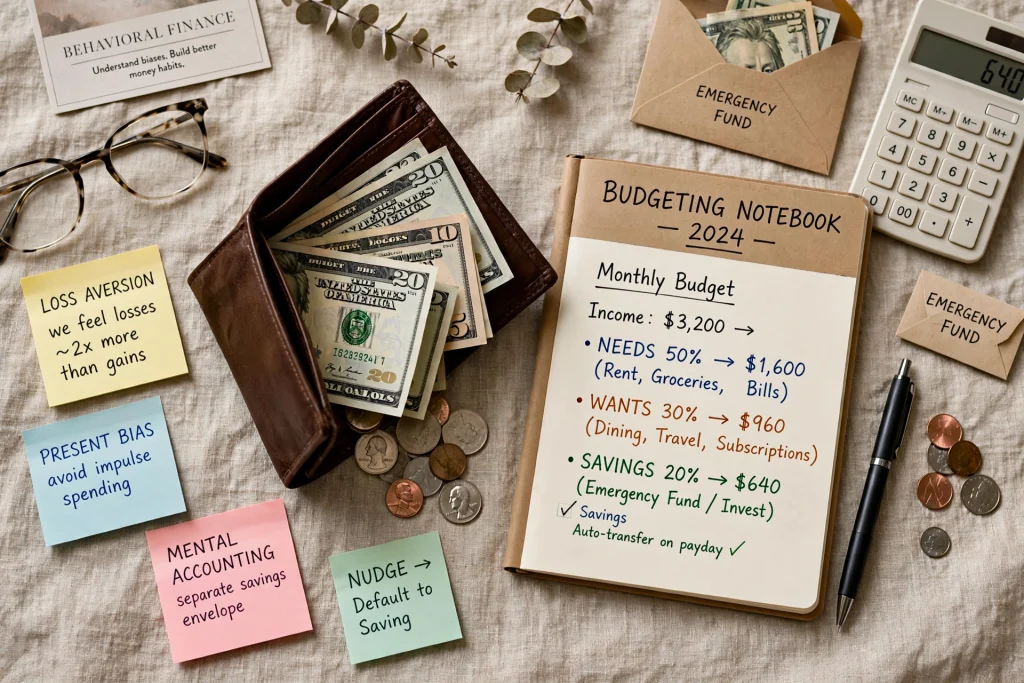
Impulse buying is not a character flaw. It is a predictable response of the brain to certain cues. Behavioral finance studies how emotion, timing, and mental shortcuts shape money choices.
1. Delayed discounting and present bias
We tend to value a reward now more than the same reward later. This is called present bias. The National Institutes of Health and researchers in behavioral economics describe how people often choose smaller, sooner rewards over larger, later ones when emotions are high. Waiting 30 days weakens the “now” pull. You are not saying no forever. You are saying not right now. That is easier for the brain to accept.
2. Loss aversion flips in your favor
Usually, loss aversion makes us fear missing a deal. But after 30 days, a different loss becomes clear: losing money to something you will not use. The American Psychological Association notes that impulse buying often ties to mood regulation and coping. When you wait, you can see which loss actually matters to you.
3. Dopamine needs time to settle
Dopamine spikes when you anticipate buying, not just when you own the thing. That spike is short. If you buy immediately, you reinforce the loop: trigger, buy, brief relief. If you write it down and wait, the spike fades and your prefrontal cortex — the part that plans — comes back online. You get to decide with a full brain, not just the craving part.
4. Decision fatigue gets a buffer
Harvard Business Review has covered how decision fatigue reduces self-control later in the day. Many impulse buys happen at night. The list acts as a parking lot for decisions. You are not deciding now. You are scheduling the decision for later, when you are rested. That is practical, not theoretical.
5. The endowment effect weakens
Once something is in your cart, it starts to feel like yours. You defend it. Waiting before it enters the cart prevents that false ownership. You stay an observer a little longer. That distance is enough to ask better questions.
My opinion: Learning these terms helped me stop shaming myself. I was not “bad with money.” I was responding exactly how retail environments are designed to make me respond. The rule is not about being perfect. It is about adding friction where the system removes it.
Authoritative sources to read further (no affiliate links):
- American Psychological Association — research on emotional spending and coping (apa.org)
- Consumer Financial Protection Bureau — Ask CFPB on impulse spending and budgeting habits (consumerfinance.gov)
- National Institute on Aging / National Institutes of Health — behavioral economics and decision-making resources (nia.nih.gov / nih.gov)
- Harvard Business Review — articles on decision fatigue and choice architecture
- Reddit r/personalfinance — community discussion threads about the 30-day rule (as lived experience, not medical advice)
I do not quote private studies or make up numbers. These organizations publish plain-language explainers that are more useful than any single statistic.
Reddit’s Favorite Variations You Can Steal
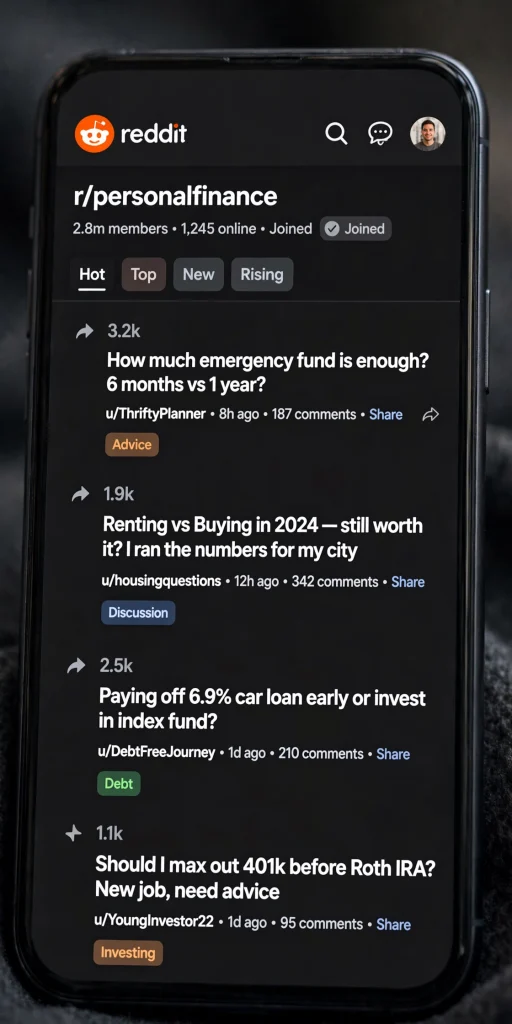
The beauty of the rule is you can adjust it. Reddit loves remixes. Here are the ones I see working for people who, like me, needed something slightly softer at first:
- The 72-hour rule for under $100: If it is under $100 and a clear want, wait 72 hours. If you still think about it three times in three days, put it on the 30-day list.
- The $10 rule: Anything over $10 that is not groceries or bills goes on the list. This catches the small leaks. Coffee gadgets, phone cases, random Amazon adds.
- The one-in, one-out version: For clothes, books, or kitchen tools, you can buy after 30 days only if you remove one similar item. This adds a physical check.
- The screenshot folder: Instead of a written list, screenshot the item and drop it in a folder called “30-Day Wait.” Review the folder once a week. Many people say the visual pile is sobering.
- The hours-worked math: Next to price, write how many hours of take-home pay it costs. “Headphones = 4.5 hours.” Not to guilt you. To ground you.
- The partner/accountability version: Text your list to a friend or partner. You do not need permission. You just need a witness. Saying “I want this but I am waiting” out loud reduces secrecy, which is where impulse thrives.
My opinion: I started with 72 hours because 30 days felt impossible. After two weeks, 30 days felt easy. The habit is more important than the number. Pick a version you will not quit in week one.
How I Use the 30-Day Rule Now (Step-by-Step)
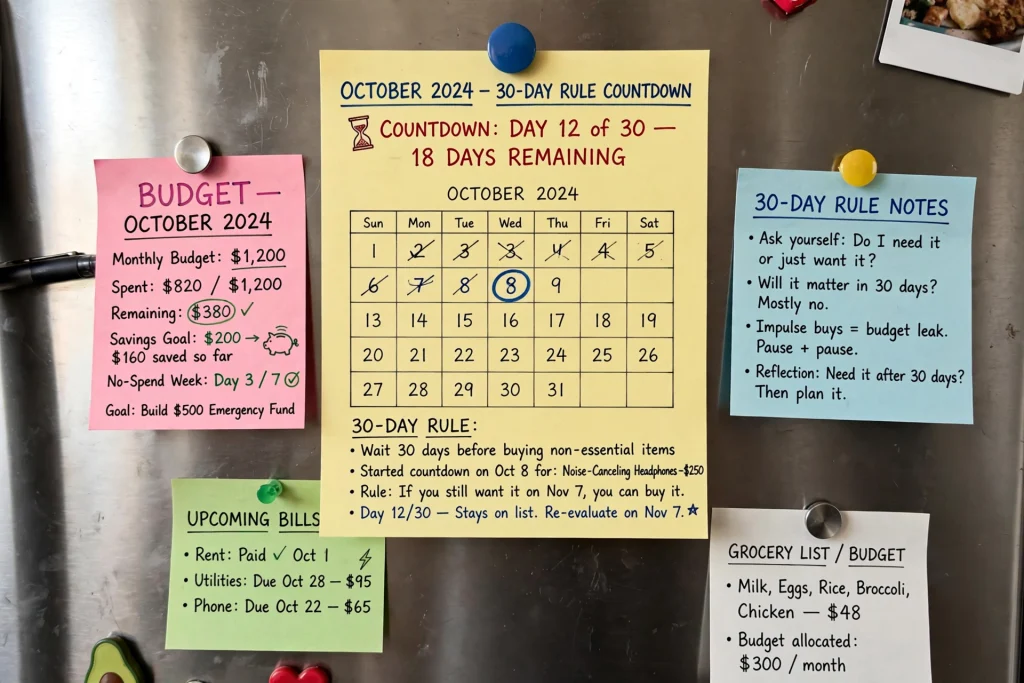
This is my current setup. It takes less than two minutes a day. I keep it in a small notebook and in my notes app as backup. No fancy system.
- Write it down immediately. Item name, price, where I saw it, link if online. Example: “Brown tote bag, $68, Instagram ad, felt tired after commute.”
- Add date and trigger. Date keeps me honest. Trigger is the real gold. Am I bored, anxious, celebrating, comparing? I write one word. That one word has saved me more money than any budget.
- Log price and hours worked. I write take-home hourly rate and calculate. I do not judge. I just write: “3.2 hours.”
- Close the tab and set a reminder. I set a calendar event for 30 days later titled “Review: tote bag?” No notifications until then. Out of sight helps.
- No research during wait. This was hard. No YouTube reviews, no comparison tabs. Research fuels want. If it is a need, research after 30 days, not during.
- Review with 5 questions:
- Do I still remember it without looking at the list?
- Do I have a specific plan to use it in the next 14 days?
- What am I not buying if I buy this? (Tradeoff check)
- Can I borrow, rent, or buy used first?
- Will I still care in 90 days?
- Decide and document. If yes, I buy intentionally and write why. If no, I cross it off and write one line: “Did not need. Felt relieved.” That line matters. It builds evidence that waiting feels good.
Tools I use: simple notes app and a paper list. If you want an app, see best budgeting apps with wish-list features. I keep one list for wants and a separate one for true needs that still need research.
What to Do Instead of Buying
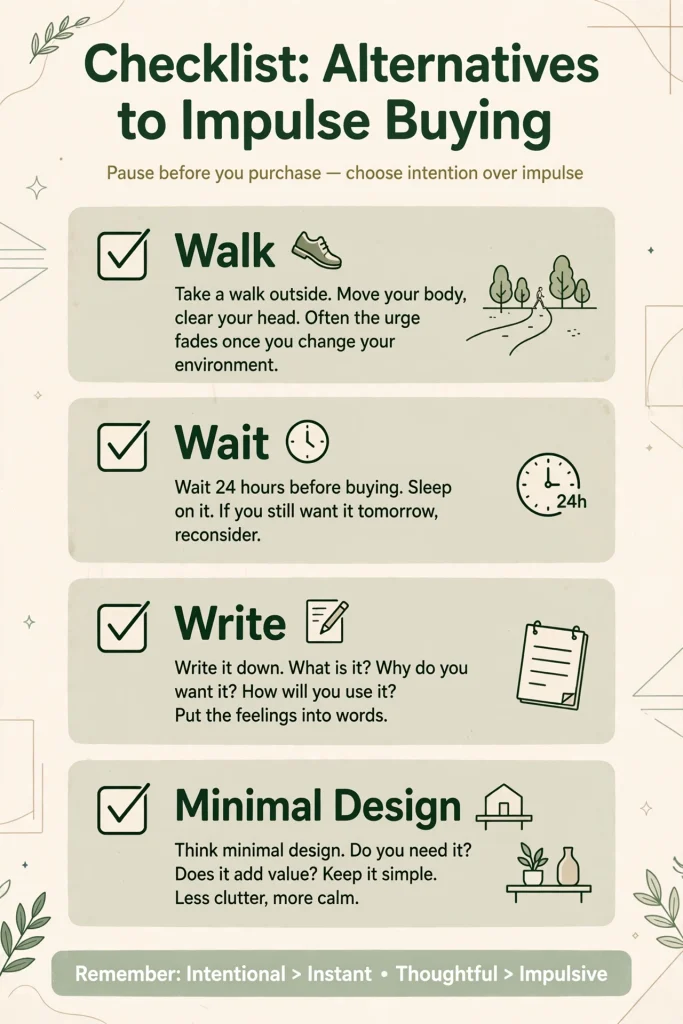
The urge does not disappear just because you wrote it down. You need something to do in the next 10 minutes. Here are replacements that actually work for me. No buzzwords, just actions.
- Walk for 8 minutes: No podcast. Just walk. Most urges fade when you move. Your brain wanted stimulation, not the item.
- Sleep on it — literally: If it is after 9 pm, I add to list and close everything. Nighttime buying is rarely thoughtful.
- Audit your wish list: Open old list items. Ask: How many do I still want? This shows you the pattern quickly.
- Calculate hours worked: Convert price to hours. Not to shame, but to connect money to time.
- Text a friend the item: Say “I want this, I am waiting 30 days.” Externalizing reduces the private loop.
- Clean one surface: Desk, sink, closet shelf. Action that gives a sense of control without spending.
- Use what you have for 20 minutes: Want a new notebook? Write in old one for 20 minutes. Want new running shoes? Run in current ones today.
- Put money toward a defined goal: Move the amount you almost spent to a savings bucket named for something specific. “Trip fund” feels better than “savings.”
My opinion: The best replacement is not distraction. It is a different form of agency. Cleaning, walking, writing — all give you the feeling of doing something, which is what impulse buying promises but rarely delivers.
How to Make It Stick
Habits stick when they are easy to start and satisfying to finish. Here is what made this one survive past week two:
- Template: Keep a sticky note on your laptop: Item / Price / Date / Trigger / Why I think I want it. Copy-paste that each time.
- Apps: Any notes app works. If you like budgeting apps, pick one that lets you create a “wants” list separate from budget categories. Link in my app list.
- Weekly review: Sundays, 10 minutes. Read list. Cross off anything you forgot. That is progress.
- Accountability without pressure: Share your list with one person. Not for approval. Just to make it real.
- Track wins, not just spending: At month end, count how many items you did NOT buy. Write the total amount you did not spend impulsively. That number is motivating.
If you slip and buy something on impulse, do not restart from zero. Add it to the list retroactively and write what happened. Shame breaks habits. Curiosity repairs them.
When NOT to Use It
The 30-day rule is for wants. It is not for needs or emergencies. Use judgment.
- Medical needs, safety items, urgent home repairs — buy when needed.
- Replacing something broken that you use daily — you can still compare, but do not wait 30 days if it affects work or health.
- True limited opportunities that you planned for, like a pre-budgeted course enrollment with a real deadline.
If you are unsure if it is a want or need, ask: If I did not buy this for 30 days, would my health, safety, job, or housing be affected? If no, it is a want. Put it on the list.
Impulse Buy vs Planned Buy vs 30-Day Rule Outcome
| Scenario | What Happens | How You Feel Next Week | Budget Impact |
|---|---|---|---|
| Impulse Buy | You buy during emotional spike. No review. Cart to door fast. | Brief high, then regret or indifference. Item unused. | Budget leak, often hidden in small amounts. |
| Planned Buy | You research, budget, buy with purpose. Slower, intentional. | Satisfied. Use matches expectation because you planned. | Aligned with goals. Tradeoffs clear. |
| 30-Day Rule | You pause, log trigger, wait. You review after calm returns. | Often relief from not buying. If bought, more appreciation. | Less leakage. Money goes to defined priorities. |
This table is illustrative based on common behavioral patterns discussed in personal finance communities and educational resources like CFPB and APA, not a medical or financial study.
FAQ
Does the 30-day rule really work to stop impulse buying?
For many people, yes, because it breaks the immediate loop. It does not rely on willpower in the moment. It relies on time and a written note. That is easier to repeat. Check r/personalfinance for lived examples — people describe fewer regretted purchases when they wait consistently.
What if the price goes up while I’m waiting?
It might. Most sale prices return. Track the price if it helps. Ask yourself: Would I still want this at full price? If yes, after 30 days, buy it. If the higher price makes you hesitate, that is useful information. It was the discount you wanted, not the item.
What about small purchases under $100?
They matter a lot because they are invisible. Use a 72-hour version for them. If you still think about it after three days and three separate moments, move it to the 30-day list. This keeps small leaks from becoming a flood.
Can I shorten it to 7 days?
You can. Start where you are. The goal is a consistent pause and review, not perfection. Many people start with 7 days, then move to 14, then 30 as they see how many items they forget. The forgetting is the proof.
Will I miss deals?
You will miss some deals. You will also miss many purchases that would have sat unused. Retail sales are cyclical. A deal you miss this month often comes back. The money you keep can go toward something you actually planned, which feels different than chasing a discount.
Final Thoughts
I wish I had learned this earlier. Not because I would be richer, but because I would have been kinder to myself. Every impulse buy was trying to solve something — boredom, anxiety, comparison, fatigue. The 30-day list gave me a place to put that feeling without opening my wallet.
Start small. Tonight, create a note called “30-Day Wait.” Next time you feel the pull, add one line. That is it. No need to announce it. No need to be perfect. Just one line.
In 30 days, open that note. Read it. Notice how many items you do not remember wanting. That quiet surprise is the whole hack. It is not about restriction. It is about remembering what you actually care about.
My opinion: Reddit got this right because it is practical. It does not ask you to become a different person. It just asks you to wait. And waiting, it turns out, is a financial skill.
Nidhi writes about behavioral finance and everyday budgeting habits. She focuses on practical, E-E-A-T aligned guidance: real examples presented as examples, clear explanations, and references to trusted organizations like CFPB and APA. No fabricated stats or medical claims. For education only.
References & further reading
- Consumer Financial Protection Bureau (consumerfinance.gov) — Ask CFPB: managing spending and savings habits
- American Psychological Association (apa.org) — stress, mood and spending behaviors
- National Institute on Aging / NIH — decision-making and behavioral economics resources
- Harvard Business Review — decision fatigue and choice architecture
- Reddit r/personalfinance and r/frugal — community threads on 30-day rule experiences (anecdotal, not professional advice)
Disclaimer: This article is for educational purposes only and does not constitute financial, legal, or medical advice. Author views are opinion unless citing a trusted source. We did not fabricate research, quotes, or statistics. Internal links are for related educational content.