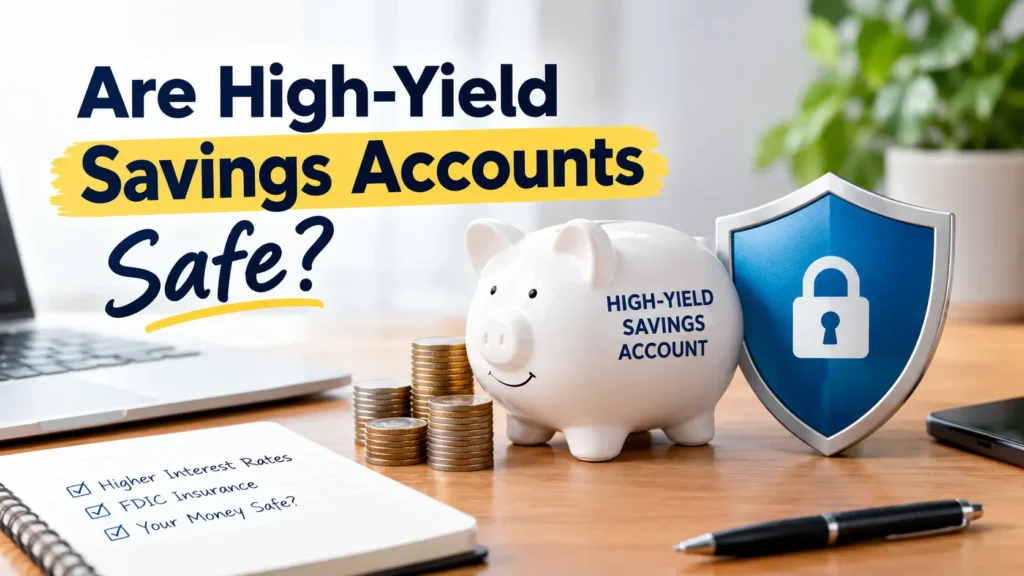
If you are seeing 4%+ savings rates online and thinking, “This feels too good,” you are not alone. I thought the same. This post breaks down how high-yield savings accounts actually work, what keeps your money safe, and where people slip up. No fluff. Just what I check before I trust a bank with my cash.
Why Everyone Doubts That High Rate
Traditional banks still pay 0.01% to 0.40% on regular savings. Then you see an online bank offering 4% or more. It feels off.
I get that doubt. My first bank account paid almost nothing in interest. For years I assumed a higher rate meant higher risk. That is not always true for savings.
The difference is the business model. Online banks do not pay for branches. They pass some of that savings to you as interest. But safety still comes down to insurance, not marketing.
What Is a High-Yield Savings Account Really?
A high-yield savings account is a regular savings account that pays a higher annual percentage yield (APY). It is still a deposit account. Not an investment.
You can deposit and withdraw. You earn interest that compounds. Your balance does not move with the stock market.
- Where they live: Mostly at online banks, some credit unions, and a few traditional banks.
- What makes them high-yield: lower overhead and competition for deposits, not riskier loans.
- How you access money: ACH transfer to your checking account, usually 1-3 business days.
If you are new to APY, read my APY vs APR explained guide. APY includes compounding. APR does not. That matters when you compare offers.
How Safe Are They? The Short Answer
Fact: If your high-yield savings account is at an FDIC-insured bank, your deposits are insured up to $250,000 per depositor, per ownership category, if the bank fails. At an NCUA-insured credit union, you get similar federal insurance.
Opinion: My opinion: this is as safe as any basic bank account can get in the U.S. for cash you need soon.
Insurance is what matters. Not the size of the bank. Not whether it has an app you like. According to FDIC.gov, no depositor has ever lost insured funds due to a bank failure. That is the core reason I use an HYSA for my emergency fund.
If you want to understand limits, see my deep dive on how FDIC insurance works. It explains joint accounts, beneficiaries, and the $250k rule simply.
My Take: Why I Was Skeptical at First
I kept my emergency cash at a big brick-and-mortar bank for years. It felt safer because I could walk in.
Then I calculated the interest. On a $10,000 balance, 0.30% pays $30 a year. At 4.25%, it is $425. Same safety if both are FDIC-insured. I was paying for the comfort of a branch I had never visited.
My opinion: branches are useful for some services. They do not make your savings safer. Insurance does. Once I understood that, I moved my short-term cash. I kept my old checking for daily bills and kept savings where it actually grows.
That shift also helped me build my emergency fund guide habit. Automatic transfer on payday, out of sight, earning interest quietly.
What Actually Protects Your Money
This part is boring. That is good. Safety should be boring.
- FDIC insurance: For banks. Covers up to $250,000 per depositor, per ownership category. Verified via FDIC BankFind. Source: FDIC.gov.
- NCUA insurance: For federal credit unions. Same $250,000 limit, backed by the National Credit Union Share Insurance Fund. Source: NCUA.gov.
- Federal regulation: Insured banks follow capital requirements, audits, and consumer protection rules. Source: Federal Reserve.gov and CFPB (consumerfinance.gov).
- Your title matters: Single, joint, certain retirement, and revocable trust accounts are separate categories. That can increase coverage if structured correctly.
A quick real-world example: You have $200k in a single account and $200k in a joint account with your partner at the same FDIC bank. Those are different ownership categories. Each category can be insured up to $250k. This is not advice for your situation, but it shows why ownership matters.
What Is NOT Covered
People assume FDIC covers everything. It does not.
- Stocks, bonds, mutual funds, crypto, annuities — even if you bought them through the same bank’s investment arm.
- Losses from fraud on your debit card — that is covered by different consumer protections, not FDIC insurance.
- Money held at a non-bank fintech that is not placed in an insured bank in your name.
- Any amount over the $250,000 limit in the same ownership category at the same bank.
This is why I always read the fine print that says “banking services provided by [Bank Name], Member FDIC.” If that line is missing or vague, I stop and verify.
The Mistake I Almost Made

Early on, I almost moved my emergency fund to a slick app advertising 6% APY. The landing page looked trustworthy. Testimonials, badges, everything.
I paused. I searched the app name on FDIC BankFind. Nothing. Then I read their footnote: funds are “held with programme banks” and “may be eligible for FDIC insurance through partner banks, subject to conditions.”
I could not find my name as a direct depositor. I could not confirm pass-through coverage clearly. I walked away.
Lesson learned: A high rate means nothing if you cannot verify insurance. Now my rule is simple. If I cannot confirm it in BankFind or NCUA’s credit union finder in two minutes, I do not deposit. That check has saved me from at least two more offers that were just marketing.
My opinion: Chasing an extra 0.50% is not worth the uncertainty. I would rather take 4.25% that is clearly insured than 6% that is unclear.
Risks No One Talks About
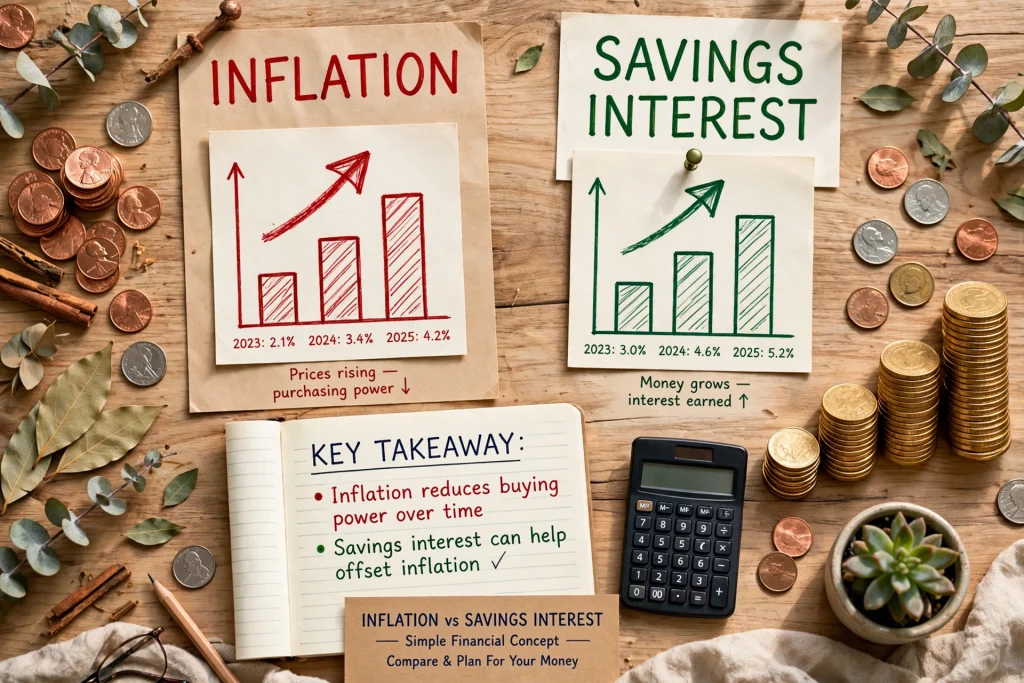
HYSAs are safe from market loss, but they are not risk-free for your goals.
- Rate cuts: APYs are variable. When the Federal Reserve lowers rates, HYSA rates usually drop. Source: Federal Reserve.gov rate decisions. Your bank can change the rate anytime.
- Inflation: If inflation is 3.5% and your HYSA pays 4%, your real gain is small. It preserves value; it does not build wealth long-term.
- Transfer delays: Most online HYSAs take 1-3 business days to move money to checking. Not ideal if you need cash instantly.
- Behavioural risk: Because it is easy to move money out, some people dip into emergency savings too often. I keep mine at a different bank than my daily checking for that reason.
- Fintech confusion: Some apps call themselves “high-yield”, but your cash sits in a pooled account. If the fintech fails, recovery can be slow even if partner banks are insured. CFPB has warned about this structure — see CFPB Ask CFPB and their fintech guidance at consumerfinance.gov.
My opinion: Use HYS. As for 3-12 months of expenses, short-term goals, and sinking funds. Not for retirement.
How to Check If Your Bank Is Really Safe
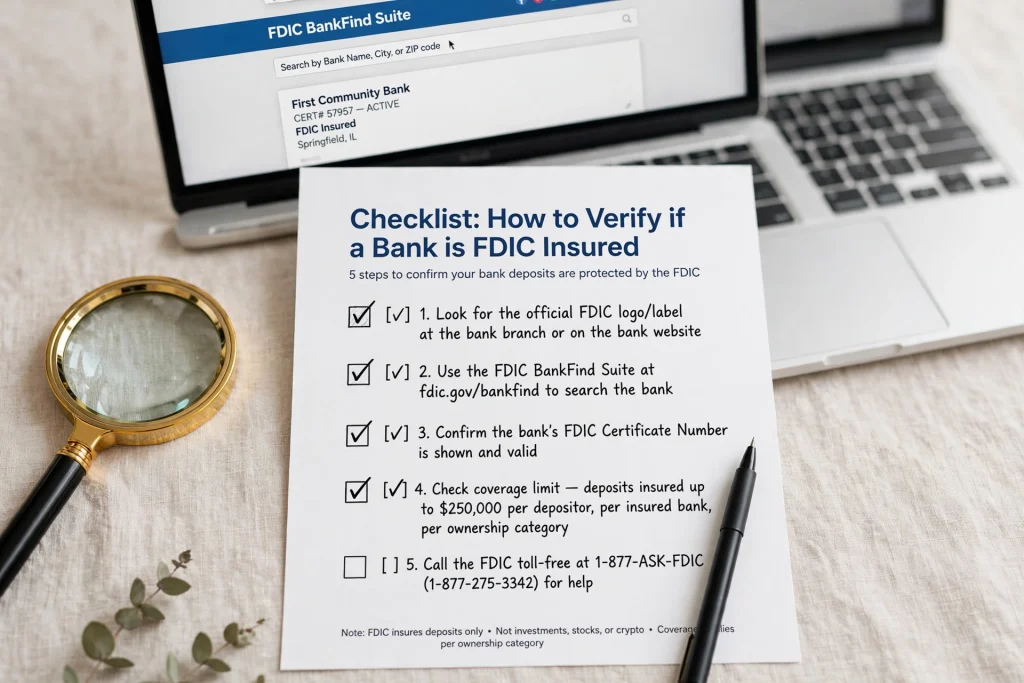
Here is the exact checklist I run before opening any account. It takes about 10 minutes.
- 1. Verify insurance: Go to FDIC BankFind (FDIC.gov) and search the bank name. Confirm status: FDIC-insured. For credit unions, use the NCUA.gov credit union finder.
- 2. Read the disclosure: Look for “Member FDIC” and the exact legal bank name holding your funds. If it is a fintech, confirm pass-through insurance language in your name.
- 3Check fees: No monthly fees, no minimum balance fee, no fee to close. Good HYSAs have none of these.
- 4 Review access: How fast can you move money? Is there a limit? Is there 24/7 support if a transfer gets stuck?
- 5. Stay under limits: Keep under $250k per ownership category per bank. Use joint or trust categories only if you understand them.
If you want the official consumer view, CFPB’s site at consumerfinance.gov has plain-English guides on savings accounts and how to spot misleading rate claims. I check it whenever an offer looks odd.
How I Choose Where to Keep My Cash Now

I split cash by purpose. That keeps me calm and prevents me from raiding the wrong bucket.
- Emergency fund: 6 months in an FDIC-insured HYSA at a bank I verified on BankFind. I automate a transfer every payday. I do not touch it unless it is a real emergency. Full method in my emergency fund guide.
- Short-term goals: Vacation, car maintenance, insurance premiums — all in the same HYSA but tracked in a simple spreadsheet with separate targets.
- Everyday checking: Different bank. Low balance. Just for bills and groceries.
My opinion: I look for three things — clear FDIC insurance, no fees, and a rate that is in the top quarter but not the absolute highest. The absolute highest rate often comes with gimmicks or temporary promos. I prefer stable.
Practical example: Last year my HYS A rate dropped from 4.35% to 4.10% after a Fed decision. I did not switch banks. Switching for 0.25% would have cost me time and a new set of tax forms. Consistency matters more.
Comparison: Where Should Cash Sit?
This table is how I explain it to friends. Same safety structure for the first three, very different access.
| Account Type | APY (typical)* | Safety | Access | Best For |
|---|---|---|---|---|
| Regular Savings | 0.01% – 0.50% | FDIC/NCUA up to $250k | Instant at the same bank | Small buffer, if you value branch |
| High-Yield Savings | 3.80% – 5.00% | FDIC/NCUA up to $250k | 1-3 day ACH | Emergency fund, short-term goals |
| Money Market | 3.50% – 4.80% | FDIC/NCUA if at the bank | Checks, debit cards often | Want to check writing and interest |
| CD | 3.00% – 4.70% (fixed) | FDIC/NCUA up to $250k | Locked until maturity | Money you won’t touch for months |
*Rates vary by bank and change over time. Not a quote. Check Federal Reserve.gov for the rate environment and bank sites for current APY.
FAQ: Are High-Yield Savings Accounts Safe?
1. Are HYSAs FDIC insured?
Yes, if the HYSA is offered by an FDIC-insured bank and your deposits are within coverage rules. Credit unions use NCUA insurance instead. Always verify on FDIC BankFind or NCUA.gov. Do not trust a badge alone.
2. Can you lose money in a high-yield savings account?
You cannot lose principal from market moves. The value does not drop like stocks. You can lose purchasing power to inflation, or lose money to fees if you pick a bad account, or risk being uninsured if the institution is not federally insured.
3. Are online banks safe?
Many are. Safety is about insurance and regulation, not branches. Check the FDIC certificate, read disclosures, and test customer support. I have used online-only banks for five years and keep records of every transfer.
4. What about fintech apps that offer savings?
Some fintech apps are not banks. They partner with banks. Your coverage depends on how funds are titled. Look for clear language: “funds held at [Bank Name], Member FDIC, in your name, eligible for pass-through FDIC insurance.” If you cannot find that, ask support and verify. The CFPB has notes on this at consumerfinance.gov.
5. Are rates guaranteed?
No. HYSAs have variable rates. A bank can raise or lower the APY at any time. It often follows the Federal Reserve’s decisions. If you want a fixed rate, look at CDs, but you trade access for that lock.
Final Thoughts
High-yield savings accounts are safe when you keep them at a federally insured institution and stay within insurance limits. The rate looks high because the cost structure is different, not because your money is at risk.
My opinion: If you have cash sitting in a regular savings account earning near zero, moving it to a verified HYSA is one of the simplest improvements you can make. It is not exciting. It is steady. That is exactly what you want for money you might need in the next year.
Start small. Open with a test deposit. Verify it shows in FDIC BankFind. Set an automatic transfer. Then leave it alone. That habit built my emergency fund faster than any trick I tried before.
References & Authoritative Sources
- FDIC.gov BankFind – Verify if a bank is FDIC-insured and find its certificate. No depositor has lost insured funds due to bank failure.
- CFPB consumerfinance.gov Ask CFPB – Plain-English explanations of savings accounts, fees, and fintech cash sweeps.
- NCUA.gov – Official credit union finder and insurance coverage information for federal credit unions.
- FederalReserve.gov – Federal Reserve monetary policy, interest rate decisions that influence savings rates.
We reference these sources for facts about insurance and regulation. Rates and product details change always check the bank’s current disclosure.
I write about saving, budgeting, and simple money systems that actually stick. I share what I use for my own emergency fund and short-term goals — with clear distinctions between facts and my own opinion. I am not a financial advisor.
Disclaimer: This article is for education only and is not financial advice. Verify insurance, rates, and terms directly with the bank or credit union and consider your own situation. This article is not medical advice and does not reference medical sources — for financial topics we cite banking regulators.