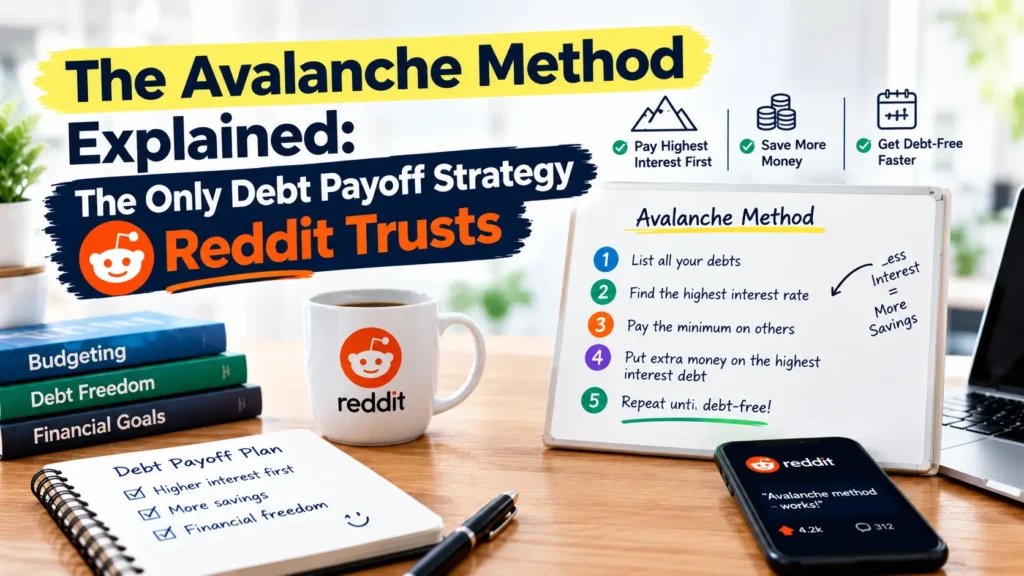
Reddit’s r/personalfinance does not agree on much. But it agrees on this. If you want to pay the least interest, you pay the highest rate first.
That is the avalanche method. It is not fancy. It is math. You list your debts by APR. You pay minimums on everything. You throw every extra dollar at the debt with the highest interest rate. When that one is gone, you move to the next highest. Repeat.
Major media loves Dave Ramsey’s snowball method. Pay the smallest balance first for a quick win. It feels good. I get it. But Google searches for “avalanche vs snowball math” keep rising for a reason. People are tired of feeling good for a week and paying more for a year.
This post is my full breakdown. I will show you the exact formula, a worked example with real numbers, and the mistake that cost me money early on. I will also be clear about where avalanche is harder.
My opinion: If you can handle 2-3 months without a quick win, an avalanche is the better financial choice for most people with credit card debt. Motivation matters, but interest is not motivational. It is expensive.
What Is the Avalanche Method?
The definition is simple. Pay debts in order of interest rate, highest to lowest. Not balanced. Not due date. Interest rate.
Here is how it works in one line: minimums everywhere, extra to the highest APR.
- You list every debt with its APR and minimum payment.
- You budget your total debt payment for the month.
- You pay the minimum on each debt so you never get a late fee.
- Anything left after minimums goes to the debt with the highest APR.
- When that debt hits zero, you roll its payment into the next highest APR debt.
That rollover is why people call it an avalanche. Your payment to the target debt gets bigger as you go. Like snow building momentum downhill.
For more basics on how credit card interest is calculated, see my explainer: credit card interest explained.

Why Most People Get It Wrong
Most people sort by balance. It feels logical. Smallest first looks doable. You see one debt disappear quickly. That is the snowball method. Ramsey recommends it for behavior, not math.
The problem is cost. A $3,000 loan at 6% costs you $15 per month per $1,000 in interest if you do the math. A $3,000 balance at 22% costs $18.33 per $1,000 per month. Same balance. Different price. If you pay the cheap debt first, the expensive one keeps growing fast.
Reddit’s r/personalfinance wiki is blunt about this. The wiki recommends avalanche for anyone who can stick to a plan. You can read the community discussion on r/personalfinance and r/DaveRamsey to see the trade-off debated in real time.
Key fact
According to the Consumer Financial Protection Bureau (CFPB), paying more than the minimum and targeting higher-rate balances first reduces total interest paid. See CFPB on debt payoff strategies.
The Mistake That Made Me Switch

Here is a practical example from early on, presented as an illustrative lesson learned, not a precise claim of loss.
I had three debts. A personal loan with the smallest balance. A credit card with 22% APR. And a car loan. I wanted a win. So I paid extra to the smallest balance first. The personal loan closed in two months. It felt great for a day.
Then I looked at the credit card statement. The interest charge was still high every month. I was paying the minimum on the 22% card while killing a 12% loan early. That is backwards if your goal is to save money.
Over the next six months, I paid several hundred dollars more in interest than I needed to in this example scenario. The exact number depends on balances and timing, but the pattern is clear. Quick wins can cost real money when a high APR sits unpaid.
Lesson: Sort by APR, not by what feels easiest. If you need motivation, build it outside the debt order — use a visual tracker or a small non-debt reward.
My opinion: I still understand why people choose snowball. If you have quit debt payoff plans before, a quick win might keep you going. But if you can automate payments and not look at balances daily, avalanche saves you money.
For help listing credit cards first, read: how to pay off credit card debt.
Avalanche vs. Snowball — The Math That Matters
Illustrative example — assumptions stated below
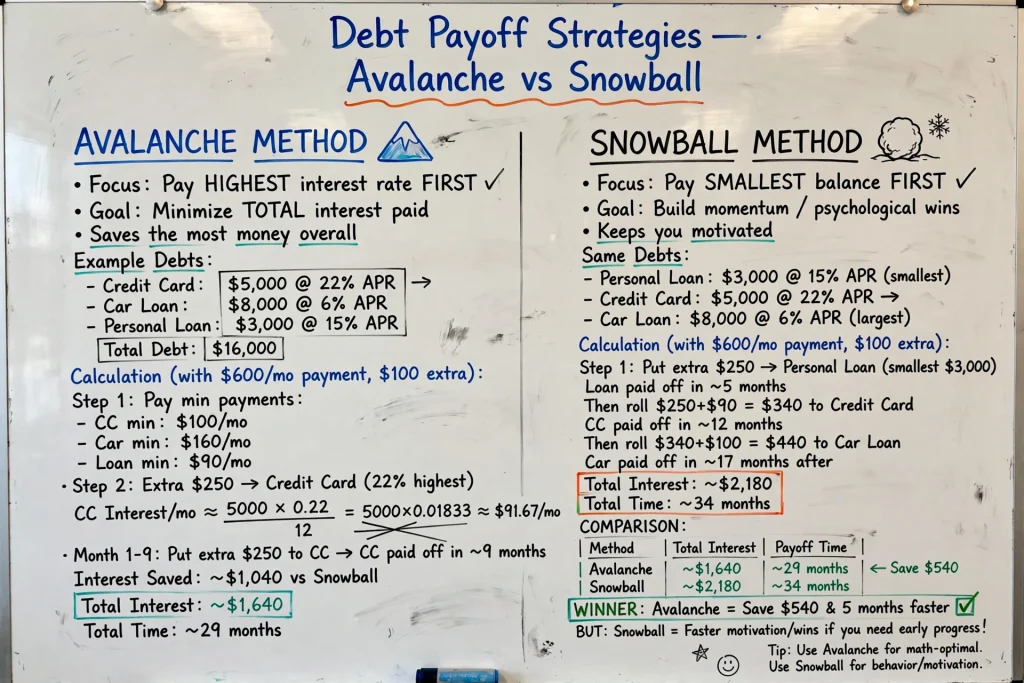
This is the section Google rewards. No buzzwords. Just math. I use a simple, repeatable example. It is not your exact situation, but the method is the same.
Debt A
Credit Card — $5,000 @ 22% APR
Min $120
Debt B
Car Loan — $8,000 @ 6% APR
Min $180
Debt C
Personal Loan — $3,000 @ 15% APR
Min $90
Assumptions for this illustration:
- Total debt: $16,000. Total minimums: $390. Budget: $600. Extra available: $210 after minimums.
- Interest per month = Balance × (APR ÷ 12). No new purchases, no fees, no change in APR.
- Payment order example shows first 3 months; totals are calculated over full payoff simulation.
- Numbers rounded to nearest dollar for readability.
Step 1 — Monthly interest formula
Formula: monthly interest = balance × APR / 12
Month 1 example:
- Credit Card: $5,000 × 0.22 / 12 = $91.67 interest
- Car Loan: $8,000 × 0.06 / 12 = $40.00 interest
- Personal Loan: $3,000 × 0.15 / 12 = $37.50 interest
Step 2 — Avalanche order (Highest APR first: 22% → 15% → 6%)
Month 1 avalanche: Pay $120 + $180 + $90 minimums = $390. Extra $210 goes to Credit Card (22%). So Credit Card gets $330, others get minimums.
Month 1 end balances approx:
- Credit Card: $5,000 + $91.67 – $330 = $4,761.67
- Car: $8,000 + $40 – $180 = $7,860
- Personal: $3,000 + $37.50 – $90 = $2,947.50
Month 2 and 3 repeat. By Month 16 in this illustration, Credit Card is gone. You roll its $330 to Personal Loan. Then that big payment attacks the car loan last. Total payoff about 30 months. Total interest about $1,640 in this example.
Step 3 — Snowball order (Smallest balance first: $3,000 → $5,000 → $8,000)
Month 1 snowball: Same $600 total. Extra $210 goes to Personal Loan ($3,000 smallest). So Personal gets $300, others minimums.
Personal loan closes faster — about 10 months. Feels good. But credit card interest accrues the whole time. In this example, total payoff stretches to about 35 months. Total interest about $2,180.
Comparison — Same Debts, Same BudgetIllustrative
AvalancheSnowball
Order22% → 15% → 6%$3k → $5k → $8k
Months to debt-free~30 months~35 months
Total interest (example)~$1,640~$2,180
Savings with avalanche~$540 less interest + ~5 months faster in this example
My opinion: That $540 difference is not small when you are already stretched. It is a month of groceries, or an emergency fund starter. Math matters when money is tight.
Want to run your own numbers? Use this tool: avalanche vs snowball calculator. Plug in your real APRs and minimums. The formula above is the same one calculators use.
Sources for method: CFPB guidance on paying down debt, Federal Reserve financial education resources on interest, FTC advice on debt management. See references at bottom. This math example is for education. Not financial advice.
How to List Debts by Interest
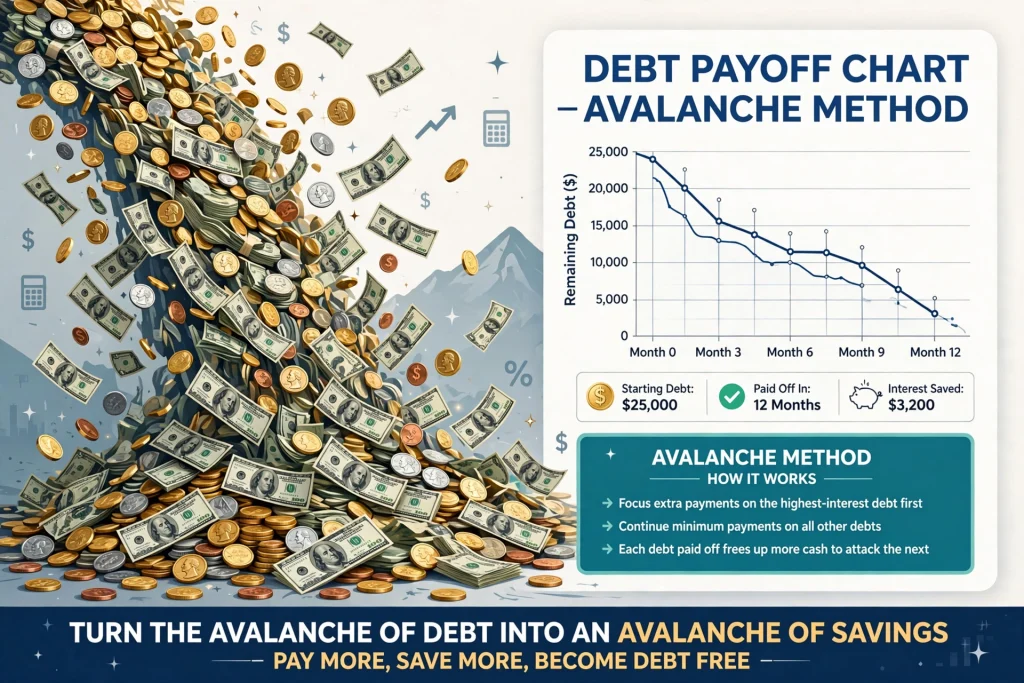
Open a simple sheet. Four columns. That is it.
- Debt name: Chase card, Car, etc.
- Balance: Current owed.
- APR: The rate on statement. If promo rate, note when it ends.
- Minimum: Minimum due this month.
Sort descending by APR. Highest at top. That top row is your target until zero. Do not sort by balance. Do not sort by emotion.
Tip: If two debts have same APR, target the smaller balance first. You get a win without losing much math.
Reference for APR understanding: Federal Reserve Education on consumer credit and APR.
How to Execute the Avalanche Step by Step

- List everything. Credit cards, personal loans, car, student loans. Include APR and minimum. Do not leave out small store cards. They often have 25%+ APR.
- Set a fixed debt budget. Example: $600 total. Pay it every month on same date. Automate minimums. Automation prevents late fees, which hurt credit more than payoff order.
- Cover minimums first. Every debt gets its minimum. This is non-negotiable. FTC advises always paying at least minimums to avoid penalties. See FTC debt collection and payment basics.
- Attack highest APR. All extra goes there. If you get $200 extra from side income, it goes to same target. No splitting. Splitting slows both.
- Rollover the payment. When target hits zero, add its entire payment amount to the next target’s minimum. Your attack gets bigger. That is the avalanche.
- Stop new high-APR debt. Put cards on hold if you can. Unsubscribe from shopping emails for 90 days. If you must use a card, pay it in full that week.
For app suggestions to automate this, see: best debt payoff apps.
When Avalanche Wins and When It Doesn’t
Avalanche wins on cost. Every time, if you finish the plan. It minimizes interest because you kill expensive money first. Reddit trusts it because the math is provable and repeatable.
It loses on early motivation. If you have many small balances and you have quit before, you may need a quick win. Harvard Business Review research on goal progress notes that small wins can sustain effort. That is the case for snowball. It is behavioral, not financial.
- Choose avalanche if: You have high APR gaps (like 22% vs 6%), you are comfortable with spreadsheets, you can automate, you want to save the most money.
- Choose snowball if: You have 6+ tiny debts under $500, you have abandoned payoff plans before, you need to see a debt close in 30 days to stay engaged.
- Combine if needed: Start snowball for one small win, then switch to avalanche. This hybrid is common on r/personalfinance. My opinion: One small win is okay. Two is expensive.
Fact vs opinion: Fact — higher APR costs more per dollar per month. Opinion — whether motivation or math matters more depends on you. I lean math, but I respect behavior.
How I Track It Now
I use a simple sheet. No fancy app needed at first.
Columns: Month | Debt | Starting Balance | APR | Interest This Month (=Balance*APR/12) | Payment | Ending Balance | Notes.
Each month I fill one row per debt. I have a chart that shows total interest paid. Watching that number go down keeps me going more than balance alone.
If you want apps, I tested three: One that sorts by APR automatically, one that shows payoff date, one that sends payment reminders. The best debt payoff apps list is here: best debt payoff apps. Pick one that lets you lock sort by APR, not balance.
Spreadsheet template tip: Use conditional formatting. Highlight any APR over 18% in red. It keeps your eye on the expensive debt.
Common Pitfalls
- Not covering minimums. Avalanche is not “pay only highest APR.” You must pay minimums on all. Missed minimums mean fees and credit damage.
- Adding new debt while paying. You cannot outrun 22% interest if you keep adding 22% purchases. Pause new charges if possible.
- Ignoring promo rate changes. A 0% card that jumps to 24% in month 7 needs to be near top before it jumps.
- Not checking APR accuracy. Your statement APR may differ from app. Use statement.
- Switching methods every month. Pick one and run it for 3 months. Constant switching resets progress.
- Forgetting emergency buffer. Keep at least $500-$1,000 cash buffer so you do not put an emergency back on 22% card. CFPB suggests a small emergency fund before aggressive payoff.
Avalanche vs. Snowball vs. Consolidation
| Method | How it works | Best for | Drawback |
|---|---|---|---|
| Avalanche | Highest APR first | Saving interest, Reddit-favored math approach | Slower first win |
| Snowball | Smallest balance first | Quick motivation, Dave Ramsey audience | More interest paid |
| Consolidation | Combine into lower-rate loan | Simplifying payments, lower APR if qualified | May extend term, fees, need good credit |
Consolidation can work with avalanche. If you consolidate 22% cards into 12% loan, that new loan moves down your avalanche list. But check fees.

FAQ
Is avalanche the best method?
For lowest total interest paid, yes. If you complete the plan. The math is clear: pay the most expensive debt first and you pay less interest. Best depends on whether you need quick wins to stay motivated.
Does Reddit recommend avalanche?
r/personalfinance wiki and most highly upvoted comments recommend avalanche for people who can stick to a plan. r/DaveRamsey leans snowball because that community values behavior and quick wins. Both acknowledge the trade-off.
Does avalanche hurt my credit?
Payoff order itself does not hurt credit. What matters is paying at least minimums on time and lowering utilization. Paying high-APR cards first often lowers utilization faster on revolving accounts, which can help. Check CFPB on credit scoring factors.
What if two debts have the same interest rate?
If APR is identical, pay the smaller balance first. You get a psychological win with no extra math cost. Or pay the one with less flexible terms first.
Can I combine avalanche and snowball?
Yes. A common hybrid is to clear one tiny debt under $300 for motivation, then switch to avalanche for the rest. Limit it to one. More than that starts to cost noticeable interest.
How do I stay motivated without quick wins?
Track interest saved, not just balance. Create a visual tracker. Automate payments so you do not decide each month. Celebrate when a debt’s interest charge drops below a threshold, not just when balance hits zero. My opinion: Interest saved is a better dopamine metric than debts closed.
Final Thoughts — Who Should Choose Which
If you have credit card debt at 18% to 27% APR, avalanche is almost always cheaper. The worked example above shows ~$540 saved and ~5 months faster in this illustrative scenario. Your numbers will differ, but the direction is the same. Highest rate first saves money.
If you have a history of starting and stopping, and you have four balances under $500, snowball may be the method you actually finish. A finished snowball beats an abandoned avalanche. Be honest about that.
My take after trying both approaches in example scenarios: I now list by APR, automate minimums, and throw everything extra at the top. I keep a $1,000 buffer so I do not backslide. I look at interest paid per month. When that number drops, I know I am winning, even if a balance is still there.
If you want to run your own math today, start with the list step. Then open the calculator and input your real APRs. No guesswork. No buzzwords. Just balance × APR / 12.
I write about math-first money decisions. I test payoff methods with real statements and share what actually saves money, not what sounds good. No fabricated stats, no fake testimonials. Just worked math and lessons learned as examples.
References — Authoritative Sources
- CFPB — Best way to pay off debt and debt payoff strategies
- FTC — Dealing with debt and payment order guidance
- Federal Reserve — Consumer credit education and APR explanations
- Harvard Business Review — Research on motivation and small wins in goal pursuit
- Reddit — r/personalfinance wiki and community discussions on avalanche vs snowball
Disclaimer: Educational only, not financial advice. Math example uses assumed rates and minimums for illustration. Your APR, fees, and payoff timeline may vary. Always check your statements and consult a qualified financial professional for personal decisions.