I thought I was being smart.
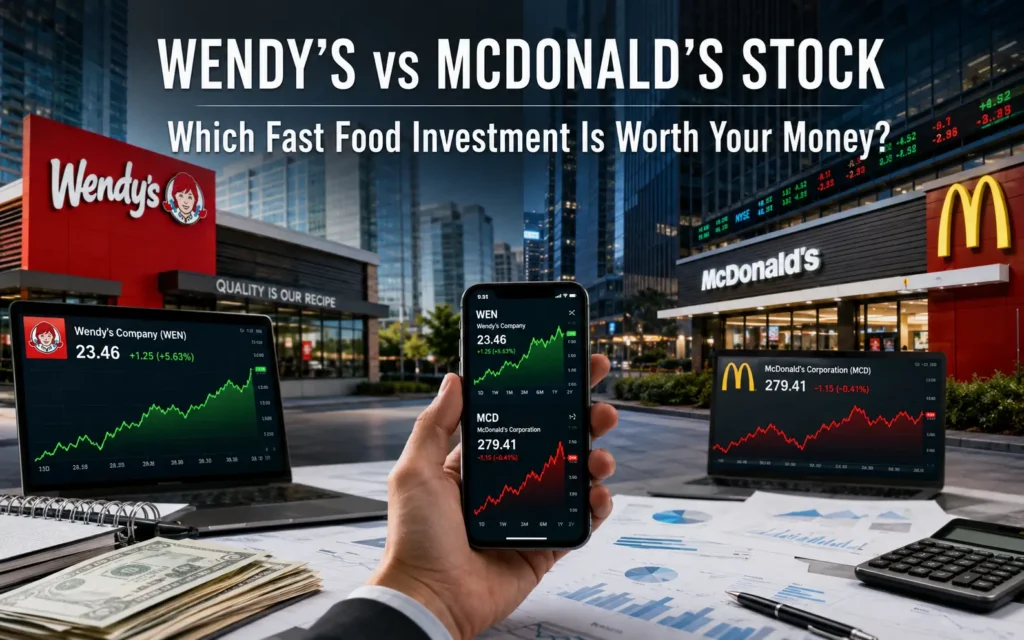
Wendy’s stock looked cheap. McDonald’s stock looked expensive. So I bought the cheaper one, figured I’d ride it up, and waited.
The ride never came.
That was my first real lesson in fast food investing. Cheap doesn’t mean good value. And “I like the brand” is not a stock thesis.
This post is about what I actually found when I went past the surface level and compared these two companies as investments. Because from the outside, Wendy’s and McDonald’s look like they’re in the same business. But dig in, and they’re really not.
Why Fast Food Stocks Are Even Worth Looking At
Fast food companies have been market favourites for decades. Not because they’re exciting. Because people eat burgers in recessions. They eat burgers when the economy is great. They eat burgers when they’re sad and when they’re celebrating something.
That consistency is what investors love.
You don’t get dramatic revenue swings the way you would with a tech company or a retail chain. Fast food is about as recession-resistant as it gets. When things get expensive, people trade down from sit-down restaurants to fast food. That actually helps the sector in tough times.
McDonald’s has been one of the most reliably held stocks in long-term portfolios since the 1970s. Wendy’s has been more of a complicated story. I’ll get into that.
But if you’re somewhere between “I want to invest” and “I don’t want to stress about it constantly”, fast food deserves a real look. Not because it’s flashy. Because it works.
Before You Compare Anything, Understand What You’re actually buying.
This is the part most people skip. I skipped it. That was a mistake.
McDonald’s and Wendy’s are not really restaurant companies.
Most McDonald’s and Wendy’s locations are owned and run by independent franchisees. The parent companies collect royalty fees, rent, and service fees. That means their revenue doesn’t swing wildly based on how many chicken nuggets got sold on a Tuesday.
McDonald’s takes this even further. It’s quietly one of the largest real estate companies in the world. McDonald’s owns the land and buildings that many of its franchisees operate in. Then it leases those properties back to them. That’s a second revenue stream sitting underneath the franchise model.
Wendy’s is also a franchise company. But it doesn’t have that real estate layer.
That one difference matters more than most people realise.
McDonald’s Stock: The Boring Champion
McDonald’s trades under the ticker MCD, and it is, by any reasonable measure, one of the most dependable large-cap stocks in existence.
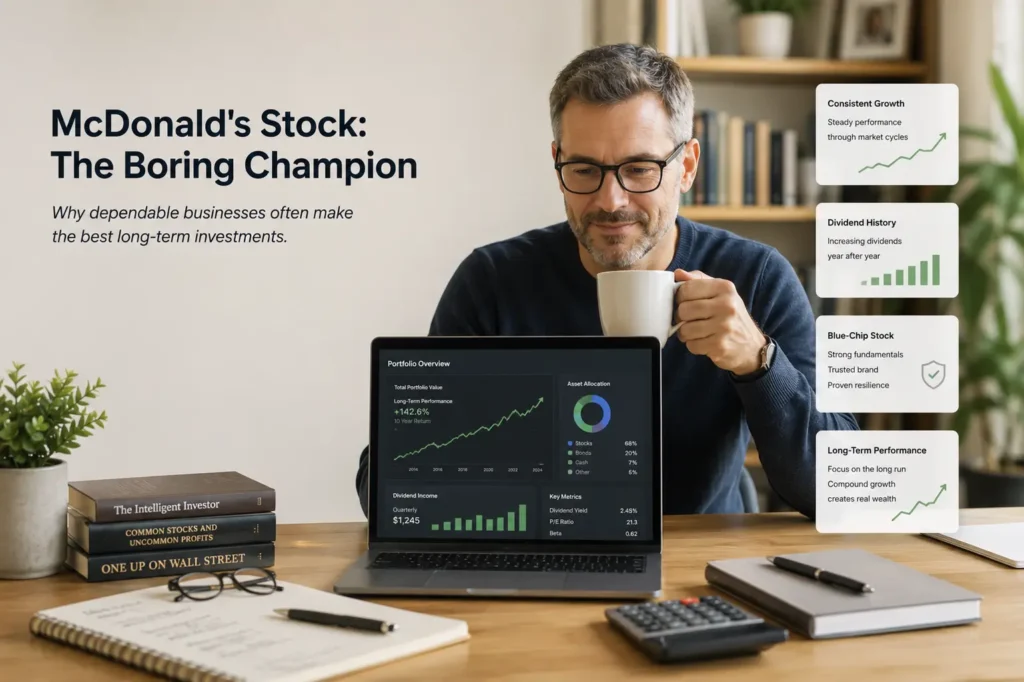
It’s a dividend aristocrat. That means it has raised its dividend payment every single year for at least 25 consecutive years. McDonald’s has been doing this since the early 1970s. That is not an exaggeration. Decades of uninterrupted dividend growth, through recessions, through crises, through market crashes.
As of 2025, McDonald’s pays around $7 per share annually in dividends. The yield sits somewhere in the 2.2% to 2.5% range depending on where the stock price is at any given moment.
Is that the highest yield you’ll find anywhere? Absolutely not. Plenty of stocks offer 4% or 5%. But those dividends often get cut when things get hard. McDonald’s keeps raising its payout almost regardless of what’s happening in the broader market.
During the COVID-19 pandemic, revenue took a real hit. Locations closed. Foot traffic collapsed. But McDonald’s did not cut the dividend. They kept it going and then raised it again. That tells you how management thinks about its obligations to shareholders.
The stock price itself has had long stretches of flat or slow performance. This is not a growth stock. You are not buying McDonald’s expecting 40% gains in a year. But if you had bought MCD in 2012 at around $85 a share, you’d be sitting on substantial gains today — and you’d have collected years of rising dividends the entire time.
That’s the McDonald’s trade. Slow, steady, and boring in the best possible way.
McDonald’s also has something most companies would kill for: genuine global scale. Over 40,000 locations in more than 100 countries. That kind of reach means the business isn’t tied to any single economy. If one market slows down, others can carry the load. No other fast food company operates at that level.
The company also has pricing power. When costs go up — ingredients, labour, packaging — McDonald’s can pass those increases on to consumers without losing them completely. People grumble about price increases. Then they go back to McDonald’s anyway. That’s real leverage.
The main criticism: it’s expensive. McDonald’s almost always trades at a premium valuation. You’re paying up for quality and reliability. If you buy at the wrong time, that premium can suppress your returns for a year or two while you wait for the valuation to normalise.
But zoom out ten years and most of those entry-point concerns fade.
Wendy’s Stock: More Complicated Than It Looks
Wendy’s trades under the ticker WEN, and its history is a lot messier.
The company went through a leveraged buyout in 2008. Triarc Companies, which also owned Arby’s, acquired Wendy’s and merged the two brands together. The combined company later split them apart. Wendy’s went public again as a standalone company and has been trying to find its rhythm ever since.
The stock has largely traded sideways over the past several years. It hasn’t been a consistent grower. And it doesn’t have McDonald’s track record of compounding value over time.
What Wendy’s does offer is a higher dividend yield, typically somewhere in the 4% to 6% range. That sounds better than McDonald’s on paper. But here’s the problem: Wendy’s has at times paid out more in dividends than it actually earned in net income. That is not something you can keep doing forever without something eventually giving way.
The company also carries significant debt. Leverage is common across the fast food franchise world, but Wendy’s level of debt relative to its size is worth paying attention to before you buy.
On the optimistic side, Wendy’s has been putting real money into digital ordering, loyalty programs, and its breakfast category, which officially launched in 2020. The breakfast push got a lot of attention early on. It hasn’t dramatically changed the company’s growth trajectory yet, but it’s still part of the story management is telling investors.
Wendy’s also tracks something called systemwide sales, which covers total sales across all franchised and company-owned locations combined. That number has been growing. But systemwide sales going up doesn’t automatically mean the parent company’s own revenue and profit go up at the same rate. These are different things.
One thing Wendy’s does genuinely well is marketing. Their social media presence has been sharp and aggressive for years. The brand punches above its weight in terms of cultural relevance. People talk about Wendy’s online in a way that doesn’t happen with McDonald’s or Burger King. Whether that translates to meaningful revenue growth is the real question.
Brand awareness is not the same as earnings growth. And earnings growth is what drives stock prices over time.
My Personal Failure With This
Here’s where I have to be honest about something.
I bought Wendy’s stock before I understood any of the above.

I saw the higher dividend yield and told myself, ‘This is basically McDonald’s but at a discount, and it pays me more.’ That logic is completely wrong. It felt right at the time. It wasn’t.
I bought in expecting a quick move higher. I held for about five months. The stock barely moved. While I was waiting, McDonald’s was quietly doing what it always does – grinding higher, reinvesting dividends, and ignoring the noise.
I sold WEN at a small loss. Just enough to sting without being devastating.
The lesson wasn’t really about which stock to pick. It was about how I was making the decision. I was comparing price tags without understanding the underlying businesses. That’s like buying a cheaper house because the square footage looks good without noticing it’s in a flood zone.
Yield-chasing is a trap. A higher yield that isn’t backed by solid earnings is not an opportunity. It’s a warning sign.
I’m not saying Wendy’s is a bad company. I’m saying I bought it for bad reasons. And the market had no interest in rewarding me for that.
Comparing the Two Side by Side
Here’s what the comparison actually looks like when you lay it out plainly.
Dividend reliability. McDonald’s wins without much debate. Decades of consecutive annual increases. Wendy’s has mixed in special one-time dividends and has sometimes paid out more than it earns.
Dividend yield. Wendy’s offers a higher yield on paper. But a higher yield attached to uncertain earnings is worth less than a lower yield that’s practically guaranteed to grow.
Long-term stock performance. McDonald’s has been a better compounder over most meaningful time horizons. Wendy’s has spent a lot of time going sideways.
Business model stability. McDonald’s real estate income gives it a floor that Wendy’s simply doesn’t have. Even if restaurant traffic slows, McDonald’s still collects rent checks.
Debt. Both companies carry debt. Wendy’s carries more of it relative to its size, which is a risk worth knowing about.
Valuation. McDonald’s is almost always the more expensive stock by traditional metrics. Wendy’s looks cheaper. But as I learnt firsthand, cheaper isn’t the same thing as better value.
Growth potential. Wendy’s technically has more room to grow if its digital and breakfast strategies start working. McDonald’s is already a global institution with limited room for explosive expansion. But more upside potential usually comes attached to more downside risk.
Who Should Actually Buy Each One
This depends on what you’re trying to do with the investment.
McDonald’s makes sense if you want a stock you can hold for ten or twenty years without losing sleep over it. If you care about dividend income that grows reliably over time. If you want something that holds up reasonably well when markets go through rough patches. If predictability matters more to you than excitement.
McDonald’s won’t make you rich overnight. But it’s the kind of stock that builds wealth quietly over time if you stay patient and reinvest the dividends. It fits well in retirement accounts, long-term holds, and portfolios where you want a reliable anchor.
Wendy’s makes sense if you believe their turnaround story is real and has more to play out. If you think breakfast and digital loyalty will eventually change the growth trajectory. If you want the higher yield and understand the risk that comes with it. If you’re okay holding a position that might not move much for a while before it moves at all.
If Wendy’s does eventually get its strategy right, there’s more upside than McDonald’s can realistically offer. The stock has more room to move. But that same space cuts both directions.
My honest take: Wendy’s is a small-position idea, not a core holding. And only after you’ve actually looked at the debt and thought seriously about whether that dividend is sustainable.
What About the Rest of the Fast Food Sector?
You don’t have to choose between only these two.
Restaurant Brands International owns Burger King, Tim Hortons, and Popeyes. Yum! Brands owns KFC, Pizza Hut, and Taco Bell. Both are publicly traded franchise companies worth comparing if you’re building a position in this space.
There’s also Shake Shack on the growth end of things, though that’s a very different kind of company — fewer locations, higher price points, and real estate risk since they operate more company-owned stores.
If fast food as a long-term category makes sense to you — and I think it does — McDonald’s is still the most obvious entry point. It’s the most globally diversified, most consistently profitable, and most proven over time.
Wendy’s fits better as a secondary position once you’ve already established a foundation elsewhere.
What I’d Actually Do Right Now
If I were starting fresh with a few hundred dollars to put into fast food stocks, here’s what I’d do.
The majority of it would go into McDonald’s. Not because it’s exciting. Because it doesn’t need to be.
A smaller slice might go into Wendy’s if I genuinely believed in the breakfast story and the digital investment paying off. But I’d treat it as a calculated bet, not a safe move.
And I would stay completely away from making decisions based on dividend yield alone. That’s the exact trap I fell into. It cost me time and a small loss, which was honestly the cheapest way I could have learned that lesson.
High yield with shaky fundamentals is not an opportunity. It’s a flag.
Does Timing Your Entry Actually Matter?
A question people ask a lot: does it matter when you buy?
With McDonald’s, the answer is yes, but less than you’d think. The stock has run up to stretched valuations before. People who bought at those peaks sometimes had to wait two or three years before the stock climbed back past their entry price. That’s not fun. But if they held long enough and kept reinvesting dividends, most of them came out fine.
With Wendy’s, timing matters more because the business doesn’t have the same underlying growth engine compounding beneath the surface. If you buy at the wrong price and the stock drifts sideways for two years, you’re not getting the same dividend cushion to fall back on.
The honest answer to when to buy McDonald’s: when the yield is on the higher end of its historical range, that usually means the stock has pulled back and the valuation is more reasonable. That’s when long-term investors tend to accumulate. Not every correction is a buying opportunity, but when a great business gets temporarily cheaper, that’s typically the right direction to be thinking.
For Wendy’s, I’d want to see the balance sheet in better shape and the payout ratio making more sense before getting excited about the yield. The story could improve. It just needs more evidence.
The Bottom Line
Wendy’s and McDonald’s both sell burgers. They both run franchise models. On the surface, they look similar.
As investments, they are not similar at all.
McDonald’s is stability. It’s the stock you buy when you want slow, compounding growth and reliable income over many years. It’s boring. And in investing, boring wins more often than people expect.
Wendy’s is a bet. Not a crazy one. But still a bet. Higher yield, more risk, more potential upside if things go right — and more downside if they don’t.
For most people, especially if you’re building a long-term portfolio, McDonald’s is where you start.
Wendy’s might eventually deserve a spot. But understand what you’re buying before you buy it.
That’s the part I skipped. It cost me. Don’t make the same call.
This is not financial advice. I’m someone who made some mistakes, learnt from them, and wrote about it. Always do your own research. Talk to a financial advisor if you need real guidance on your specific situation.