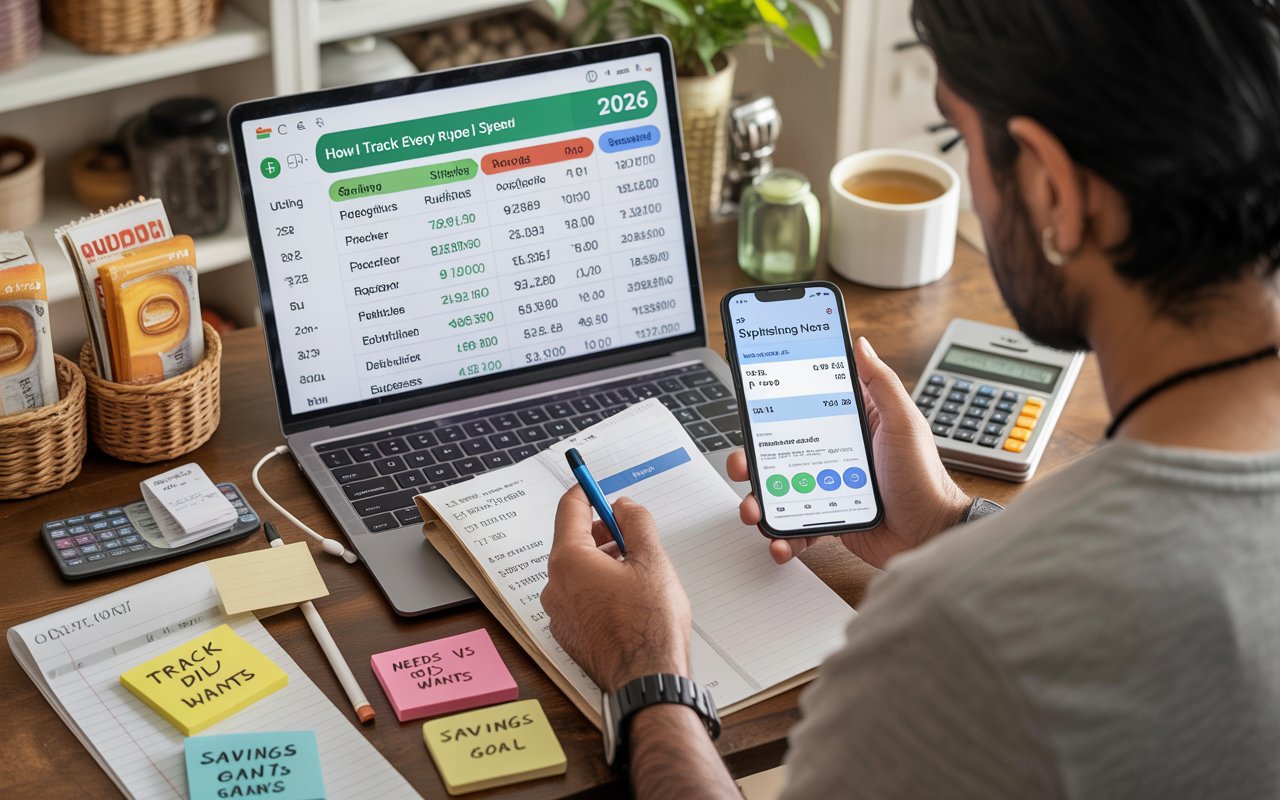
Have you ever wondered where all your MONEY goes at the end of each month? One day you get your salary, feeling rich & confident, & then suddenly you’re checking your bank balance with pure TERROR in your eyes. Trust me, I’ve been there too. Three years ago, I was that person who lived paycheck to paycheck, always wondering why I never had enough money for the things I really wanted. It can simply track every about your payment.
The BREAKTHROUGH came when I realized that most people fail at money management not because they don’t earn enough, but because they have absolutely no idea where their money actually goes. It’s like trying to fill a bucket that has holes in it – you can pour as much water as you want, but it’ll keep leaking out. That’s when I decided to create a simple tracking system that would help me see exactly where every rupee was going.
What I’m about to share with you isn’t some COMPLICATED spreadsheet system or expensive app that requires a degree in accounting to understand. This is a super simple method that takes less than 5 minutes per day & has completely transformed my financial life. In this article, I’ll walk you through my exact step-by-step process, share the tools I use, & show you how this system helped me save over 40% more money than I ever thought possible. Get ready to take CONTROL of your finances once & for all!
The Wake-Up Call That Changed Everything
Let me tell you about the day that changed my entire relationship with money FOREVER. It was a regular Tuesday evening, & I was sitting at my favorite coffee shop with a friend. When the bill came, I confidently reached for my wallet, but my card got declined. Not once, but twice. The EMBARRASSMENT was crushing, but what happened next was even worse.
When I checked my bank account that night, I discovered I had only 847 rupees left, & it was just the 15th of the month. I sat there staring at my phone screen, trying to figure out where all my money had gone. I earn a decent salary, I don’t buy expensive clothes or gadgets regularly, & I don’t even go out that often. Yet somehow, my money had just VANISHED into thin air.

That night, I made a PROMISE to myself that I would never again be in a situation where I didn’t know where my money was going. I spent the next few weeks researching different methods of expense tracking. Some people recommended complex budgeting apps with hundreds of categories. Others suggested maintaining detailed Excel sheets with formulas that looked like rocket science. But I knew that if the system was too complicated, I would give up within a week.
The solution I came up with was embarrassingly SIMPLE, & that’s exactly why it works. Instead of trying to track everything perfectly from day one, I decided to start with just understanding my spending patterns. I didn’t want to change my habits immediately – I just wanted to SEE them clearly first. This approach made all the difference because it removed the pressure & guilt that usually comes with budgeting.
My Three-Pillar Tracking System
After months of trial & error, I developed what I call my “Three-Pillar System.” It’s so SIMPLE that even my 12-year-old cousin could use it, yet it’s powerful enough to give you complete control over your finances. The three pillars are: Immediate Capture, Daily Review, & Weekly Analysis. Each pillar serves a specific purpose & together they create an unbreakable foundation for financial awareness.
Pillar One Immediate Capture – This is where the MAGIC happens. Every single time I spend money\, whether it’s 5 rupees for a pen or 5000 rupees for groceries\, I immediately record it in a simple notes app on my phone. I don’t categorized it\, I don’t analyze it\, I just capture it. The entry looks something like this: “Coffee – 150” or “Auto – 80” or “Grocery – 2340.” That’s it. No complicated categories\, no lengthy descriptions\, just the item & the amount.
Pillar Two: Daily Review – Every night before I go to bed\, I spend exactly 3 minutes reviewing what I spent that day. I open my notes app & just READ through the entries. I don’t judge myself\, I don’t feel guilty\, I just observe. Sometimes I’m surprised by how much I spent on small things\, sometimes I’m proud of my restraint. This daily review helps me stay CONNECTED to my spending patterns.
Pillar Three: Weekly Analysis – This is where I actually learn from my data. Every Sunday morning\, I take all my daily entries & put them into a simple spreadsheet. I have just four categories: Needs (rent\, groceries\, transportation)\, Wants (entertainment\, dining out\, shopping)\, Savings\, & Unexpected (medical\, repairs\, emergencies). This weekly session takes about 15 minutes & gives me INCREDIBLE insights into my money behavior.
The Tools That Make It EFFORTLESS
You might think you need expensive software or complicated apps to track your money, but the truth is much simpler. I use three basic tools that most people already have on their phones, & the total cost is absolutely ZERO. These tools are so simple that there’s no learning curve, no setup time, & no monthly subscription fees to worry about.
1: Phone Notes App – This is my immediate capture tool. Whether you have an iPhone or Android\, your phone already has a notes app installed. I create a new note at the beginning of each month with the title “Expenses – [Month] [Year].” Every time I spend money\, I quickly add a line to this note. The beauty of using your phone’s built-in notes app is that it syncs across all your devices\, so you can access your data from anywhere.

2: Google Sheets – For my weekly analysis\, I use a super simple Google Sheets document. I have just five columns: Date\, Item\, Amount\, Category\, & Notes. That’s it. No fancy formulas\, no complicated charts\, just basic addition & subtraction. Google Sheets is FREE\, works on any device\, & automatically saves your data to the cloud so you never lose anything.
3: Phone Calculator – At the end of each week\, I use my phone’s calculator to add up each category & see where I stand. Some people might laugh at this old-school approach\, but I’ve found that manually calculating my totals helps me REMEMBER the numbers better than if I just relied on automatic formulas.
The key to making this system work is to keep it as SIMPLE as possible. I’ve seen too many people get excited about expense tracking, download a complex app with 50 different features, spend hours setting it up perfectly, & then abandon it after a week because it’s too much work. My system works because it’s so easy that I can do it even when I’m tired, busy, or stressed.
How This System TRANSFORMED My Financial Life
The results of using this simple tracking system have been absolutely MIND-BLOWING. Within just three months, I had identified spending patterns that I never knew existed & made small changes that saved me thousands of rupees. But the benefits went far beyond just saving money – this system gave me confidence, control, & peace of mind that I had never experienced before.
1: The Invisible Money Drains – The first major revelation was how much I was spending on tiny purchases throughout the day. A samosa here\, a cold drink there\, an auto ride instead of walking – these small amounts were adding up to nearly 8\,000 rupees per month! I wasn’t aware of this because each individual purchase felt insignificant\, but together they were eating up almost 30% of my income.

2: Emotional Spending Patterns – By reviewing my daily expenses every night\, I started noticing that I spent more money on days when I was stressed\, bored\, or upset. On bad days at work\, I would automatically order expensive food instead of eating the lunch I brought from home. When I was feeling lonely\, I would go shopping for things I didn’t really need. Recognizing these patterns allowed me to find HEALTHIER ways to deal with my emotions.
3: The Power of Awareness – The most surprising discovery was that just tracking my expenses\, without making any conscious effort to change my spending\, naturally led to better financial decisions. When I knew I would have to write down “expensive coffee – 300\,” I found myself automatically choosing the smaller\, cheaper option. This awareness created a natural brake system for unnecessary purchases.
After six months of consistent tracking, I had managed to increase my monthly savings by 12,000 rupees without feeling like I was depriving myself of anything important. The money I saved came from eliminating unconscious spending & making slightly better choices throughout the day. This EXTRA money allowed me to build an emergency fund, which gave me incredible peace of mind.
Your Next Steps to Financial Freedom
Now that you understand my system, you’re probably wondering how to get started without feeling overwhelmed. The SECRET to success with expense tracking is to start small & build the habit gradually. Don’t try to transform your entire financial life overnight – that’s a recipe for failure. Instead, commit to following my system for just one week & see what you discover.
Week 1: Just Track – Your only goal for the first week is to write down every expense in your phone’s notes app. Don’t worry about categories\, don’t try to change your spending habits\, just focus on capturing everything. If you forget to record something\, don’t stress about it – just start fresh with the next purchase. The goal is to build the HABIT of awareness.
Week 2: Add Daily Review – In your second week\, continue tracking but add the daily review component. Every night\, spend 2-3 minutes reading through your expenses for the day. Notice what surprises you\, what makes you proud\, & what makes you curious. Remember\, you’re not judging yourself – you’re just OBSERVING your patterns with friendly curiosity.

Week 3: Weekly Analysis – Now you’re ready to start organizing your data. Take all your entries from the past two weeks & put them into a simple spreadsheet with the four categories I mentioned: Needs\, Wants\, Savings\, & Unexpected. Add up each category & see what percentage of your income goes to each area. This is when the real insights start to EMERGE.
The beauty of this gradual approach is that by the time you reach week three, tracking will feel natural & automatic. You won’t have to force yourself to remember because it will have become a HABIT. More importantly, you’ll start to see the immediate benefits of financial awareness, which will motivate you to continue.
Remember, the goal isn’t to become a perfect money manager overnight. The goal is to develop a clear understanding of your spending patterns so you can make informed decisions about your financial future. Some weeks you’ll spend more, some weeks you’ll spend less, & that’s perfectly normal. What matters is that you’ll always know exactly where you STAND & why.
This simple tracking system has given me something that no amount of money can buy: complete confidence in my financial decisions. I no longer worry about money because I know exactly where it’s going & why. I hope this system brings you the same sense of control & peace of mind that it has brought me. Your future self will thank you for taking this important step toward financial FREEDOM!