I’ll be honest with you.
When I first started looking at WEN stock as a passive income play, I got excited too fast. The numbers looked great on paper. A fast food brand most of us grew up with. A quarterly dividend. A yield that crushed what any savings account was offering.
So I bought in.
And then Wendy’s cut the dividend.
I’m going to tell you exactly what happened, why it happened, and what the current situation looks like in mid-2026. Because if you’re googling “WEN stock dividend” right now, you deserve a straight answer — not a sales pitch dressed up as research.
Let’s get into it.
What Is WEN Stock?
WEN is the ticker symbol for The Wendy’s Company. It trades on the Nasdaq.
Wendy’s is one of the biggest fast food chains in the world. As of late 2025, they had about 5,969 locations in the United States and another 1,428 restaurants across 38 other countries. That’s over 7,000 restaurants globally.
The company makes most of its money through franchising. Individual restaurant owners pay Wendy’s a royalty fee to run their locations under the brand. Wendy’s also operates some restaurants directly. And through a separate segment called Global Real Estate & Development, it earns income by leasing properties to franchisees.
This franchise-heavy model is actually one of the reasons dividend investors get interested in WEN. Franchise revenue is relatively predictable. You’re not as exposed to the day-to-day chaos of running a kitchen. The royalties keep flowing whether or not a specific quarter was great.
That stability is what made me look at WEN as a dividend stock in the first place.
The WEN Dividend Right Now (Mid-2026)
Let me give you the current numbers.
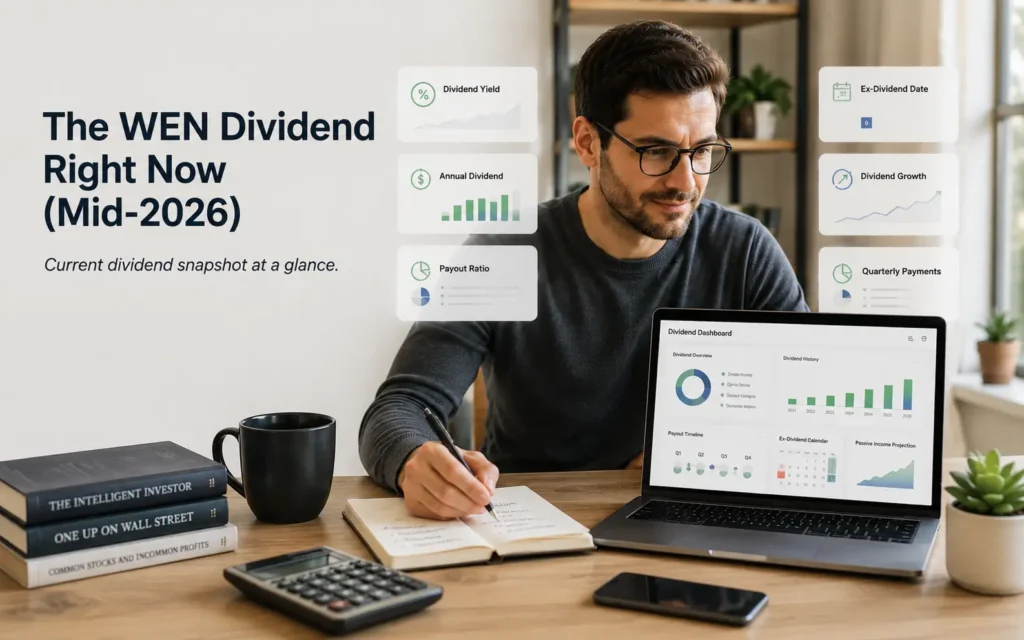
Wendy’s pays a quarterly dividend. As of the most recent payment in June 2026, the dividend was $0.14 per share per quarter. Annualised, that works out to $0.56 per share per year.
The stock price as of early July 2026 is sitting around $7.43 to $7.47 per share.
At that price, the dividend yield works out to roughly 7% to 7.5%, depending on exactly which day you check. Some trackers show it as high as 8.2% due to minor price fluctuations.
To put that in perspective: the average dividend yield for S&P 500 stocks is around 1.3% to 1.5%. Wendy’s is paying out roughly five to six times that. The industry average for restaurant stocks is even lower — around 1.8% to 2.2%.
So yes, on raw yield alone, WEN looks attractive.
But that’s not the whole story. Not by a long shot.
The Dividend History — And the Cut That Stung
Here’s the part I wish someone had explained to me more clearly before I jumped in.
Wendy’s has been paying dividends since 2000. That’s over two decades of quarterly payments without completely stopping. In total, the company has made 113 dividend payments over 23 years. There’s a real history here.
For a while, the quarterly dividend was sitting at $0.25 per share. That works out to $1.00 per year. At certain stock prices, that gave you a yield of 4% to 5%, which is still solid.
Then 2025 happened.
In Q1 2025, Wendy’s paid the usual $0.25. But starting in Q2 2025, they cut it to $0.14 per quarter. That’s a reduction of 44%. For income investors, a 44% dividend cut is not a minor event. It’s the kind of thing that makes your stomach drop.
Here’s where I’ll tell you my failure.
I bought WEN shares in early 2025 because I was building a small passive income portfolio. My thinking was simple: well-known brand, long dividend history, high yield. I ran the numbers on $0.25 per quarter and felt good about the position. I didn’t dig into the balance sheet deeply enough. I didn’t look at the payout ratio carefully. I just saw the brand name and the yield, and I clicked buy.
When the cut was announced in Q2 2025, I learnt an expensive lesson. Dividend investing isn’t about finding the highest yield and parking money there. It’s about understanding whether that dividend is sustainable. I didn’t do that work. I paid for it.
The total dividend Wendy’s paid out in 2025 was $0.67 per share — one full quarter at $0.25, then three quarters at $0.14. If you had been expecting $1.00 per share for the year, you got $0.67 instead. That’s real money left on the table.
Why Is the Yield Still So High?
Good question. If the dividend was cut, why is the yield still over 7%?
The answer is the stock price.
WEN shares have fallen significantly. The 52-week range as of July 2026 is $6.07 to $12.00. The all-time high for the stock was around $22.78 back in June 2021. So the stock is trading at less than a third of its peak.
When a stock price drops and the dividend stays the same, the yield goes up. That’s just math.
So the 7%+ yield you’re seeing today is partly the result of a beaten-down stock price – not necessarily a sign that Wendy’s suddenly became a more generous company. The company cut the dividend once already. The stock has dropped dramatically from its highs.
That context matters.
The Real Risks You Need to Know About
I’m not going to pretend this is a risk-free income play. It isn’t. Here are the things that actually concern me.
The debt is genuinely alarming. Wendy’s debt-to-equity ratio is sitting at roughly 2,974%. That’s not a typo. The company carries an enormous debt load relative to its equity. For an income investor, high debt means more of the company’s cash flow goes toward interest payments — not dividends. It also means the dividend is the first thing on the chopping block if business gets worse.

Earnings are under pressure. In Q1 2026, Wendy’s reported earnings per share of $0.12 — down from $0.20 in Q1 2025. Net income dropped 42% year over year. The company’s profit margin fell from 7.5% to 4.2% in the same period. That’s a meaningful decline. Higher operating costs, inflationary pressure on labour and commodities, and softer consumer spending all played a role.
The payout ratio is stretched. Wendy’s current earnings payout ratio is around 82%. That means for every dollar the company earns, it’s paying out 82 cents in dividends. That doesn’t leave a lot of room for error. The cash flow payout ratio is better — around 45% — which is why analysts haven’t been screaming about another cut. But earnings need to recover for this to feel truly safe.
The “Fresh Start” plan. Wendy’s is currently closing around 5% to 6% of its U.S locations — roughly 200 underperforming restaurants — as part of what the company calls its Fresh Start turnaround plan. Fewer locations means lower royalty revenue in the short term. The hope is that trimming weak locations improves overall system health. But it’s still a contraction, not growth.
The Meme Stock Complication
Here’s something you didn’t expect to be part of a dividend article: WEN briefly became a meme stock in June 2026.
Reddit communities, particularly WallStreetBets, got behind Wendy’s stock in a big way. Trading volume exploded. The stock spiked. There was talk of a short squeeze. Headlines like “Meme-Stock Traders Rally Around Wendy’s” showed up in the Wall Street Journal and Fast Company.
Why does this matter for dividend investors?
Because it muddies the water. When a stock gets caught in a meme rally, the price movement stops reflecting business fundamentals. The stock could spike 30% in a week on retail enthusiasm, then fall back when that enthusiasm fades. If you’re buying WEN primarily for the dividend income, you don’t want to overpay during a meme spike and then watch the price slide back down.
The 52-week high of $12.00 coincided roughly with this meme activity. The stock quickly fell back to the $7-$8 range after the excitement cooled. That’s the kind of volatility that passive income investors generally want to avoid.
My take: if you’re buying WEN for the dividend, buy it based on business fundamentals. Not because Reddit is excited about it. The meme crowd moves on fast.
Is WEN Worth Buying for Passive Income Right Now?
Here’s my honest opinion.

I think WEN is interesting at these prices, but it is not a comfortable hold.
Let me explain what I mean. At around $7.43 per share with a $0.56 annual dividend, you’re getting a yield above 7%. For income-focused investors who believe Wendy’s will hold the $0.14 quarterly payment and slowly recover, this is genuinely attractive. The franchise model is resilient. The brand is durable. And the company has been paying dividends for over two decades without completely stopping.
But there are real reasons to be careful.
The dividend was already cut once — recently. The stock has lost significant value over three years. Debt is extremely high. Earnings are declining. And the share price got artificially inflated by a meme rally that has already started to cool.
I wouldn’t load up on WEN and call it my core passive income position. But as a small allocation within a diversified dividend portfolio — maybe 3% to 5% of your income portfolio — the current yield makes it worth watching.
If the company’s Fresh Start restructuring works and earnings stabilise in late 2026, the dividend could look a lot safer twelve months from now. But I’m not betting the house on it.
How to Actually Buy WEN Stock
If you’ve decided you want exposure, this part is simple.
WEN trades on the Nasdaq under the ticker symbol WEN. You can buy it through any broking platform — Zerodha, Fidelity, Schwab, Robinhood, Interactive Brokers, or whichever broker you use for US equities.
Look at the ex-dividend date before you buy. To qualify for a dividend payment, you need to own the shares before the ex-dividend date. The most recent ex-dividend date was June 1, 2026. The next payment is expected around September 2026.
Keep an eye on the quarterly earnings report too. Wendy’s next earnings release is estimated for August 6, 2026. That report will give you a much clearer picture of whether the $0.14 quarterly dividend is sustainable going forward.
Frequently Asked Questions About WEN Stock Dividend
What is the current WEN dividend per share? As of July 2026, Wendy’s pays $0.14 per share per quarter. Annualised, that’s $0.56 per share per year.
What is Wendy’s dividend yield right now? At the current stock price of around $7.43, the dividend yield is approximately 7% to 7.5%. Some trackers show slightly higher or lower depending on the price at the time of calculation.
When does WEN pay its dividend? Wendy’s pays dividends quarterly. The last payment was on June 15, 2026. The next payment is expected in September 2026, with the ex-dividend date typically falling about two weeks before the payment date.
Did Wendy’s cut its dividend recently? Yes. In Q1 2025, Wendy’s paid $0.25 per share. Starting in Q2 2025, the quarterly dividend was reduced to $0.14 per share – a cut of roughly 44%.
Is Wendy’s dividend sustainable? The cash flow payout ratio is around 45%, which suggests the current $0.14 quarterly payment is manageable from a cash perspective. However, the earnings payout ratio is around 82%, and net income has been declining. It’s not in immediate danger, but it’s not rock-solid either.
How long has Wendy’s been paying dividends? Wendy’s has been paying dividends since 2000. The company has made over 113 consecutive dividend payments across 23 years, though the amount has varied significantly over that time.
Is WEN a good dividend stock to buy right now? That depends on your risk appetite. The yield is high at over 7%, and the brand is well-established. But the company carries heavy debt, recently cut its dividend, and has earnings under pressure. It can work as a small part of a diversified income portfolio, but I wouldn’t treat it as a set-it-and-forget-it income stock at this stage.
What is Wendy’s stock price right now? As of early July 2026, WEN is trading around $7.43 to $7.47 per share, with a 52-week range of $6.07 to $12.00.
Final Thoughts
WEN stock offers a dividend yield that looks genuinely compelling on the surface. And in a world where savings accounts and most dividend stocks are paying far less, 7%+ does stand out.
But I’ve been burnt by chasing yield without doing the full homework. The 2025 dividend cut was a reminder that a high yield can sometimes be a warning sign — not a reward. When a stock falls sharply and the dividend doesn’t keep pace, the yield goes up for the wrong reasons.
If you’re looking at WEN right now, do the full work. Look at the debt. Look at the payout ratio. Understand what the Fresh Start plan means for near-term revenues. Read the next earnings report in August before you commit significant capital.
The passive income opportunity here is real. But so is the risk. Know what you’re buying.
This post is for informational purposes only. It is not financial advice. Always do your own research before investing. The author may hold positions in the stocks mentioned.