If you need your money in the next few months or a few years, the “best” investment is usually not the one with the most exciting return. It is the one that is still there when you need it.
That sounds obvious. It is also easy to forget when headlines are full of hot stocks, crypto stories, and promises of fast money. Short-term goals need a different approach. You have less time to recover from a loss. You may need access on a specific date. A market dip can turn a planned purchase into a delayed one.
This guide compares common choices for short-term goals. It focuses on safety, access, and timing. The examples use U.S. products and rules. If you live elsewhere, check local protections and taxes.
Important: This is general education, not personal investment, tax, or financial advice. No investment is risk-free. Read the account terms and consider a qualified adviser for decisions that affect your finances.
What counts as a short-term goal?
There is no single official number that makes a goal “short term”. In practice, it means you need the money soon enough that a large market loss would cause a problem.
Common examples include:
•A car purchase in six months
•A home down payment in one to three years
•Tuition or a planned medical bill next year
•A wedding, relocation, or major repair
•A tax payment or business expense
•An emergency reserve that must be available now
The date matters more than the label. Money needed in eight months should not be managed like retirement money needed in thirty years.
FINRA describes a time horizon as the expected number of months, years, or decades before you need money for a goal. It also separates time horizon from liquidity needs. Liquidity means how quickly and easily you can turn an investment into cash without a major loss or penalty.
My view is simple: start with the date. Then ask what loss you could tolerate on that exact date. If the honest answer is “almost none”, your choices should stay conservative.
The first decision: protect the goal or chase growth?
Every investment decision has a trade-off. More potential return usually comes with more uncertainty. A stock fund might grow strongly over a long period, but it can also fall when you need to sell.
The SEC warns that securities such as stocks, bonds, and mutual funds can lose some or all of their principal. It also says that cash investments may be appropriate for short-term goals, while noting that inflation can reduce their purchasing power over time.
That creates two risks:
•Loss risk: Your balance falls before you need it.
•Inflation risk: Your balance is stable, but prices rise faster than your earnings.
For a short deadline, I would usually give more weight to loss risk. Missing a possible gain is frustrating. Losing money set aside for a house or tuition can change the plan.
Before choosing an account, write down:
1. The amount you need.
2. The date you need it.
3. The minimum amount you can afford to lose.
4. How quickly you may need access.
5. Whether you need a guaranteed balance or can accept some fluctuation.
This exercise prevents many poor choices.
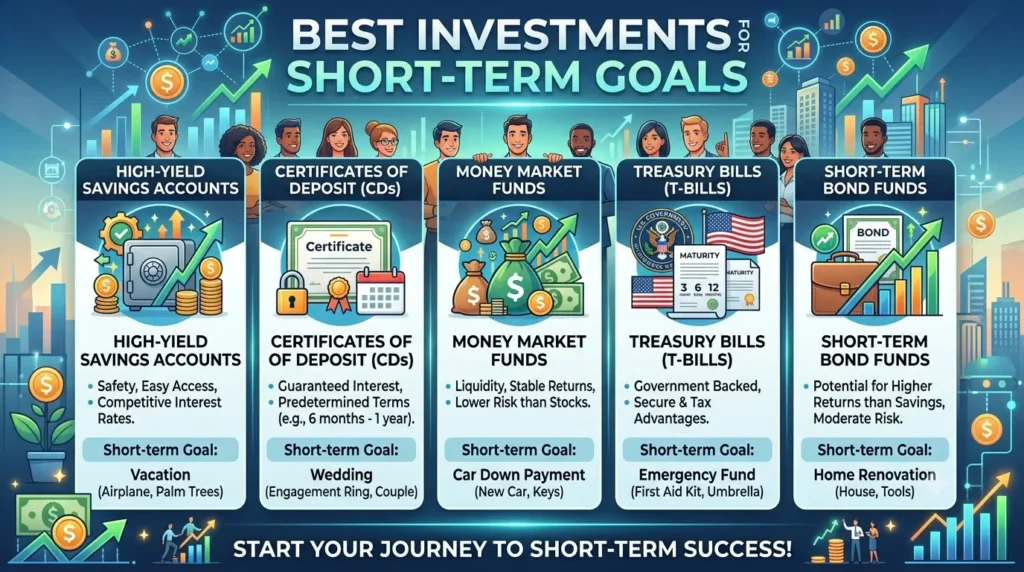
Best option for many goals: a high-yield savings account
A high-yield savings account can be a practical home for money needed soon. It generally lets you deposit and withdraw cash while paying interest. The rate can change, so the return is not fixed for the entire period.
At an FDIC-insured bank, eligible deposits are insured up to the applicable limit. The FDIC currently describes standard coverage as $250,000 per depositor, per ownership category, at each FDIC-insured bank. That protection applies to covered deposit accounts. It does not apply to stocks, bonds, mutual funds, crypto assets, or Treasury securities.
Look for FDIC or NCUA insurance, low fees, a manageable minimum balance, convenient transfers, and a clear withdrawal policy. Check whether the rate is variable or promotional.
A savings account may be the best fit when your date is uncertain. An emergency fund is a good example because access matters more than locking in a rate.
Do not confuse a money market deposit account at a bank with a money market mutual fund at a brokerage. They are different products with different protections.
Certificates of deposit: useful when the date is clear
A certificate of deposit, or CD, is a bank deposit that usually pays a stated rate for a set term. The term might be a few months or longer. In exchange for committing the money, you may receive a more predictable return than with a variable-rate savings account.
A CD can make sense when you know approximately when you need the money, can leave it untouched until maturity, and have confirmed the rate, penalty, and FDIC coverage.
The main catch is early withdrawal. Many CDs charge a penalty if you take money out before maturity. Some may not allow early withdrawals except in limited situations.
A CD ladder divides money among several maturity dates instead of one long CD. This can improve access, but it does not remove rate risk, reinvestment risk, or penalties.
Check the maturity date, automatic renewal terms, early withdrawal penalty, minimum deposit, and how interest is paid.
Treasury bills for short, defined periods
U.S. Treasury bills are short-term securities issued by the federal government. TreasuryDirect lists bill terms ranging from four weeks to 52 weeks. Bills are sold at a discount or at face value, and you receive the face value at maturity. You can also sell a bill before maturity, although the market price may be different from what you paid.
Treasury bills may suit someone who:
•Has a defined time window.
•Can plan around the maturity date.
•Understands that a security is not the same as an FDIC-insured deposit.
•Wants a government security rather than a bank deposit.
TreasuryDirect says bills have a minimum purchase of $100 and are sold in $100 increments. It also notes that interest is subject to federal tax but not state or local tax. Tax rules can change, so confirm current treatment for your situation.
If you sell before maturity, the price can move. If a bill matures after your goal date, you may have to sell early or delay the goal. Match maturity to your cash calendar.
Money market funds: convenient, but not bank deposits
Money market funds invest in short-term debt and are commonly available through brokerage accounts. They can be convenient if you already keep your goal money at a broker. They are not the same as bank money market deposit accounts.
A money market fund is an investment product. It is not an FDIC-insured deposit. Its value and income can be affected by the securities it holds, interest rates, liquidity conditions, fees, and the fund’s rules.
Before using one, check its type, fees, withdrawal settlement time, variable yield, transfer limits, and prospectus.
This option may be convenient, but convenience should not replace understanding. Read the prospectus and compare it with insured deposits and treasury bills.
My opinion: separate goal money from long-term money.
My strongest opinion on short-term investing is that goal money should have its own job. Do not mix a down payment with retirement investments just because both appear in the same brokerage account.
Separate buckets can make the decision clearer:
•Emergency bucket: accessible savings for unexpected bills.
•Near-term bucket: savings, CDs, or bills matched to a known date.
•Long-term bucket: diversified investments that can withstand market swings.
This is not a promise of the highest return. It helps avoid selling a long-term investment at a bad time or gambling with money that already has a purpose.
The SEC also recommends building an emergency fund and paying attention to high-interest credit card debt. In some cases, paying down expensive debt is a better use of cash than seeking a small investment return.
One common failure: reaching for return at the wrong time
A failure worth naming is the temptation to chase a higher return after the goal date is already close. Someone sees a low rate in a savings account, moves the money into a volatile fund, and feels clever while prices are rising. Then the market drops two weeks before the money is needed.
That is not a personal story about a specific portfolio. It is a common real-world mistake and an important lesson: a return target is not more important than the date and purpose of the money.
If your deadline is approaching, consider reducing uncertainty rather than increasing it. A lower expected return can be the sensible price of knowing the money is available.
Risks to avoid
Short-term investing attracts promises that sound too good. Be careful with:
• “Guaranteed” high returns with little or no risk
•Social media tips that create urgency
•Investments you cannot explain in one paragraph
•Unregistered offerings or private deals with unclear terms
•Products with large surrender charges or hidden fees
•Borrowing money to invest
•Concentrating the entire goal in one stock or asset
•Chasing a recent winner without a plan for an exit
Investor.gov warns investors to be sceptical of unsolicited opportunities and high-return promises with little risk. Take time to verify the firm, product, fees, and risks through an independent source.
A simple short-term investing checklist
Before moving the money, ask:
•Is the institution insured or regulated in the way I think it is?
•Can I access the money on the date I need it?
•What happens if I withdraw early?
•Can the balance fall?
•Can the rate change?
•Are taxes or fees likely to reduce the return?
•What is the maturity date?
•Do I understand the product’s official disclosure?
•Would a delay or loss force me to borrow?
Keep a written record of the goal amount, deadline, account, maturity date, and backup plan. Review it before the deadline.
For related planning, see your emergency fund guide, budgeting checklist, and long-term investing basics. Replace these example links with the real pages on your site before publishing.
FAQ: best investments for short-term goals
What is the safest investment for a short-term goal?
No investment is completely risk-free. For many U.S. savers, an FDIC-insured savings account or CD can provide deposit insurance within applicable limits. Treasury bills are government securities, but they are not FDIC-insured deposits. Review the specific protections and risks before choosing.
Are stocks good for a short-term goal?
Usually, stocks are not a good default for money needed on a fixed near-term date. Their value can fall when you need to sell. A stock investment may suit a long-term goal better, but the right choice depends on your time horizon, finances, and risk tolerance.
Is a high-yield savings account an investment?
It is a deposit account used to save money and earn interest. People often include it in short-term investment discussions because it can provide a return while keeping funds accessible. Confirm whether the bank is FDIC-insured and check the account terms.
Should I use a CD or savings account?
Use a savings account when access and flexibility matter. Consider a CD when you know the date and can leave the money untouched until maturity. Compare rates, penalties, insurance, and renewal terms.
Are Treasury bills safer than a money market fund?
They are different products. Treasury bills are direct government securities with a stated maturity, while money market funds hold a portfolio of short-term investments and are not FDIC-insured deposits. Neither should be described as risk-free in every circumstance.
Final thoughts
The best short-term investment is often the least dramatic one. Match the product to the date. Protect liquidity. Check insurance. Understand penalties. Keep speculation away from money that already has a job.
A modest, understandable return can be more useful than a larger possible return that arrives too late. That is the standard I would use when comparing short-term choices.
References
•Investor.gov: Introduction to Investing
•SEC: Ten Things to Consider Before You Make Investing Decisions
•FDIC: Understanding Deposit Insurance
•TreasuryDirect: Treasury Bills
•FINRA Rule 2111 FAQ: Liquidity Needs, Time Horizon, and Risk Tolerance