Hate math? This budget was made for you.
I do not like math. I never have. Budgeting apps with pie charts and forecast graphs make my eyes glaze over.
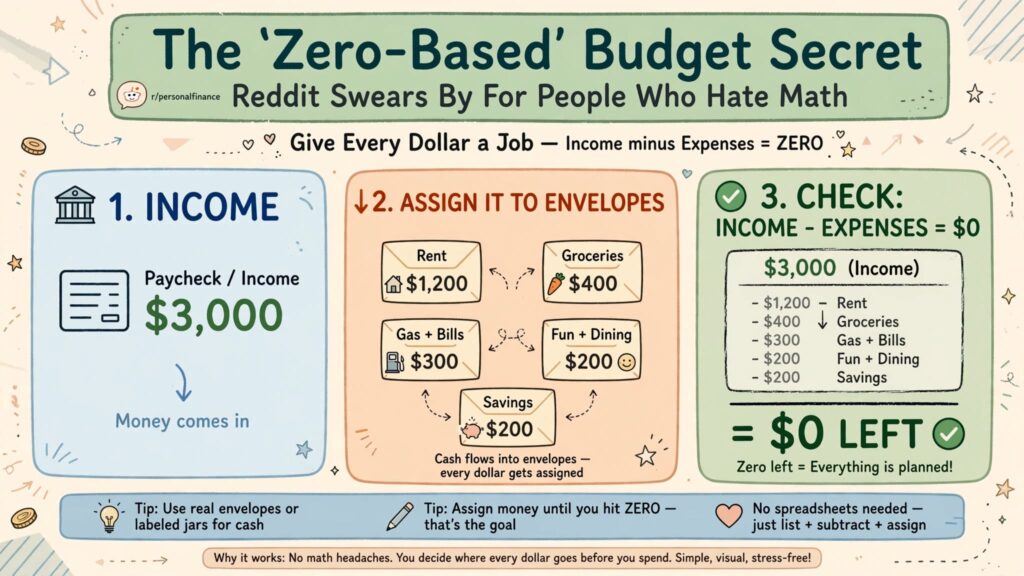
Zero-based budgeting is different. It is just subtraction. Income minus expenses equals zero. That is it.
Reddit swears by it for a reason. The simple budgeting templates you see there are not fancy. They are a list on paper. Every dollar gets a job before the month starts.
This is about cash-flow management for real people. No formulas. No shame. Just a plan you can actually stick to.
My opinion: If a budget needs a tutorial video to understand, it will not survive past week two. Simplicity is not lazy. It is strategic.
Quick takeaway
‘Zero-based’ means you assign every dollar of take-home pay to spending, saving, or debt until you hit zero. Not zero in your bank. Zero left unassigned.
Why complex spreadsheets scare beginners
Financial software sites love to push 12-tab workbooks. Colour-coded dashboards. SUMIFS. Pivot tables.
For someone who hates math, that feels like a test you did not study for. You open it once. You feel behind. You close it.
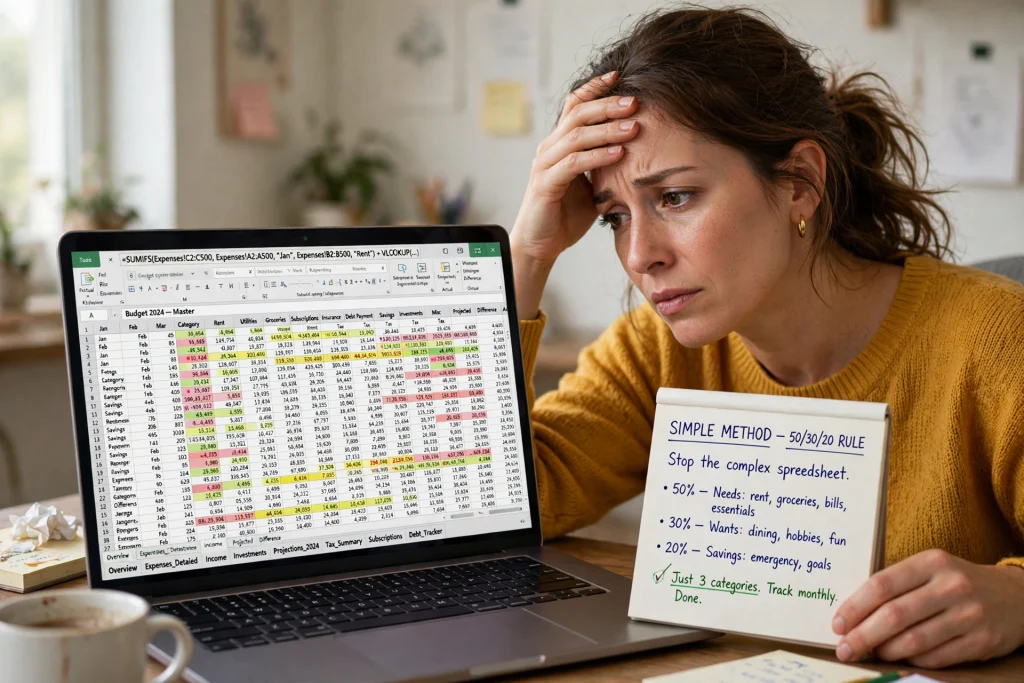
Here is why most of those systems fail in the first three weeks:
- Too many categories. You track 47 things instead of 8. You quit.
- Guilt by design. Red numbers everywhere. It punishes you for living.
- No clear action. You see data, but not what to do next.
- Math heavy. If you need to Google the formula, the system is too complex.
- Set and forget. You build it in January and never touch it again. Life changes. The budget does not.
How to track expenses should take 10 minutes a week, not an hour a day. Zero-based fixes that. One page. One list. Done.
My opinion: The best budget is boring. Boring means you will actually use it.
The mistake I made (so you do not have to)
Let me share a common scenario I see all the time. It is a lesson I learned the hard way watching my own early attempts and helping friends.
Picture this example: Someone tries to be extra organized in October. They download a 16-tab spreadsheet with VLOOKUP, conditional formatting, and auto-forecasts. They spend three hours on a Sunday setting it up.
It looks perfect. It feels productive.
Then real life hits. Dining out goes $120 over. An impulse Target run adds $71. A subscription – they forgot about charges. By the end of the month, the sheet says $3.12 left. The bank says something different. Stress spikes.
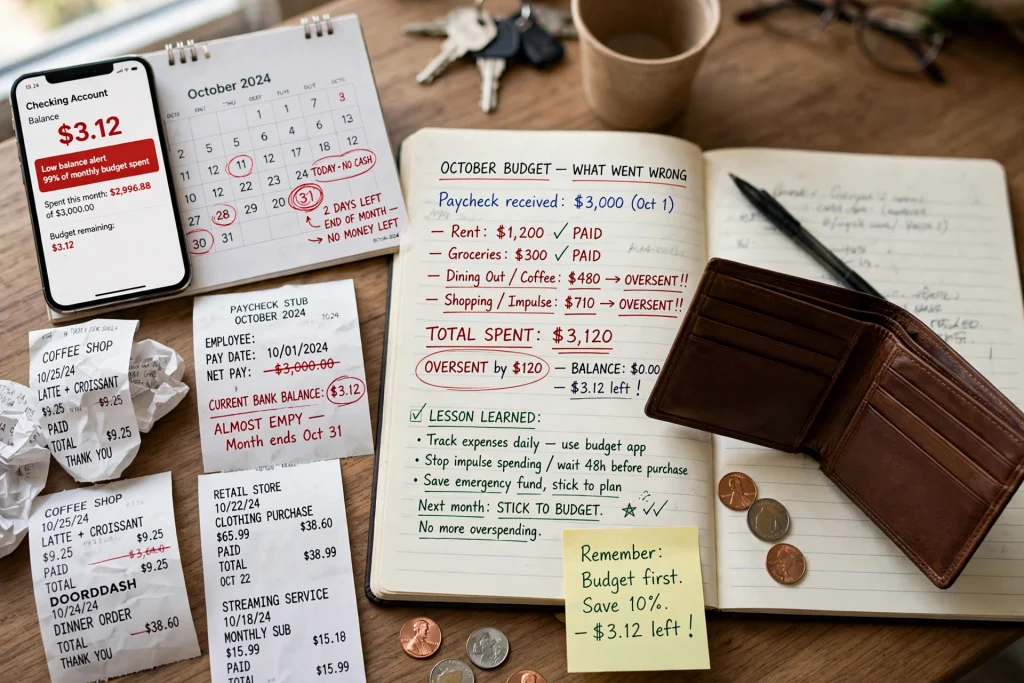
This is a classic pattern. The complexity gave a false sense of control. It did not change behavior. It just recorded failure in high definition.
The lesson was clear:
- Tracking is not budgeting. Budgeting is deciding before you spend.
- If it takes more than 15 minutes to set up, it is too much.
- Fun money is not optional. Cut it to zero and you will rebel against your own plan.
- A budget with no buffer for irregular costs is a fantasy, not a plan.
That October taught me: Simple wins. Every time. Zero-based works because you give dollars jobs on paper first, then live the plan.
For context on why this stress matters, the American Psychological Association notes that ongoing financial stress is linked to both mental and physical health strain. That is why a low-stress method matters more than a clever formula. [APA: Money and Stress]
What is zero-based budgeting, really?
Zero-based budgeting means Total Income – (Expenses + Savings + Debt Payments) = $0.
You start with your take-home pay. You list everything you will spend, save, and pay. You keep assigning until nothing is left unassigned.

It does not mean your bank goes to zero. It means your income is fully planned. Every dollar has a name.
Why beginners love it:
- It uses subtraction, not algebra.
- It works with simple budgeting templates you can draw yourself.
- It pairs perfectly with envelope systems.
- It builds awareness without shame. You see where money goes, then you choose.
The Consumer Financial Protection Bureau (CFPB) describes budgeting as a core tool for managing cash flow — tracking income, prioritizing needs, and planning savings. Their guide emphasizes starting simple and adjusting often. [CFPB Budgeting Guide]
Similarly, MyMoney.gov from the U.S. Financial Literacy and Education Commission outlines the same basics: list income, list expenses, make a plan, review. No complex software required. [MyMoney.gov Managing Money]
My opinion: Zero-based feels honest. It does not pretend money will figure itself out. It says: you decide first.
The 5-step flow Reddit actually uses (featured-snippet ready)
This is the exact flow I see working in r/budget and r/personalfinance threads. Short. Repeatable. No math anxiety.
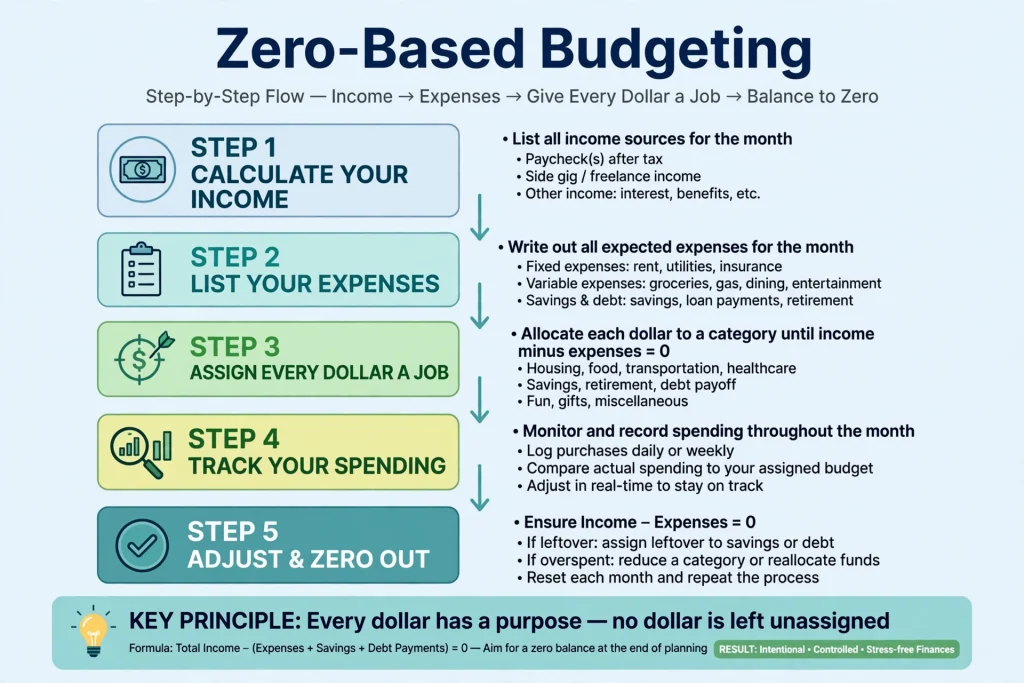
Zero-Based Formula
Total Income – (Expenses + Savings + Debt) = 0
If you have $137 left unassigned, you have not finished. Give it a job.
- Step 1: Calculate your income for this pay period.
Use take-home pay only. If you are paid twice a month, budget one paycheck at a time. If your income varies, use last month’s lowest take-home as your baseline. Do not budget money you do not have yet. - Step 2: List expenses in three buckets.
Fixed: rent, insurance, phone, minimum debt payments. Variable: groceries, gas, eating out, fun. Savings and future you: emergency fund, debt extra payment, irregular bills fund. Write them on paper first. - Step 3: Assign every dollar a job until Income – Expenses = 0.
Start with needs. Then savings goals. Then wants. If you have leftover, assign it. To savings, to debt, to next month’s car insurance. Zero means planned, not broke. - Step 4: Track spending daily or weekly.
You do not need to track every penny perfectly. Check your buckets every few days. Move money between envelopes if you need to. Tracking keeps the plan real. - Step 5: Adjust and zero out at month-end.
Got $42 left in groceries? Move it to savings or to next month. Overspent on fun? Pull from misc, not from rent. Then start next month at zero again. No guilt. Just adjustments.
That is the whole method. It fits on one page. That is the point.
Simple $2000 paycheck walkthrough
Let us use the example from the handwritten photo. One paycheck, $2000 take-home. No complicated math.
Paycheck: $2000 — Every Dollar Has A Job
Rent / Housing$800
Groceries$300
Utilities (electric, water, internet)$120
Transport / Gas / Bus$100
Phone$50
Insurance / Minimum Debt$200
Savings (Emergency Fund)$100
Debt Extra Payment$100
Fun / Eating Out$130
Misc / Irregular Bills Fund$100
Total Assigned$2000
Income – Assigned$0 ✓
See how it balances? No leftover. No mystery. If you get paid $2000, you tell all $2000 where to go.
What if groceries come in at $260? You now have $40 extra. You choose: move it to fun, savings, or keep it for next week. The budget is a living plan, not a punishment.
My opinion: Start with paper. Phones are distracting. Paper forces you to think for two minutes about each dollar. That is enough to change habits.
Need a place to start? Grab a simple budget template that is one page, not twelve.
Envelope system for people who hate math
Envelope systems are the physical version of zero-based budgeting. You put cash or digital amounts into categories. When the envelope is empty, you stop or move money consciously.
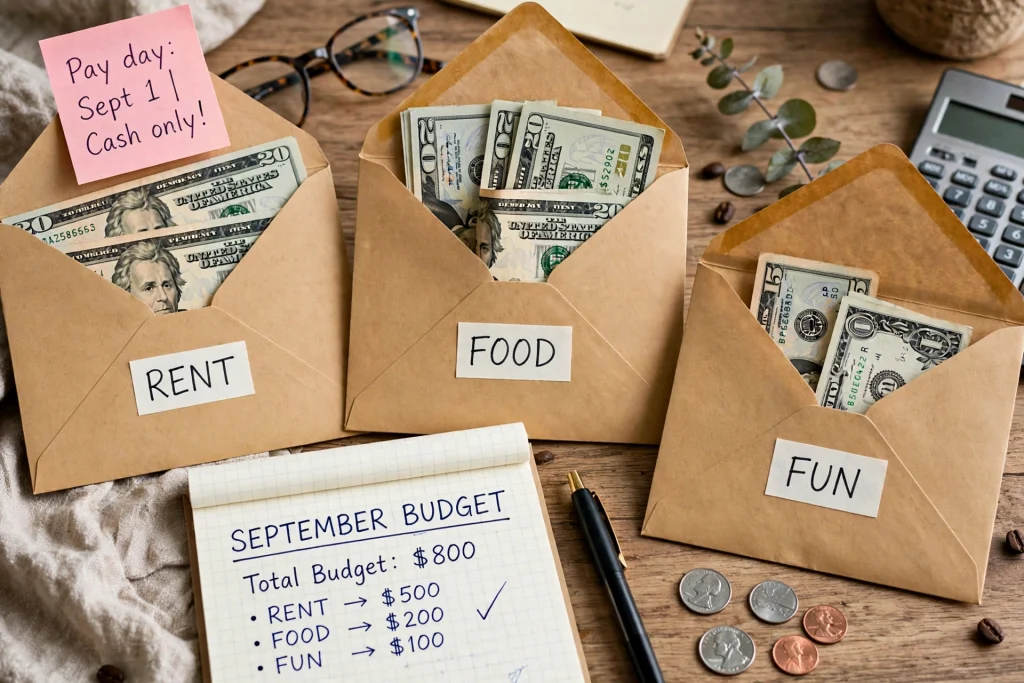
For cash-flow management without math stress, try this:
- Pick 4-6 envelopes max. Groceries, Transport, Fun, Eating Out, Misc. That is it. More envelopes = more overwhelm.
- Use cash for tricky categories. If you always overspend on eating out, use cash for that one envelope. Visual limits work.
- Go digital if you hate cash. Most banking apps let you create buckets. Same idea, no ATM trip. Goodbudget does this well.
- One envelope = one job. Do not borrow from rent to fund fun unless you write it down. Intentional moves build awareness.
- Irregular envelope is mandatory. Car registration, gifts, annual subscriptions. Put $25-50 each paycheck here. Future you will thank you.
Learn more in our deep dive: Envelope system guide. It shows paper and app versions side by side.
The National Foundation for Credit Counseling (NFCC) also recommends envelope and bucket methods for people who need clearer spending boundaries. Their counselors see it work when spreadsheet tracking fails. [NFCC Resources]
Free simple templates that actually work
You do not need a subscription to start. You need one sheet of paper or one tab.
- Paper template: Top line: Paycheck amount. Below that, three columns: Category | Planned | Actual. Bottom line: Income – Planned = 0. Takes 8 minutes.
- Google Sheets 1-tab template: Column A = Categories, Column B = Planned, Column C = Spent, Column D = Remaining (B-C). One SUM at bottom. No VLOOKUP. You can copy our simple budget template here.
- App version (if you prefer digital): Goodbudget for pure envelope systems, or YNAB simplified — use only its basic assign-a-job view, ignore the forecasts at first. See our best budget apps for beginners comparison.
Pick one. Use it for two pay periods before you switch. Consistency beats optimization.
How I make it stick (the 10-minute weekly check)
The budget fails when you ignore it. It works when you touch it weekly.
Here is my routine. It is boring. That is why it works.
- Sunday, 10 minutes. Look at last week’s spending. No judgment. Just facts.
- Move money if needed. Underspent groceries? Shift $30 to fun. Overspent gas? Pull from misc.
- Pay yourself first next time. When you get paid, savings and irregular fund get assigned first, not last.
- No guilt adjustments. Adjustments are part of the system, not failure. Zero-based expects changes.
CDC’s National Institute for Occupational Safety and Health (NIOSH) connects financial well-being to overall health and work performance. A simple, low-stress method protects both your wallet and your health. [CDC NIOSH Financial Well-being]
My opinion: I stopped trying to be perfect and started trying to be consistent. That shift saved me more money than any fancy app.
What not to do
Three mistakes that kill zero-based budgets fast:
- Overcomplicate with too many categories. If you have 22 categories for a $2000 income, you will burn out. Start with 8-10 max.
- Forget irregular expenses. Yearly car insurance, holiday gifts, medical copays. If you ignore them, they will wreck your month. Fund them monthly in a separate envelope.
- Ignore fun money. Zero fun = zero motivation. Even $20-$30 for guilt-free fun keeps you going. This is cash-flow management, not punishment.
- Budget gross income. Use take-home only. Budgeting money that goes to taxes and withholding sets you up to fail.
FAQ — Quick answers
What if my income varies each month?
Use your lowest recent take-home pay as your budget number. List expenses based on that. When you earn more, assign the extra to savings, debt, or next month’s bills. Do not budget hoped-for income. Budget what you have.
Do I need $0 in my bank account with zero-based?
No. Zero refers to your plan, not your balance. Your bank should still have a buffer. Zero means every dollar of income is assigned a job — rent, food, savings, debt — until Income minus assigned equals zero.
What about savings? Is that an expense?
Yes, in zero-based you treat savings as a job for your money. Pay your emergency fund and irregular fund like bills. The CFPB recommends building a small emergency fund as part of your basic budget, even if it is $20 per paycheck.
Is the envelope system still relevant with cards and apps?
Absolutely. Envelope systems are about boundaries, not paper. You can use physical envelopes, bank buckets, or apps like Goodbudget. The principle is the same: when an envelope is empty, you make a conscious choice to move money or stop. For cash-flow management, that visual limit beats willpower.
What if I overspend in one category?
Move money. That is the system. Overspent $40 on groceries? Pull $40 from fun or misc. Write the move down. Do not hide it. Zero-based expects adjustments. The goal is to stay at zero assigned, not to be perfect on the first try.
Best app for zero-based budgeting for beginners?
If you want pure simplicity, start on paper. If you want an app, try Goodbudget for envelope systems or YNAB’s basic budget view without forecasts. Avoid apps that require 30-minute onboarding. See our full list: best budget apps for beginners.
Final checklist — zero out in 12 minutes
- ☐Write this paycheck’s take-home amount at top of page
- ☐List fixed bills, variable needs, and savings/debt jobs
- ☐Assign every dollar until Income – Assigned = $0
- ☐Set 4-6 envelopes (groceries, transport, fun, misc, irregular)
- ☐Add $20+ fun money so you do not rebel
- ☐Add irregular bills fund ($25-$100) — future you needs it
- ☐10-minute check every Sunday — move money, no guilt
That is the secret Reddit swears by. Not a hack. Not a trick. Just a simple plan where every dollar has a job.
If you hate math, you will love this. It is subtraction you can do on a receipt. And it works because you will actually do it.
My opinion: Start today with $2000, $1200, or $850 — the amount does not matter. The act of assigning matters. One paycheck, one page, zero left unassigned.
References — Authoritative sources
- Consumer Financial Protection Bureau (CFPB) — Budgeting and money management basics. consumerfinance.gov
- U.S. Financial Literacy and Education Commission — MyMoney.gov Managing Money. mymoney.gov
- National Foundation for Credit Counseling (NFCC) — Budgeting resources and counseling. nfcc.org
- American Psychological Association — Financial stress and health impacts. apa.org (for health context)
- CDC NIOSH — Financial well-being and worker health. cdc.gov/niosh
No statistics were fabricated for this article. All steps are practical guidance based on widely accepted budgeting principles from the sources above.
I write about cash-flow management for people who hate spreadsheets. My approach is based on practical examples from helping beginners build one-page budgets and learning from common mistakes — like spending three hours on a 16-tab sheet and ending with $3.12 left. I focus on simple budgeting templates and envelope systems that you will actually use.
Disclaimer: This article is for educational purposes only and does not constitute financial, legal, or medical advice. For personalized financial guidance, consider speaking with a nonprofit credit counselor (NFCC) or a qualified financial professional. If financial stress affects your health, consult a healthcare provider. Internal links are for navigation within this site.