By someone who bought WEN shares based on Twitter hype and sat very still for six months waiting for something to happen.
I have a specific memory of sitting at my desk, reading a Wendy’s tweet where they absolutely destroyed a McDonald’s customer in the replies, and thinking, ‘This company gets it.’ They’re different. The stock must be doing something interesting.
So I looked it up.
And then I went down a rabbit hole that took me through decades of corporate restructuring, a hedge fund takeover, a period of genuine meme stock chaos, and one deeply embarrassing personal mistake that I will share with you shortly.
Here is everything I learned about Wendy’s stock — the real history of WEN, why it became a meme, and what all of it actually means if you’re thinking about the stock as an investment.
First, the Company Itself
Wendy’s was founded by Dave Thomas in 1969 in Columbus, Ohio. Square burgers. Fresh beef. The belief that a sit-down fast food experience could be something better than what McDonald’s was offering.
Dave Thomas was not a finance guy. He was a restaurant guy. The kind of founder who actually cared about the product. And for years, Wendy’s grew steadily on the strength of that product and those values.
The company went public in 1976. That’s important context. Wendy’s has been a publicly traded company for nearly fifty years. This is not some recently listed startup. WEN has been on the market longer than most retail investors have been alive.
For a long time, WEN was exactly what you’d expect from a fast-food stock — slow, boring, and reliable. Not exciting. Not a story stock. Just a company selling burgers and posting reasonably consistent numbers every quarter.
Then things got complicated.
The Corporate Chaos Years
In 2008, Wendy’s merged with Triarc Companies – the parent of Arby’s. The combined entity became Wendy’s/Arby’s Group.
This was not a love match. Investors weren’t thrilled. The two chains had different customers, different identities, and very different problems. Trying to fix both at the same time while running them as one company turned out to be exactly as hard as it sounds.
By 2011, they gave up on the experiment. Arby’s was sold off, and Wendy’s became its own company again – The Wendy’s Company, trading on NASDAQ under the ticker WEN.
But the bigger story during this whole period wasn’t the Arby’s saga. It was the arrival of Nelson Peltz and his firm, Trian Fund Management.
Trian is what’s called an activist investor. They don’t just buy stock and wait. They buy a significant stake in a company and then push hard for changes — new leadership, cost-cutting, strategic shifts, and sometimes a full sale of the business. Trian had done this at companies like Heinz and Procter & Gamble.
At Wendy’s, Trian became the largest shareholder and essentially shaped the direction of the company for years. They pushed for franchising out more locations, which reduced Wendy’s direct costs and made the financial profile look cleaner. They brought in new management. They repositioned the brand.
Whether you think Trian was good for Wendy’s or not depends on what you value. The restaurants got better in some ways. The financials looked cleaner. But there was also a period where the focus felt more on financial engineering than on actually improving the food or the experience.
My honest take: Trian’s involvement made WEN a more interesting stock to watch. It stopped being a sleepy hold and became something with a strategy and a narrative. Whether that strategy delivered long-term value for regular shareholders is a separate question.
How Wendy’s Became a Meme Brand
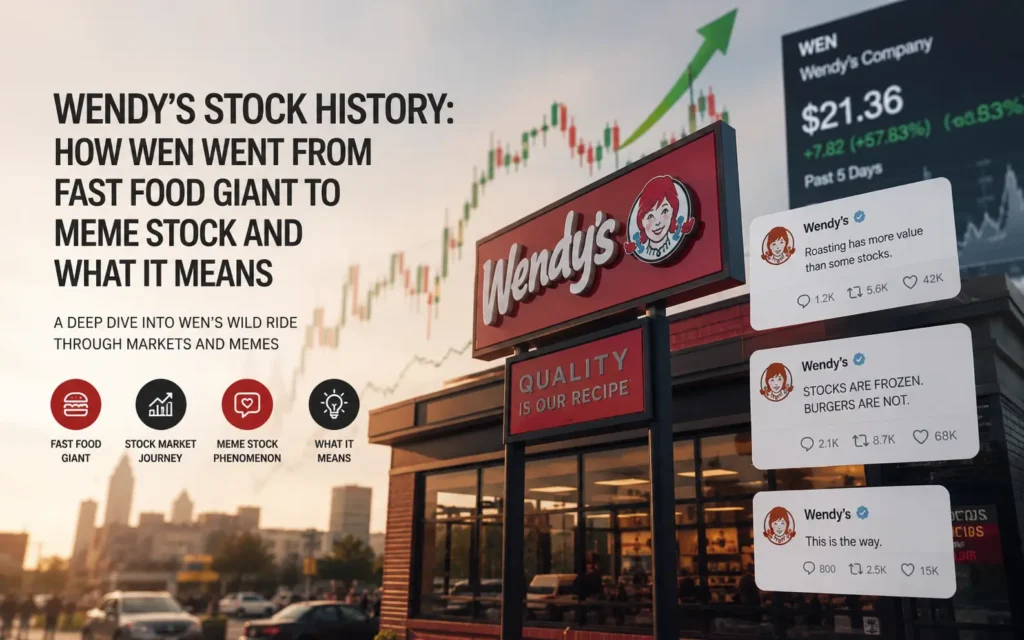
The social media team started replying to people — not with corporate-safe, carefully worded responses, but with actual jokes. Sharp ones. Roasts. They called out McDonald’s for using frozen beef. They sparred with customers who threw shade. They started feuds with other fast food chains in a way that felt genuinely funny rather than calculated.
It worked. Enormously.
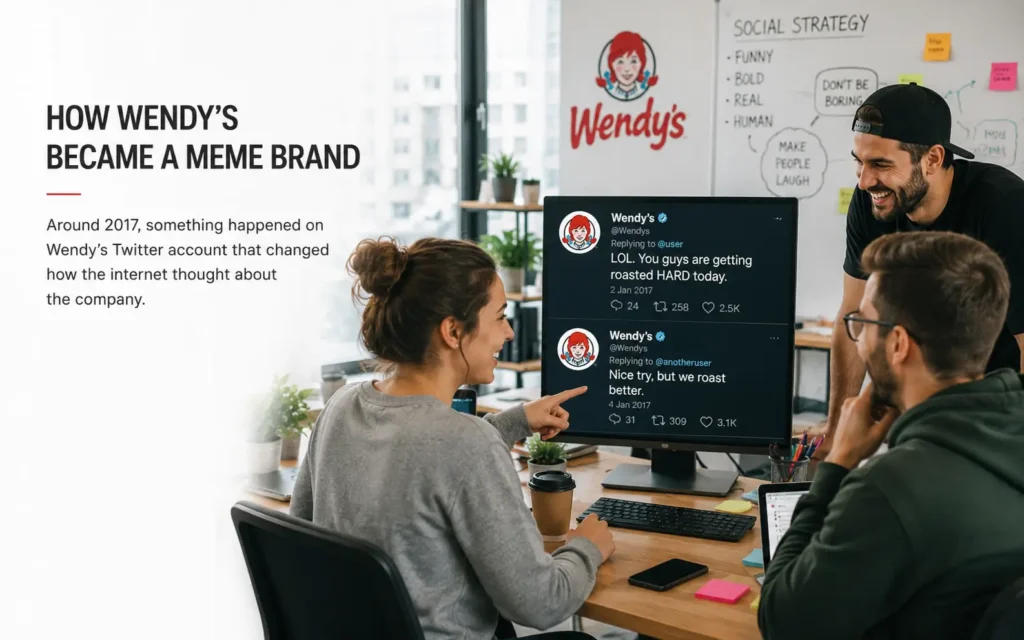
Wendy’s became one of the most talked-about brands on social media. People started following the account just for entertainment. Screenshots of their tweets went viral weekly. They weren’t paying for that attention. They were earning it by being actually funny.
For a fast food brand competing against companies with much bigger marketing budgets, this was a genuinely clever move. It kept Wendy’s in cultural conversation in a way that TV commercials never could have.
But here’s where I need to be careful — and where a lot of retail investors made a mistake.
Brand awareness is not the same as stock performance.
A company being talked about on Twitter does not automatically mean its revenue is growing, its margins are improving, or its stock is heading up. Those are separate things. The excitement around Wendy’s social media presence was real. The assumption that it would translate directly into stock gains was a leap that the numbers didn’t always support.
I made that leap. We’ll get there.
When the Meme Brand Met the Stock Market
In early 2021, the meme stock phenomenon took over retail investing. GameStop was the headline. AMC followed. A wave of attention and retail money flooded into stocks that had cultural resonance — regardless of their fundamentals.
Wendy’s got caught in this orbit.
WEN was mentioned across Reddit investing communities. It had the brand recognition. It had the meme’s reputation. It had a story regular people could understand and repeat. For a few weeks, there was genuine noise around WEN from retail investors who weren’t necessarily looking at the balance sheet.
The stock moved. Not as dramatically as GameStop. Not with the same explosive energy. But WEN saw attention and price movement that had very little to do with quarterly earnings or same-store sales growth.
This is what “meme stock” actually means in practice. It means the market price temporarily disconnects from the underlying business performance. Momentum takes over. Sentiment drives the price more than any financial metric.
For some people who got in early and got out fast, this was profitable.
For people who bought into the excitement and held — expecting the momentum to continue because the company was fun and the tweets were good — it was a different experience.
My Personal Failure
Okay. I promised you this part. Here it is.
I started paying attention to WEN in late 2020. I’d been following Wendy’s Twitter for a while. I genuinely liked the brand. I thought the franchising model was smart. I thought they were positioned well against McDonald’s in the fresh beef conversation.
So I bought shares.
Not a massive position. But real money. And I bought it with a thesis that was mostly built on: this brand has great energy right now, and I think more people are going to start noticing.
That is not a thesis. That is a vibe.
I held on through the early 2021 meme stock period, which briefly made me feel like a genius. Then I kept holding after that, waiting for the momentum to come back. It didn’t come back the way I expected.
The stock settled. Life went on. My position sat there, roughly flat, while I had money tied up that could have been working somewhere else.
Eventually I sold. No disaster. Not a horror story. But not what I thought it would be.
I also made a second mistake during this period that I’m slightly embarrassed to admit. I averaged down — meaning I bought more shares when the price dipped, convinced I was getting a better deal. I was not getting a better deal. I was just committing more money to a position I hadn’t properly analysed in the first place. Averaging down only makes sense if your original thesis was right. Mine wasn’t rigorous enough to know either way.
The lesson: buying a stock because you like the company’s Twitter account is not an investment strategy. I knew that in theory. I ignored it in practice because the excitement felt like information. It wasn’t. Excitement is just excitement.
If I had spent the same amount of time I spent reading Wendy’s tweets actually looking at the earnings calls and the franchisee satisfaction numbers and the long-term debt load, I would have made a much more informed decision. Maybe the same decision. Maybe not. But an informed one.
What WEN Stock Actually Looks Like as a Business
Let me give you the picture that matters.
Wendy’s runs on a heavily franchised model. The company owns relatively few restaurants outright. Most Wendy’s locations are owned and operated by franchisees who pay royalties and fees to the parent company. This makes the business asset-light and the revenue more predictable.
That’s a real strength. Franchising means Wendy’s isn’t carrying the costs of thousands of individual restaurants on its balance sheet. The revenue is smaller than if they owned everything, but the margin quality is better and the risk is more distributed.
The risk that matters more with WEN is debt. The company has carried significant debt for years — partly a legacy of the various restructuring periods, partly a reflection of how capital was returned to shareholders through buybacks and special dividends. Debt isn’t automatically bad. But it means the business has less room to absorb shocks – an economic slowdown, a commodity price spike, a bad news cycle – without feeling real pressure.
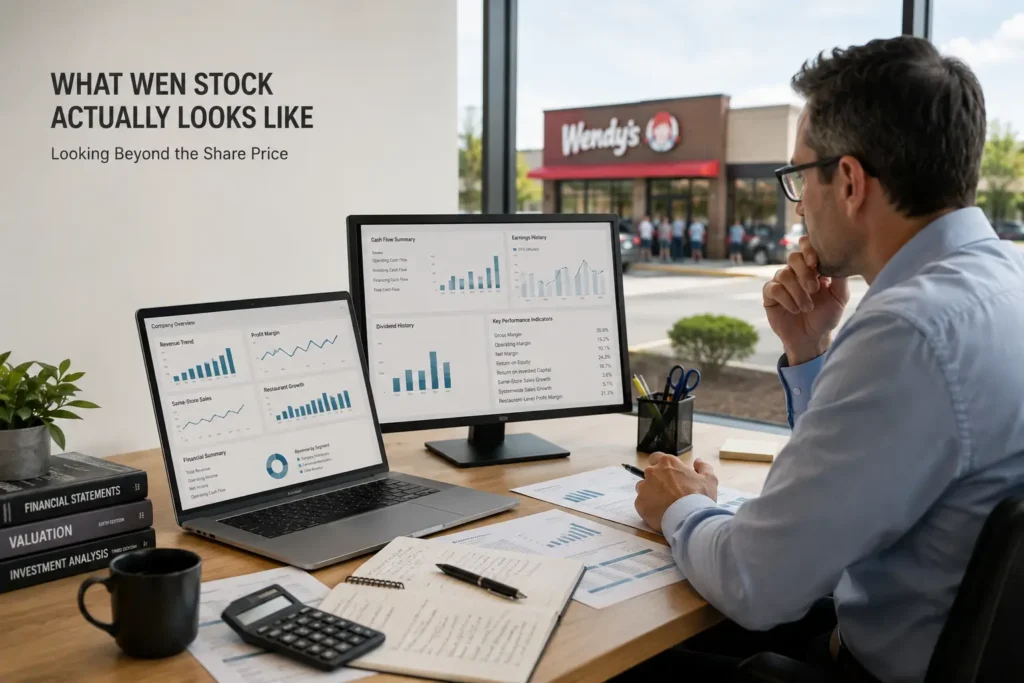
On the dividend side: Wendy’s has historically been a dividend payer, which attracts a certain type of income-focused investor. There have been periods with special dividends on top of the regular payout. For long-term holders who bought at the right price, the dividend income is part of the real return.
The competition picture is brutal and honest. Wendy’s is the third-largest fast food burger chain in the US by number of locations. McDonald’s is first. Burger King is second. Wendy’s has won on product quality perception in many surveys — more people think Wendy’s food is better than McDonald’s. But McDonald’s has more locations, more marketing money, and decades of brand infrastructure. Winning the taste test and winning the market are different things.
Internationally, Wendy’s has room to grow — but international expansion in fast food is genuinely hard. Local tastes, local competition, supply chain complexity, and finding the right franchise partners all make it slower and messier than it looks on a slide deck. Wendy’s has been pushing international growth for years. Progress has been real but gradual. It’s not the kind of expansion story that moves a stock dramatically in the short term. It’s the kind that might matter meaningfully ten years from now — if execution stays consistent.
What the Meme Stock Moment Actually Revealed
Here’s what I think the 2021 meme stock attention around WEN exposed — and this applies to any stock that gets caught in retail momentum.
The people buying WEN for brand love were not wrong about the brand. Wendy’s is genuinely a well-run consumer brand with a clear identity and a loyal customer base. That’s real.
But stock prices are set at the margin. The price on any given day reflects what the most recent buyers and sellers agreed to. When momentum investors and retail speculators pile in, the price can move well above where fundamental analysis would place it. And when that group moves on — to the next story, the next meme, the next hot thing — the price tends to drift back.
WEN was never going to go to the moon because the tweets were funny. That was never on the table. But for a period, enough people acted as if it might that the price reflected that speculation.
Understanding this distinction is worth more than any specific stock tip I could give you.
Should You Buy WEN Today?
I’m not a financial advisor. I’m very much not. Please don’t make any money decisions based on a blog post, including this one.
But here’s how I think about WEN as someone who has followed it for a while.
It is a stable, dividend-paying stock in a sector — fast food — that tends to hold up reasonably well during economic downturns because people still eat cheap burgers when money is tight. That’s a genuine defensive quality.
It is not a high-growth stock. Wendy’s is not going to double its restaurant count in three years. The upside is not that kind of exciting.
The debt level is something any prospective buyer should look at carefully before deciding. So is the dividend sustainability – whether the payout is comfortably covered by earnings or stretched.
If you’re looking for a boring, income-generating hold in the consumer sector, WEN deserves a look. If you’re looking for the next meme rocket, this is not it. That was a moment, not a model.
FAQ: Wendy’s Stock (WEN)
Is WEN a good stock to buy? That depends entirely on what you’re looking for. As a dividend-paying consumer defensive stock, it has genuine appeal for income investors. As a growth play, it’s not the right tool. Do your own research on current earnings and debt levels before deciding.
Why did Wendy’s become a meme stock? Two reasons. First, Wendy’s built one of the most recognisable and entertaining brand voices on social media — particularly on X (formerly Twitter) — through sharp, funny responses that went viral regularly. Second, during the broader meme stock frenzy of early 2021, retail investors piled into stocks with strong cultural recognition, and WEN caught some of that wave.
Who owns the most Wendy’s stock? Trian Fund Management, led by Nelson Peltz, has historically been the largest or one of the largest shareholders. Institutional investors hold a significant portion of the float overall.
Does Wendy’s pay a dividend? Yes. Wendy’s has historically paid a regular quarterly dividend and has issued special dividends in some years. The specifics change, so check the current rate before making any decisions.
What does WEN trade on? WEN trades on the NASDAQ stock exchange.
Final Thought
Wendy’s is a fifty-year-old fast food company that somehow became an internet personality. That’s a genuinely strange thing. It’s also a real business with real debt, real franchisees, real quarterly earnings, and real competition from companies that are much larger.
The meme and the stock are not the same thing.
One of them makes you laugh. The other one requires you to actually do your homework.
I learnt that the slow way. You don’t have to.
Followed WEN for a while and have thoughts? Drop them in the comments – I’m genuinely curious what other people’s experience with this one has been.