You type it at 11:42 pm. “30, no savings, am I screwed?” Your chest feels tight. Instagram shows someone your age buying a house. LinkedIn shows a promotion. You have rent, maybe student loans, and a checking account that resets to zero every month.
If you are here, you are not late. You are aware. That matters more than you think.
I spent my late twenties assuming investing was for other people. People with finance degrees. People in the US with a 401(k). People who started at 22. I was none of those.
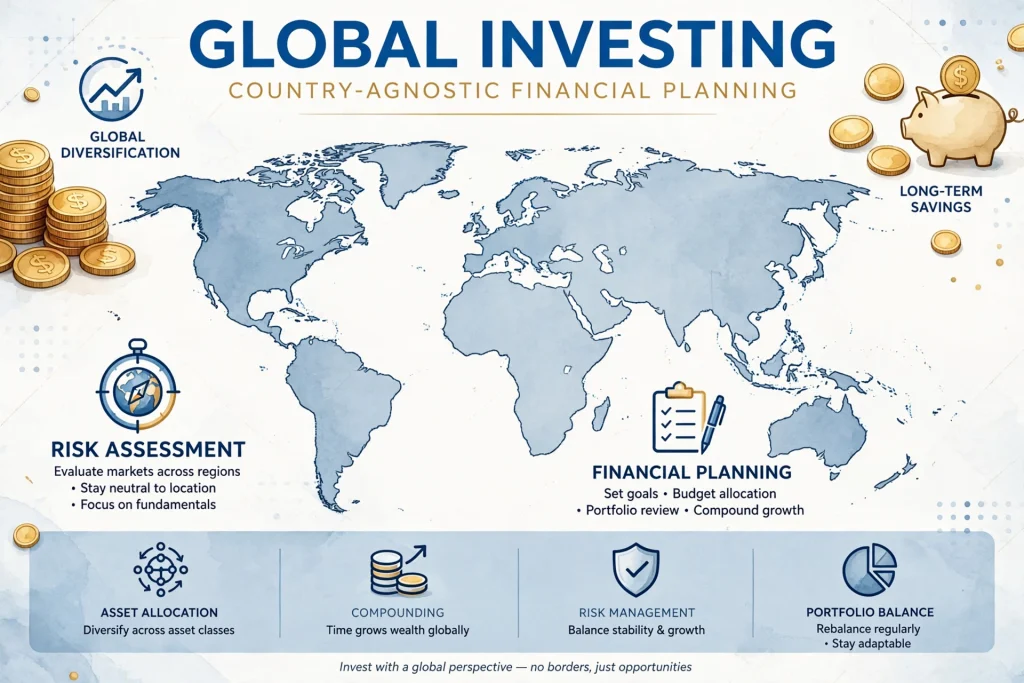
This post is the exact roadmap I wish someone gave me. It is built from what actually works in Reddit communities like r/personalfinance, r/FIRE, and r/IndiaInvestments, plus guidance from organizations like the Consumer Financial Protection Bureau (CFPB), Vanguard investor education, and OECD financial literacy research. It is not US-tax advice. It works whether you live in Pune, Berlin, Toronto, or Austin.
My opinion: Bank blogs make you feel worse. They give you a wall of products. “Max your IRA, buy this mutual fund, talk to an advisor.” They skip the first step: calming down and getting your base right. This blueprint does that first.
Why 30 With No Savings Feels So Scary
Turning 30 is a social deadline. No one wrote it down, but we all feel it. By now you should have a house, a portfolio, a plan. Right?
That pressure comes from three places. It helps to name them.
- Comparison is built into the feed. You see the highlight. Not the debt behind it. Federal Reserve data on household finances shows wide variation in savings at every age. Averages hide the real story.
- Your brain does math wrong under stress. Panic makes 30 feel old. In money years, it is still early. OECD research on financial literacy finds that starting consistent habits in your 30s still leaves decades of compounding.
- Bank articles assume you already have money. This is the competitor gap. They talk about tax-loss harvesting before you have $500 saved. They talk US-only accounts before explaining basics that work anywhere. That makes you close the tab.
What to remember: If you have $0 saved at 30, you are not broken. You are in a very common group. World Bank Findex data shows many adults globally have no formal savings buffer. Your job now is not to catch up to someone else. It is to build a base that will not break again.
The Mistake I Made at 28
Illustrative example — lesson learned, not financial advice

At 28, I did what a lot of people do when they feel behind. I skipped step one.
I had no emergency fund. Maybe $200 in my account after rent. A friend sent a tip: a small stock that was “about to double.” I put in $400. Money I could not afford to lose.
It dropped. Not to zero, but enough. I sold in panic. I lost about half of it in a week. The exact amount does not matter. The pattern does.
Here is what I learned from that example:
- If you have no buffer, every dip feels like an emergency.
- Tips from friends are not a plan. They are entertainment.
- Boring works because it is repeatable. Exciting fails because it is not.
My opinion: I wish I had put that $400 into a separate savings account and forgotten it. That would have been a win. Catching up does not start with a brilliant trade. It starts with not needing to sell at the worst time.
That is why this blueprint puts emergency savings before investing. It is not slow. It is protection.
Reddit’s Global Blueprint — The 4 Buckets Explained
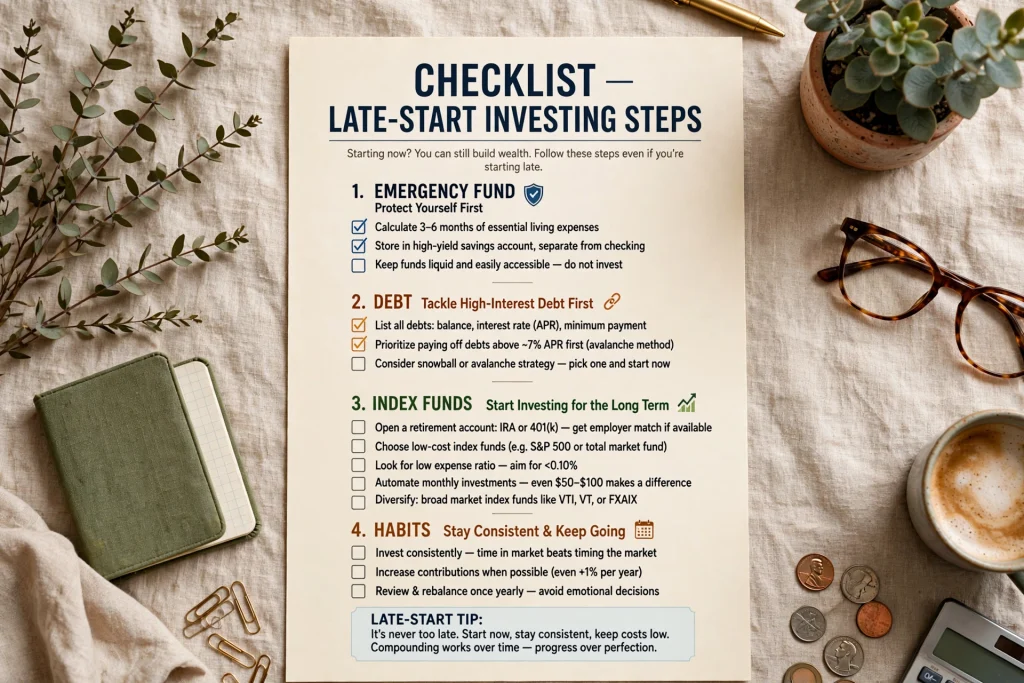
If you read 100 threads on r/personalfinance, r/FIRE, and r/IndiaInvestments, the same order shows up. Different words, same logic. It is country-agnostic because it is about order, not product.
| Bucket 1 | Bucket 2 | Bucket 3 | Bucket 4 |
| Emergency buffer | High-interest debt | Low-cost index investing | Habits + Automation |
| 1 month → 3-6 months of essential expenses. Parked where you can access it in 1-2 days. | Anything above ~7% APR. Credit cards, personal loans, pay-later balances. This is a guaranteed return when you pay it. | Simple, diversified, low-fee funds. Automate monthly. Ignore noise. Works in any country. | Pay yourself first, increase 1% yearly, yearly rebalance, and no emotional trading. |
Why order matters: If you invest before you have a buffer, you will raid the investment when life happens. If you invest while paying 24% APR on a credit card, you are trying to outrun a faster runner. The order removes that conflict.
Authoritative context: The CFPB defines an emergency fund as savings for unexpected costs to avoid debt. Vanguard investor education explains that low costs and broad diversification are the two factors investors can control. Both ideas appear repeatedly in Reddit community wikis. Sources linked at bottom.
Internal guides: Emergency Fund Guide • Avalanche vs Snowball
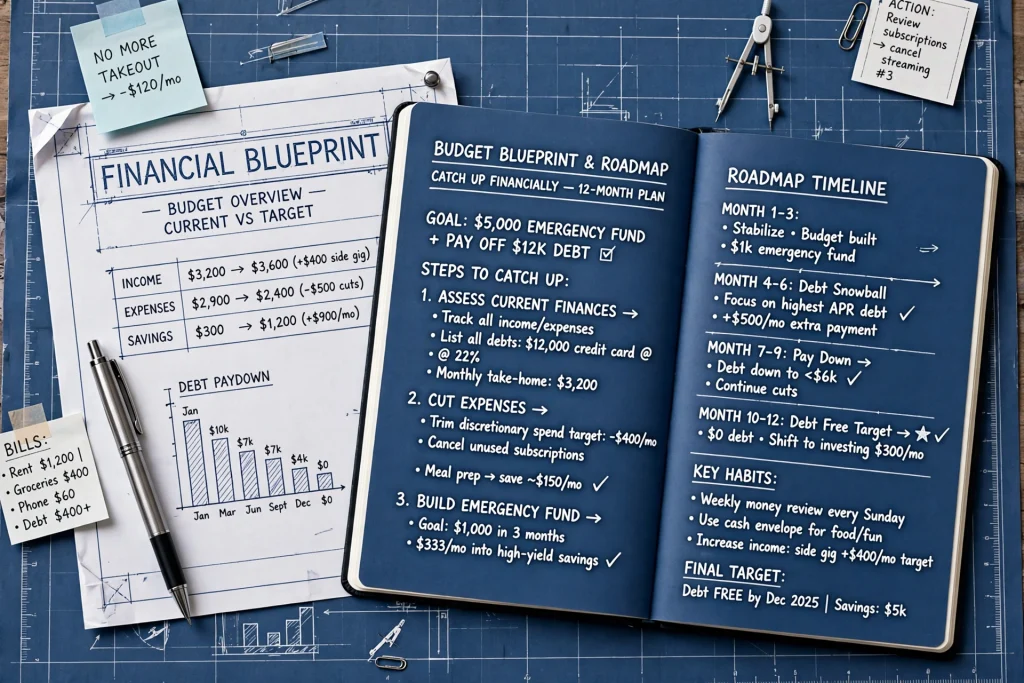
Step 1: Emergency Fund First
Start small. One month of bare essentials. Rent, food, transport, phone, and minimum debt payments. Not your full salary. Just what keeps you alive.
Two-stage target
- Starter: 1 month
Open a separate account. Label it “Do Not Touch”. Automate $25-$100 on payday. Even $50 matters. This stops the next $400 surprise from going on a card. - Full: 3-6 months
Once high-interest debt is gone, build to 3 months if your job is stable and 6 if you are a freelance or single-income household.
Where to park it — country examples (check locally):
- US: High-yield savings account (HYSA) at an FDIC-insured bank.
- India: Separate savings with auto sweep to FD, or liquid fund for same-day access.
- UK/EU: Instant-access savings or money market account. Look for protection schemes like FSCS.
- Canada/Australia: High-interest savings, no market risk.
This is not investing. Do not chase yield here. You want access, not growth.
Step 2: Kill High-Interest Debt
If your debt charges more than about 7% APR, paying it is your best investment. No market can guarantee that return.
List it all — honest snapshot
Credit card A24% APR
Pay-later / BNPL18-28% APR
Personal loan12% APR
Student loan (example)4.5% — lower priority
Method: Avalanche. Most efficient mathematically, widely recommended in r/personalfinance wiki.
- Pay minimums on everything.
- Put extra cash on highest APR first.
- When that is gone, roll its payment to next highest.
- Keep your emergency starter intact. Do not drain it to pay debt.
Want the alternative? Snowball pays smallest balance first for motivation. Avalanche saves more interest. Pick one and stick to it.
My opinion: I used avalanche because I needed to see math winning, not just emotion. If you need quick wins to stay motivated, snowball is fine. The best method is the one you finish.
Step 3: Start Investing Late — The Boring Way
You do not need to time the market. You need time in the market. Starting at 30 still gives you 25-35 years.

What to look for anywhere in the world
- Low cost: Expense ratio under 0.20% is good. Under 0.10% is excellent. Vanguard explains this as one of few predictors of future relative performance.
- Broad: Owns hundreds or thousands of companies, not 5. Global diversification lowers single-country risk.
- Automatic: You can set monthly auto-invest, even $50.
| Example — Global one-fund | Example — Two-fund | Example — India |
| VT or similar world index | US + International (VTI + VXUS) | Nifty 50 / Nifty Next 50 index |
| One fund, whole world. Simple. Check your local broker for equivalent. | Split lets you adjust US vs non-US. Many non-US brokers offer similar ETFs. | Low-cost index funds from large AMCs. Often discussed in r/IndiaInvestments. |
Where to check locally (not recommendations, just account types to research):
- US: 401k if employer match, then IRA. Always check IRS rules.
- UK: ISA for tax-efficient investing, SIPP for retirement.
- EU: Local broker ETFs, check capital gains rules per country.
- India: PPF, NPS, ELSS for tax sections — research lock-ins and limits.
More: Best Index Funds for Beginners • How to Start With Small Amounts
Fact vs opinion: Fact — low fees and diversification are linked to better investor outcomes in Vanguard and OECD studies. Opinion — one global fund is enough for most starters. You can add complexity later if you want.
Step 4: Habits That Actually Catch You Up
Money is behavior more than math. Reddit threads that succeed have the same four habits.
✓
Automate on payday
Move money the same day you get paid. If you wait to see what’s left, nothing is left. Set auto-transfer to emergency fund, then investing.
✓
Increase 1% every year
Got a raise? Increase your investing rate by 1%. You won’t feel it. Over 10 years, it doubles your contribution without pain.
✓
One side lever
Pick one: sell unused items, freelance 2 hrs/week, or negotiate one bill. Put 100% of that extra to bucket 2 or 3.
✓
Yearly rebalance, no daily checking
Check allocation once a year. Not daily. Daily checking makes you trade on emotion. Annual is enough.
Age-Based Financial Benchmarks Without Panic
You have seen the chart: “At 30, have 1x salary saved. At 40, 3x.” It comes from Fidelity. It is a guideline. Not a grade.
| Age | Common Guideline | Context |
| 30 | ~1x salary | Many have 0x. That’s data, not failure. |
| 40 | ~3x salary | Assumes steady income. Life rarely is steady. |
| 50 | ~6x salary | Health and location matter more than the chart. |
| 60 | ~8x salary | Still workable if you save more later. |
Why it can mislead:
- It assumes US salaries and US retirement age. Cost of living in Mumbai vs Munich vs Mississippi is different.
- It counts only retirement accounts. It ignores emergency fund and debt payoff, which are progress too.
- It does not count breaks: caregiving, study, immigration, and health. Real lives have gaps.
My opinion: Use it as a compass, not a report card. If you are at 0.2x at 30 and move to 0.8x by 35, you are catching up fast. Progress over perfect.
Catch Up Math — Illustrative Examples
Illustrative math only — assumptions stated, not a guarantee or prediction

Small monthly amounts still matter because time does heavy work. Below is simple math to show the idea. It uses a 7% real return assumption for illustration. Real returns vary. Markets go down too. This is not advice.
Illustrative example: Start at 30, $0 today, monthly investing for 30 years
Monthly$300/mo~$340,000 at 60 (illustrative)
Monthly$400/mo~$454,000 at 60 (illustrative)
Monthly$500/mo~$567,000 at 60 (illustrative)
Assumptions7% annual real return, monthly compounding, no fees/taxes/inflation adjustment beyond real return, consistent contribution. Actual outcome will differ. For education only.
What changes outcome most?
- • Starting now vs waiting 5 years matters more than picking perfect fund.
- • Increasing contribution 1% yearly adds more than trying to beat market.
- • Avoiding high fees keeps more of return.
Quick calc you can do
Take your monthly amount x 12 = yearly. Yearly x years left x 0.6 = very rough low-end illustration if returns are modest. Use real calculators from Vanguard or your local bank for better estimates. This rough calc is just to break panic.
References for learning: Vanguard — principles for investing success; Federal Reserve — Survey of Consumer Finances shows median savings variation; CFPB — emergency savings guidance.
What Not to Do When You Feel Behind
- !Don’t chase crypto, meme stocks, or leveraged trades to catch up. That is the exact mistake from my example at 28. It turns a late start into a hole.
- !Don’t skip the emergency fund to invest faster. You will sell at the worst time.
- !Don’t take a personal loan to invest. Debt at 12% vs uncertain market return is math that rarely works.
- !Don’t copy a US-only tax strategy if you live elsewhere. IRA, Roth, 401k rules don’t apply in India, EU, UK. Check local rules.
- !Don’t check your portfolio daily. Set alerts yearly. Emotion is expensive.
FAQ — Starting at Zero at 30
Is it too late to start saving at 30?
No. Many people start at 30. You still have 30+ years of potential compounding. What matters more than age is consistency now. Start with a 1-month emergency buffer, then automate small monthly investing. Progress counts more than perfect timing. Source: OECD financial literacy reports show habit formation in 30s still improves long-term outcomes.
How much should I have saved at 30?
Common guideline is ~1x salary, from Fidelity. Treat it as a compass, not a rule. If you have 0x, your next goal is 0.25x, then 0.5x. Cost of living, debt, and country change the number. CFPB focuses on having emergency savings first rather than hitting a multiple.
Should I invest if I still have debt?
If debt is above ~7% APR, pay that first. That’s a guaranteed return. If debt is low-rate (e.g., 3-5% student loan), you can often invest while making minimum payments. List your debts by APR and tackle highest first — the avalanche method popular in r/personalfinance.
What if I live outside the US?
The 4-bucket order works anywhere. Only account names change. Instead of 401k/IRA, you might use UK ISA/SIPP, India PPF/NPS/ELSS, EU brokerage ETFs, Canada TFSA/RRSP, Australia super. Check local regulator rules and tax. Avoid US-specific tax advice if it doesn’t apply to you.
Can I still retire early if I start at 30?
Early retirement depends on savings rate and spending, not just start age. r/FIRE community often targets high savings rates, but even 20-30% can build options. Don’t promise yourself a specific age. Focus on increasing your rate 1% each year and keeping fees low. Illustrative math shows small increases add up over decades.
What if my income is low?
Start with what you can automate. Even $25 or ₹1000 monthly builds the habit. Use the side lever: sell unused items, one freelance gig, negotiate one bill. Put that extra to emergency fund first. World Bank and OECD data show automatic transfers improve savings even at lower incomes. Consistency beats amount at start.
Final Checklist & Next 7 Days Action Plan
You do not need to do everything today. Do this week.
7-Day Starter
Day 1-2Open separate savings, label Emergency. Auto-transfer payday + $50. Read Emergency Fund Guide.
Day 3List debts by APR. Highest first. Set minimums autopay. Bookmark Avalanche vs Snowball.
Day 4Pick one low-cost broad index fund in your country. Check expense ratio. Read Best Index Funds.
Day 5Automate $50-$100 monthly investing, even small. See Start With Small Amounts.
Day 6Cancel one unused subscription. Move it to debt or emergency fund.
Day 7Delete trading apps from home screen. Set calendar for yearly rebalance. Done.
My opinion on what works globally
Boring automation beats motivation. You will not feel like saving every month. The auto-transfer does it anyway. That is why Reddit’s blueprint lasts it removes willpower from the equation. My opinion: start tiny and stay consistent. The amount can grow later.
If you are 30 with $0, you are not behind. You are at the start of a system that works in any country. Emergency fund. Kill high-interest debt. Automate low-cost index investing. Repeat.
Close the panic tabs. Open one savings account. That is your win today.
I write about starting late, saving on low income, and country-agnostic money systems. No finance degree. Just lived mistakes and community research. My posts use illustrative examples, not personal financial advice. I cite CFPB, Federal Reserve, World Bank, Vanguard, and OECD for facts.
References & Further Reading
- Consumer Financial Protection Bureau (CFPB) — Emergency funds and managing debt basics.
- Federal Reserve — Survey of Consumer Finances, household savings variation by age.
- Vanguard — Principles for investing success: low cost, diversification, long-term.
- OECD/INFE — Financial literacy and behavior research, importance of automation.
- World Bank Global Findex — Savings buffer prevalence globally.
- Reddit r/personalfinance Wiki — Prime directive: order of operations (emergency → debt → invest).
- Reddit r/FIRE & r/IndiaInvestments — Community insights on low-cost index investing globally.
Disclaimer: Educational content only. Not financial advice, not US-tax advice, not investment recommendation. All numbers are illustrative examples with stated assumptions, not guarantees. Investment values can go down. Check local regulations, tax rules, and consult a qualified professional for your situation.